AI Brand Monitoring: Your Guide to Reputation in 2025 and Beyond
Updated December 17, 2025
AI brand monitoring is the process of tracking how your brand is represented across artificial intelligence platforms like ChatGPT, Google's AI Overviews, and Perplexity. Think of it as the next evolution of social listening. Instead of just tracking tweets and reviews, you're monitoring the final, synthesized answers that millions of people now use to make decisions. In 2025 and 2026, this isn't a futuristic concept; it's the new front line for brand reputation, where your company's story is being told by algorithms.
It's about seeing your brand through the eyes of the AI that your customers trust for information.
Why AI Brand Monitoring Is Essential Now
Imagine a potential customer asks a smart assistant, "What is the best software for project management?" The answer they receive isn't from a single webpage. The AI synthesizes information from dozens of articles, customer reviews, and forum discussions to construct a single, authoritative summary. Effective AI brand monitoring is how you track and analyze those summaries.
Understanding Your Brand's AI Footprint
This new discipline is designed to answer critical business questions:
Is your brand mentioned in relevant AI-generated answers? Is the tone positive, negative, or neutral?
What sources is the AI using to form its "opinion" of your brand?
Where are your competitors gaining ground in this new information channel?
This isn't a distant trend. According to Gartner, by 2026, 30% of organic search traffic will come from AI-generated experiences, not the classic blue links we're used to. Your brand's story is increasingly being written by algorithms, which makes it absolutely essential to monitor and shape that conversation.
The Shift to AI Brand Intelligence
Traditional social listening tools are great for keeping tabs on conversations on Twitter or Reddit, but they are completely blind to the complex, synthesized outputs of large language models (LLMs). This gap is exactly where specialized AI-powered brand monitoring comes in. To get a handle on this, it's useful to explore the different AI monitoring tools now available, as they're built to track a totally new kind of mention.
This massive shift means companies are no longer just reacting to what people say online. They're proactively managing how they're represented inside an AI's knowledge base. This involves tracking your AI search visibility and getting smart about generative SEO.
How AI Search Redefines Brand Visibility
For decades, the rules of search were simple. You created great content, built some links, and climbed the rankings. Today, that game is over. AI search engines have completely rewritten the rules, changing how brands get seen. Instead of sifting through a list of blue links, your customers now get a single, summarized answer generated by an AI.
This new reality is driven by Large Language Models (LLMs), the engines powering platforms like ChatGPT and Google's AI Overviews. These models digest mind boggling amounts of information from across the web, from news articles and reviews to forum threads and your own website. Your brand's entire digital history is now training data. The result directly impacts your AI search visibility, which is how often and how favorably your brand shows up in these AI-generated answers.
The Mechanics of Generative SEO and LLM Tracking
To influence these AI models, you must first understand how they "think." Picture an AI as a very diligent, literal researcher. You ask it, "What's the best CRM for a small business?" It scours the web and might pull from five recent tech articles, dozens of customer reviews, and one highly critical Reddit thread about a bug. The AI then weaves these scattered sources into a single, cohesive answer.
This is the heart of generative SEO: the work of shaping your brand's information ecosystem so AI models are more likely to generate positive, accurate content about you. The measurement side of this is LLM tracking, which involves keeping an eye on how these models are portraying your brand over time. An old press release or a single bad review can skew the AI's final answer, creating a narrative that might be misleading or even damaging.
Key Metrics for AI Brand Monitoring Analysis
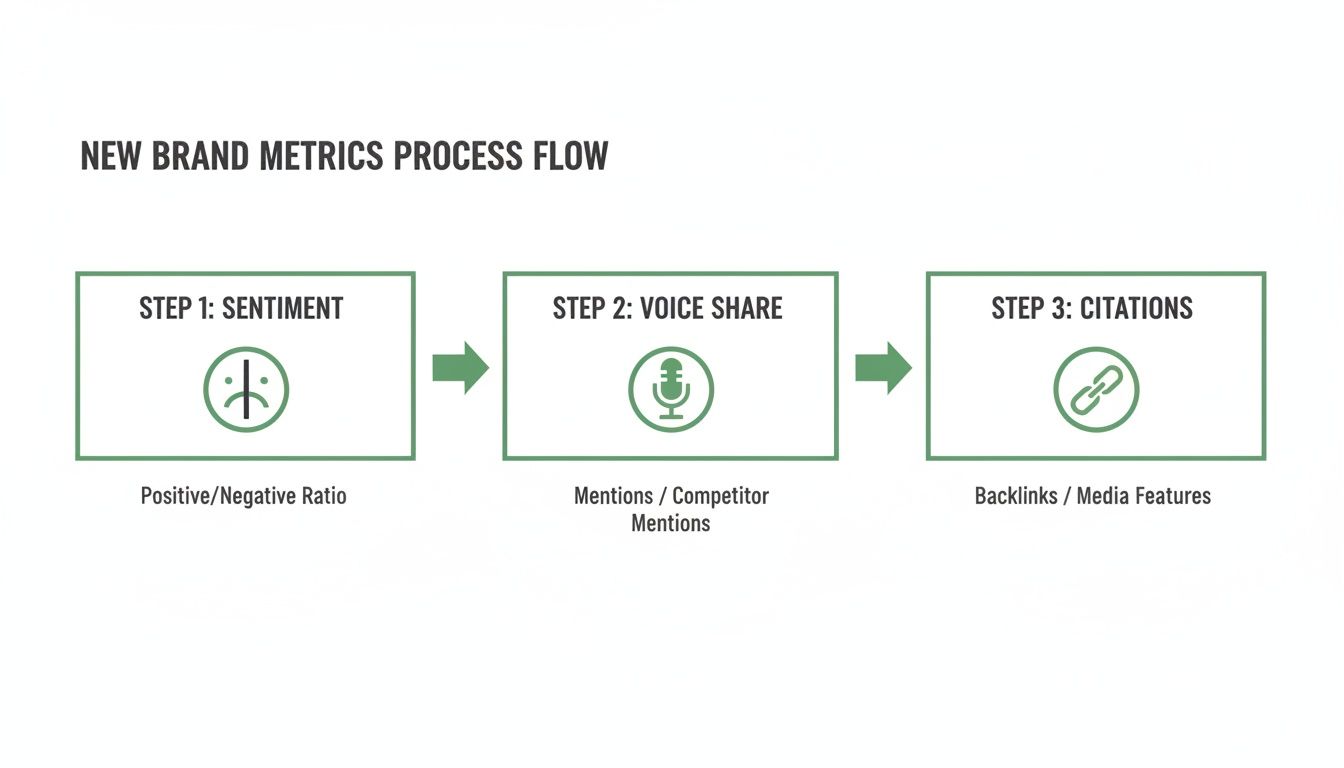
Traditional metrics like mention counts are no longer enough. To understand your brand's performance in 2025 and beyond, you need to measure what the AI models see. This means moving into metrics that give you an actionable view of your AI search visibility and the story being told about you.
Measuring Share of Voice in AI Answers
First is share of voice (SOV), but with a critical twist. This isn't about counting brand name pop ups. It’s about measuring your brand’s prominence when a customer asks an AI a question that matters to your business. Think about a query like, "What are the top 3 project management tools?" If your brand is listed first, your SOV for that query is high. If you're not mentioned at all, you're invisible. For a deeper look, you can explore how to calculate share of voice and adapt this classic metric for the AI era.
Tracking Citation Quality and Frequency
AI models often cite their sources. This brings us to citation quality and frequency. This metric tracks which websites and pages are used as the building blocks for an AI's mention of your brand. A citation from a respected industry journal is gold. A mention sourced from a random, decade old forum thread is not. Knowing which sources the AIs trust is the core of generative SEO, allowing you to focus your content and PR efforts on earning a spot on those influential domains.
Comparing AI Brand Monitoring with Traditional Methods
This table breaks down the shift from surface level metrics to the deeper signals that matter in an AI driven world.
| Metric | Traditional Monitoring | AI Brand Monitoring |
|---|---|---|
| Visibility | Keyword rankings on a SERP | Share of Voice in generated answers |
| Authority | Backlink count and domain authority | Citation quality and source frequency |
| Perception | Basic positive/negative sentiment | Nuanced narrative and topic association |
| Response | Manual brand audits (infrequent) | Real time alerts for narrative shifts |
Building Your AI Brand Monitoring Workflow
Moving from theory to practice means building a structured workflow that integrates AI brand monitoring into your team’s daily routine. It’s about creating a system that turns AI insights into fast, smart actions. A good workflow ensures you catch critical shifts in your brand’s story before they become permanent.
Setting Up Your AI Monitoring and Alert System
It starts with precise tracking. You'll need to monitor not just your brand name, but also key competitors, important industry topics, and the high intent questions your customers are asking. From there, you set up intelligent alerts that flag major events, like a sudden drop in sentiment or a competitor getting cited in an AI answer where you should have been. For instance, a B2B software company might set up alerts for any mention of its brand alongside the term "security vulnerability." This shifts your team from reactive to proactive.
Integrating Insights for Smarter AI Brand Management
Once data is flowing in, the next step is getting those insights to the right people. An AI brand monitoring workflow is most powerful when it breaks down silos and fuels collaboration. The SEO team can use citation analysis to find high authority domains that influence AI models, creating a hit list for link building and digital PR. They can spot content gaps where competitors are winning and build new assets to capture that AI search visibility.
The PR team can manage reputation and detect crises early, while the product team can gather unfiltered feedback. This integrated approach transforms AI brand monitoring from a simple reporting function into the central nervous system for your entire marketing organization. You can find more strategies in our guide on how to monitor brand mentions in ChatGPT and Perplexity.
Real World Examples of AI Brand Monitoring
Theory is one thing, but seeing AI brand monitoring in the wild reveals its true value. Let's look at scenarios where these strategies protect a brand’s reputation and open new opportunities.
Imagine a consumer goods company launches a product with eco friendly packaging. A few weeks later, their AI monitoring platform flags a growing rumble of negative sentiment. The system found that AI assistants, when asked about the product, were summarizing complaints from a handful of online forums about the container being hard to open. Before this narrative could snowball, the brand team got an alert, launched a social media campaign with "how to open" videos, and updated product descriptions.
Correcting AI Misinformation with Proactive Monitoring
Another powerful use case is stamping out inaccuracies. Think of a B2B software company that finds out AI assistants are misrepresenting its features. When users asked an AI to compare their tool against a competitor's, the summary falsely claimed their platform was missing a key integration. The monitoring tool traced the source to an old, outdated review site. Armed with that knowledge, the SEO and PR teams ran an outreach campaign to get the review updated and published new, clear content. Within weeks, the tracking showed the AI's answers were corrected.
This kind of proactive work is non negotiable. The AI in marketing sector has grown to a $47.32 billion valuation, a huge jump from $12.05 billion in 2020. Monitoring is also critical for spotting threats like deepfakes. Getting familiar with detecting deepfakes is a skill every brand team needs today.
Summary and Next Steps
AI brand monitoring is no longer an option; it's a necessity for any serious business. To thrive in this new landscape, you must take control of how your brand appears in AI-generated answers. Every piece of your online footprint, from old blog posts to new customer reviews, now acts as training data for these models. Your first move should be to audit your current brand monitoring tools and processes. Can they truly see what an AI sees?
This audit should assess whether your team can track the KPIs that matter in the age of AI. For those ready to go deeper, check out our guide on AI search optimization. The goal is to move from simply watching to actively shaping your brand's reputation in AI. Look for platforms like Riff Analytics that were built from the ground up to provide actionable insights on how to improve your visibility and close the gap with competitors.
Frequently Asked Questions
What is the difference between AI brand monitoring and social listening?
Social listening tracks raw, public conversations on platforms like Twitter and Reddit. AI brand monitoring analyzes the final, synthesized answers that AI models produce after processing all that information. It's the difference between hearing the discussion and reading the final verdict.
How can I improve my brand's visibility in AI search?
Start by auditing your brand's existing online presence to find and fix negative or outdated information. Then, focus on creating high quality, authoritative content that directly answers customer questions and encourages positive reviews on trusted third party sites. This is the foundation of generative SEO.
Can a single negative article really affect my brand's AI perception?
Yes. If that article ranks well or appears on a highly trusted site, an AI model can give it significant weight when building a summary about your brand. It can easily overshadow more positive sources, making proactive monitoring essential.
What tools work for monitoring my brand in AI search?
Look for specialized tools that offer LLM tracking across multiple AI models, provide detailed citation source analysis, and send real time alerts. Traditional SEO tools are not equipped to provide the necessary insights for generative SEO and AI search visibility.
How do I measure the ROI of AI brand monitoring?
Measure ROI through metrics like crisis aversion (the cost of a reputation crisis you prevented), sentiment improvement over time, and share of voice growth for high value commercial queries. These connect monitoring efforts to tangible business outcomes like protected brand equity and increased qualified leads.