Mastering AI Overview Tracking: Your Guide to Generative SEO Success
Updated January 5, 2026
AI overview tracking is the practice of monitoring your brand’s visibility within the AI-generated answers that now appear at the top of search results. Looking ahead to 2025 and 2026, this is no longer a niche tactic but a core marketing function. Instead of just tracking website rankings, this discipline measures how often your brand, products, or data are cited as a source in the direct summaries provided by engines like Google. As users increasingly rely on these instant answers, being part of that conversation is critical for brand authority and discovery.

Understanding AI Overview Tracking in Modern Search
Imagine a search result where the answer appears before you even see a single blue link. That is the new reality of AI Overviews, and it fundamentally changes how people find information. AI overview tracking is the modern version of brand monitoring, but it is laser focused on this powerful new real estate. Think of it less like climbing a ladder of rankings and more like earning a direct mention in an expert's summary.
This shift is critical because user behavior is changing right along with it. Instead of clicking through multiple links to piece together an answer, people are leaning on the instant summary the AI provides. This has a direct impact on your website traffic, your brand's authority, and how potential customers discover you in the first place. Tracking your presence here is no longer optional, it is essential.
The Impact of Tracking Your AI Search Visibility
Monitoring your AI search visibility is not about vanity metrics. It is about getting hard data on your brand's authority and relevance in the eyes of an AI. When your brand is consistently cited, it sends a powerful signal that search engines like Google see your content as a trustworthy source on specific topics. It is a powerful form of digital validation.
According to recent data, as of mid 2025, Google AI Overviews appear in a significant portion of searches, fundamentally altering user engagement and leading to a rise in "zero click" searches. This makes it crucial for brands to adopt advanced tools for AI brand monitoring to understand their standing.
Why Every Business Needs This Generative SEO Tracking
If you ignore AI Overviews, you are missing a huge and growing segment of your audience. As these AI generated summaries become the norm, the brands featured inside them will capture the most attention and be seen as the definitive leaders in their field. Effective AI overview tracking lets you identify which topics trigger AI answers, see where competitors are getting cited, and measure your "Share of Answer" over time. This proactive approach is the only way to ensure your brand stays visible and authoritative.
How Generative AI Builds an Answer
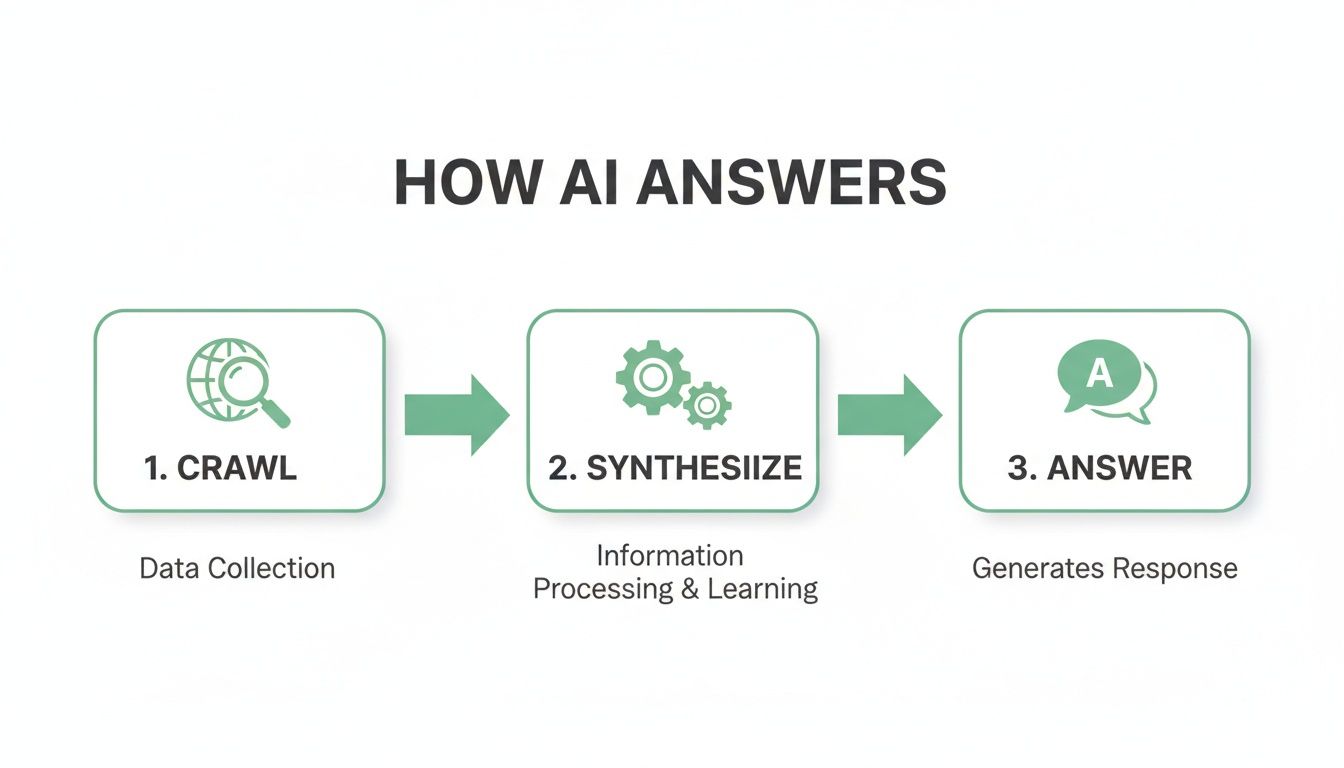
To win at this new game, you have to understand how the answers get made. In 2025 and beyond, Large Language Models (LLMs) which power tools like Google AI Overviews are not just returning search results. They are complex synthesis machines. They digest information from countless web sources and construct entirely new, cohesive summaries. Nailing your AI overview tracking depends on understanding this process.
Think of an LLM as a hyper efficient research assistant. It does not just find the single best article. Instead, it reads dozens of blog posts, forums, and data sheets, pulls out the core facts, and then writes a fresh summary. This synthesis is the key to mastering your visibility in AI search.
Foundation Training Data vs. The Live Web Index
Every AI model starts with foundational training data, a giant, static snapshot of the internet used to teach the model about language and context. To give you a current, relevant answer, AI engines like Google constantly dip into the live web index in real time. This means for any given query, the AI is actively hunting for the freshest, most authoritative content it can find right now.
The AI Answer Synthesis Process and LLM Tracking
The real magic happens during the synthesis stage where the AI blends information from multiple trusted sources. It prioritizes content that is clear, packed with facts, and well structured. This is exactly why LLM tracking is so critical; you need to know which of your pages the AI deems trustworthy enough to include. The process involves deconstructing the user's query, retrieving relevant information, evaluating sources for accuracy, and constructing a new narrative, citing the most credible sources. Understanding the basics of AI-powered content creation can provide deeper insight into how these models operate.
The Core Metrics for AI Overview Tracking
To get a handle on your brand's presence in AI search, you must look past the old SEO playbook. Success in 2025 and 2026 is not just about clicks; it is about influence. It is about becoming an authority woven directly into the AI generated answer itself. This shift means we need a new scorecard, a set of key performance indicators (KPIs) built for this new era of generative search.
Measuring Your Share of Answer in Generative SEO
If there is one metric that defines this new landscape, it is Share of Answer. This KPI tells you what percentage of an AI summary features your brand, your content, or your data. Think of it as your market share within a specific AI generated response. A high Share of Answer means your brand is dominating the narrative for that topic. The concept is a direct descendant of a classic marketing metric; you can learn more about how to do a share of voice calculation to see the parallels.
Key Performance Indicators for Monitoring AI Search Visibility
While Share of Answer is the north star, a complete AI overview tracking dashboard needs other critical metrics. Each one offers a different angle on your performance and helps you spot opportunities. Together, they create a full, actionable picture of your brand's standing in AI search.
| Metric | What It Measures | Why It Is Important |
|---|---|---|
| Citation Frequency | The total number of times your domain is cited as a source across a set of target queries. | High frequency shows that AI models see your site as a consistently reliable source of information. |
| Sentiment Analysis | The positive, negative, or neutral tone used when your brand is mentioned within an AI Overview. | This tells you not just if you are mentioned, but how. It is crucial for protecting brand perception. |
| Competitor Ranking | Your Share of Answer and Citation Frequency compared directly against your top competitors. | This reveals who is winning the AI narrative for your most important topics and where the gaps are. |
| Unbranded Visibility | Instances where your content is used as a source but your brand name is not explicitly mentioned. | These are prime opportunities to update source content to better associate your brand with the answer. |
Tracking these metrics gives you the data driven foundation you need to build a smarter, more effective strategy for winning in AI powered search.
Establishing a Workflow for AI Overview Tracking
Getting a handle on generative search is not about one off checks. It is about building a repeatable process. An effective workflow for AI overview tracking turns abstract data into an actual game plan, moving you from just watching your brand’s presence to actively shaping it. For marketing and SEO teams aiming to win in 2025 and 2026, this kind of systematic framework is the first step toward a real competitive advantage. Think of it as a continuous cycle: identify, monitor, analyze, and optimize.
Step 1: Identify Your Core Business Topics
First, you cannot track what you have not defined. Start by mapping out the core topics and queries most critical to your business. To build a solid list, audit your existing keywords, analyze competitor mentions to see which queries trigger AI Overviews that cite them, and focus on question based queries like "how to choose the best project management software." This step ensures your LLM tracking efforts target topics that drive business results.
Step 2: Establish a Performance Baseline
Once your target topics are locked in, you need a starting line. You cannot measure progress if you do not know where you began. This means running an initial audit to capture your current performance on key metrics like Citation Frequency and Share of Answer for your most important keywords. This baseline is your "before" picture, crucial for proving the ROI of your work later on and for spotting the lowest hanging fruit right away.
Step 3: Set Up Specialized AI Monitoring Tools
With your topics identified and a baseline set, it is time to put a monitoring system in place. Manual spot checks are fine for a quick look, but a real workflow needs specialized tools built to track mentions across multiple AI engines. According to Samuel Schmitt of thruuu, a smart move is to "find keywords where your domain is used as a source, but your brand isn’t mentioned. That’s a low hanging fruit." That kind of insight is nearly impossible to find by hand. A good tool automates the tedious work of checking thousands of keywords.
Step 4: Analyze and Refine Your Generative SEO Strategy
The final step is turning data into action. Regularly review your tracking reports to see which sources and content formats AI engines prefer. Look for patterns. Are they citing pages with structured data more often? Do they favor content with specific stats? Use these insights to tune up your content and technical SEO. This constant loop of auditing, analyzing, and optimizing makes AI overview tracking a core part of your growth engine.
How to Optimize Content for AI Citations
So you have a system to track your AI visibility. Now for the fun part: actually improving it. Optimizing for AI citations is not about tweaking keywords. It is a total mindset shift. You need to stop writing for old school algorithms and start creating content that Large Language Models (LLMs) see as the definitive, trustworthy source on a topic. In 2025 and 2026, the brands winning in AI search will be the ones that master this. This comes down to three things: clarity, authority, and technical precision.
Prioritize E-E-A-T and Factual Density
The absolute bedrock of any AI optimization strategy is E-E-A-T: Experience, Expertise, Authoritativeness, and Trustworthiness. AI models are trained to identify these signals to determine if your content is reliable. This is a non negotiable for generative SEO. To make this real, ground your content in hard data. Do not just say your product is "popular." State that it has "over 50,000 active users." Swap out generic claims for specific stats and research findings. This factual density makes your content easy for an AI to parse, verify, and cite.
Implement Comprehensive Structured Data for AI Visibility
Think of structured data, especially Schema markup, as a translator. It speaks directly to AI engines, giving them explicit context about your information so they do not have to guess. Key Schema types include FAQPage for Q&A content, HowTo for step by step guides, and Article to reinforce authority signals. Getting your structured data right can dramatically increase the odds of your content being used to build an AI Overview. For a deeper dive, check out this guide to optimize content for AI search.
Structure Content to Answer Questions Directly
AI Overviews exist to provide one thing: direct answers. So, your content needs to be structured to do the same. Frame your articles and service pages to tackle specific user questions head on. According to industry analysis, clear, concise, and well structured content that directly answers a specific user query has a significantly higher probability of being featured in AI generated responses. This means using clean headings, bullet points, and starting paragraphs with a punchy topic sentence. For more practical tips, see how to start structuring your content for AI and zero-click search wins. This approach helps AI and your human readers too.
The Future Isn't Just Google Anymore
For years, the world of search was a one horse race. But the game has fundamentally changed. The explosion of specialized AI engines marks a critical turning point for any brand serious about its digital future. As we look ahead to 2025 and 2026, a smart AI overview tracking strategy has to cover a much broader, more fragmented world. Relying only on Google AI Overviews is like running ads on just one social media platform; you are leaving huge chunks of your audience behind.
Beyond Google: Tracking Multiple Engines for AI Search Visibility
A multi engine approach to AI search visibility is essential. Platforms like Perplexity are carving out a niche with users who want direct, perfectly sourced answers. ChatGPT continues to be the go to for conversational discovery. Each of these engines plays by its own rules. A brand that is all over Google might be a ghost on Perplexity, creating a massive blind spot. To get a true picture of your brand's authority, you have to be tracking your LLM presence across this entire spectrum.
Why a Multi Engine AI Tracking Strategy Is Crucial
The speed of this shift is staggering. The AI search market has seen explosive growth, with query volume making up a substantial portion of all searches. While giants like Google AI Overviews have the biggest user bases, chat first engines like ChatGPT and Perplexity often drive significant referral traffic. You can discover more insights about the evolving AI search market share to understand what this means for your brand. This data tells a crucial story: the AI search ecosystem is not a monolith. A one size fits all strategy is destined to fail.
| Engine Type | Primary User Behavior | What It Looks For |
|---|---|---|
| Integrated (Google) | Quick, convenient answers inside traditional search. | Authoritative, well structured web content (E-E-A-T). |
| Conversational (ChatGPT) | In depth exploration and creative brainstorming. | A huge range of web data and its own training knowledge. |
| Answer Engine (Perplexity) | Factual research with direct source citations. | Academic papers, news articles, and data heavy sources. |
Summary and Key Takeaways
The main takeaway is simple: the future of search is diverse. The brands that adapt their AI overview tracking to monitor this fragmented landscape will build a durable competitive advantage. Ignoring the rise of alternative AI engines means leaving brand visibility, traffic, and authority on the table. Comprehensive, multi engine tracking is no longer a forward thinking idea. It is a modern competitive necessity.
Frequently Asked Questions
1. How is AI overview tracking different from traditional SEO?
Traditional SEO focuses on ranking web pages in a list of links. AI overview tracking aims to get your brand’s information cited directly inside the AI generated summary at the top of the results. The goal shifts from earning a click to influencing the direct answer that users see first.
2. What are the best tools for tracking AI search visibility?
While traditional SEO platforms are adapting, specialized "generative SEO" tools provide the best insights. These platforms are built to monitor brand citations across multiple engines like Google AI Overviews, Perplexity, and ChatGPT, giving you a comprehensive view of your AI search presence and competitive landscape.
3. How can I optimize for AI Overviews on a limited budget?
You can achieve significant results by focusing on fundamentals. Prioritize creating high quality, factually dense content that directly answers user questions. Implement technical best practices like structured data (Schema markup for FAQs and HowTos) to make your content easy for AI to understand. These foundational steps align with good SEO and are highly effective for improving AI citations.
4. Why is tracking more than just Google's AI Overviews important?
The search market is diversifying. Users are turning to specialized AI engines like Perplexity for research and ChatGPT for exploration. Each platform has a different user base and algorithm. By only tracking Google, you miss a growing portion of your potential audience and get an incomplete picture of your brand's authority online.
5. What is "Share of Answer" and why does it matter?
Share of Answer is a key metric in AI overview tracking. It measures the percentage of an AI generated response that features your brand, content, or data. A high Share of Answer indicates that you are a dominant and trusted source for a specific topic in the eyes of the AI, making it a critical KPI for measuring influence in the generative search era.