AI Overviews Tracking: Your 2025 Guide to Generative SEO Metrics
Updated January 25, 2026
What is AI Overviews tracking? In simple terms, it's the process of monitoring how often your brand, products, or content are featured in the AI generated answers at the top of Google search results. Think of it as the new "position zero." As we head into 2025 and 2026, tracking this AI search visibility is no longer a niche tactic but a core component of any modern SEO strategy, determining who wins and who becomes invisible in the age of generative search.
The New SEO Frontier: Why AI Overviews Tracking Matters
The landscape of information discovery is undergoing a seismic shift. For decades, users scanned a familiar list of blue links. Now, they receive a direct, synthesized answer at the very top of the page. This isn't a distant trend; it's fundamentally altering traffic flow and brand perception right now. Your website might rank well in traditional organic results, but if a competitor consistently owns the citation in the AI Overview for your most valuable keywords, you are losing visibility at the most critical point in the user's journey.
Understanding Your Generative SEO Performance
This new reality demands a strategic pivot. Effective LLM tracking means measuring your footprint on this prime digital real estate, a discipline known as generative SEO. The objective is no longer just optimizing for web crawlers; it's about optimizing for the large language models (LLMs) that construct these AI summaries. According to research from First Page Sage, Google's AI Overviews are projected to handle queries from nearly two billion users by the end of 2025. This is where tools like Riff Analytics become essential, tracking how often your brand appears in Overviews and answers from competitors like ChatGPT or Perplexity. This shift introduces a new set of key performance indicators you must monitor:
Answer Share: What percentage of relevant AI answers mention your brand?
Citation Frequency: How often do AI engines link to your website as a source?
Contextual Accuracy: Is the information presented about your brand correct and favorable?
Monitoring your presence in these AI generated spaces is no longer optional. It is how you protect your reputation, identify new content opportunities, and benchmark against the competition in this AI powered search world. To learn more, explore our guide on measuring AI brand visibility.
Defining the Metrics for Your AI Search Visibility
Before you can improve your presence in AI Overviews, you must define what you are measuring. Effective tracking extends beyond vanity metrics to provide actionable data on your performance in this new AI driven search environment. The first step is establishing a clear baseline, transforming the vague concept of "AI visibility" into concrete numbers that can guide your strategy and demonstrate impact. The goal is to understand not just if you appear, but how, where, and why. By establishing the right KPIs from the beginning, you can set realistic goals, identify weaknesses, and spot competitor opportunities.
Key Metrics for Tracking Your AI Overview Performance
A robust tracking framework should be built around three core pillars: how often you appear, the quality of those appearances, and your performance relative to competitors. Together, these elements provide a complete picture of your AI search visibility. A great starting point includes:
Answer Share: This is your primary metric. It represents the percentage of AI Overviews for your target keywords that mention your brand or cite your domain. It is the most critical indicator of your overall presence.
Citation Frequency: This metric tracks how often your domain is used as a linked source within an AI generated answer. High citation frequency builds authority and signals to AI models that your content is trustworthy.
Contextual Sentiment: This qualitative metric assesses whether the AI Overview portrays your brand in a positive, neutral, or negative light. A negative mention can be more detrimental than no mention at all.
According to research from the SEO platform thruuu, an excellent initial step is to identify keywords where your domain is cited as a source, but your brand name is not mentioned in the answer. This represents a significant opportunity to update your content and directly enhance brand visibility within the AI summary.
Comparing Your Core AI Visibility Metrics
The focus of your efforts will depend on your business objectives. While all these metrics are important, their priority may shift based on whether your primary goal is building brand awareness, driving traffic, or managing your online reputation.
| Metric | Primary Goal | What It Tells You | Actionable Insight |
|---|---|---|---|
| Answer Share | Brand Awareness | Your overall visibility across a set of keywords. | Indicates if you are a recognized player in your topic area. |
| Citation Frequency | Authority & Traffic | Whether AI engines view your content as a reliable source. | Shows which content pieces are successfully earning citations. |
| Contextual Sentiment | Reputation Management | How AI is portraying your brand or products. | Flags potential reputational issues that need addressing. |
Ultimately, a strong strategy for AI Overviews involves monitoring all these components. To delve deeper, see this guide on how to calculate your share of voice in this new search environment. By segmenting this data by topic, competitor, and specific AI engine, you will uncover the insights needed to succeed in generative search.
Choosing the Right Tools for AI Overviews Tracking
Navigating the world of generative search requires more than manual spot checks. Traditional tools like Google Search Console are still vital, but they were not designed to provide a clear view of your visibility inside AI Overviews, leaving a significant blind spot in your analytics. To accurately measure your performance in AI generated answers, you need a new class of tools specifically built for this purpose. The right platform can transform guesswork into a data driven strategy, delivering scalable insights on citation frequency, competitive landscape, and performance trends over time.
Key Capabilities in a Modern AI Overviews Tracking Tool
When evaluating different solutions, focus on features that provide clear, actionable intelligence. The best tools do more than simply report brand mentions. Look for platforms that offer:
Comprehensive Engine Support: Visibility in Google AI Overviews is critical, but users also get answers from ChatGPT, Perplexity, and Claude. A robust tool must track your presence across all major large language models.
Competitor Benchmarking: Knowing your Answer Share is useful, but its true value is revealed when compared against top rivals. This helps identify weaknesses and opportunities.
Source Citation Analysis: The tool should identify the exact URLs used as sources for AI answers. This information is invaluable for understanding which content is performing well and why.
Understanding the broader AI tool ecosystem, such as the capabilities of Microsoft AI Copilot, also helps in comprehending how different AI assistants are shaping user information consumption habits.
Comparing AI Overviews Tracking Methods and Tools
Your choice of tools will depend on your team's scale, budget, and commitment to this area. A manual workflow might suffice for a small site, but any larger business will need an automated, scalable solution to remain competitive. For a more detailed comparison of options, check out our guide to the best SERP tracking tools and their adaptation to this new landscape.
| Method/Tool | Accuracy | Scalability | Competitor Analysis | Supported Engines | Best For |
|---|---|---|---|---|---|
| Manual Checks | Low | Very Low | Limited | Google Only | Small sites or initial keyword research. |
| General SEO Platforms | Medium | Medium | Basic | Mostly Google | Teams needing basic AI data alongside traditional SEO metrics. |
| Specialized AI Platforms | High | High | Advanced | Google, ChatGPT, etc. | Businesses focused on winning Answer Share and needing deep insights. |
As the table indicates, for a serious generative SEO campaign, specialized platforms like Riff Analytics offer a distinct advantage with the depth and automation required to succeed.
Building a Practical Workflow for Monitoring Generative SEO
Once you have selected your tools, the next step is to transform data into a repeatable, strategic process. A solid workflow enables your team to move from passively watching metrics to actively shaping your visibility in AI search. This involves establishing a system to consistently track brand mentions, monitor competitor citations, and prioritize content optimizations. The goal is to create a feedback loop where insights from AI Overviews directly inform your content strategy, turning tracking into a targeted function that guides your efforts to earn more citations and increase Answer Share.
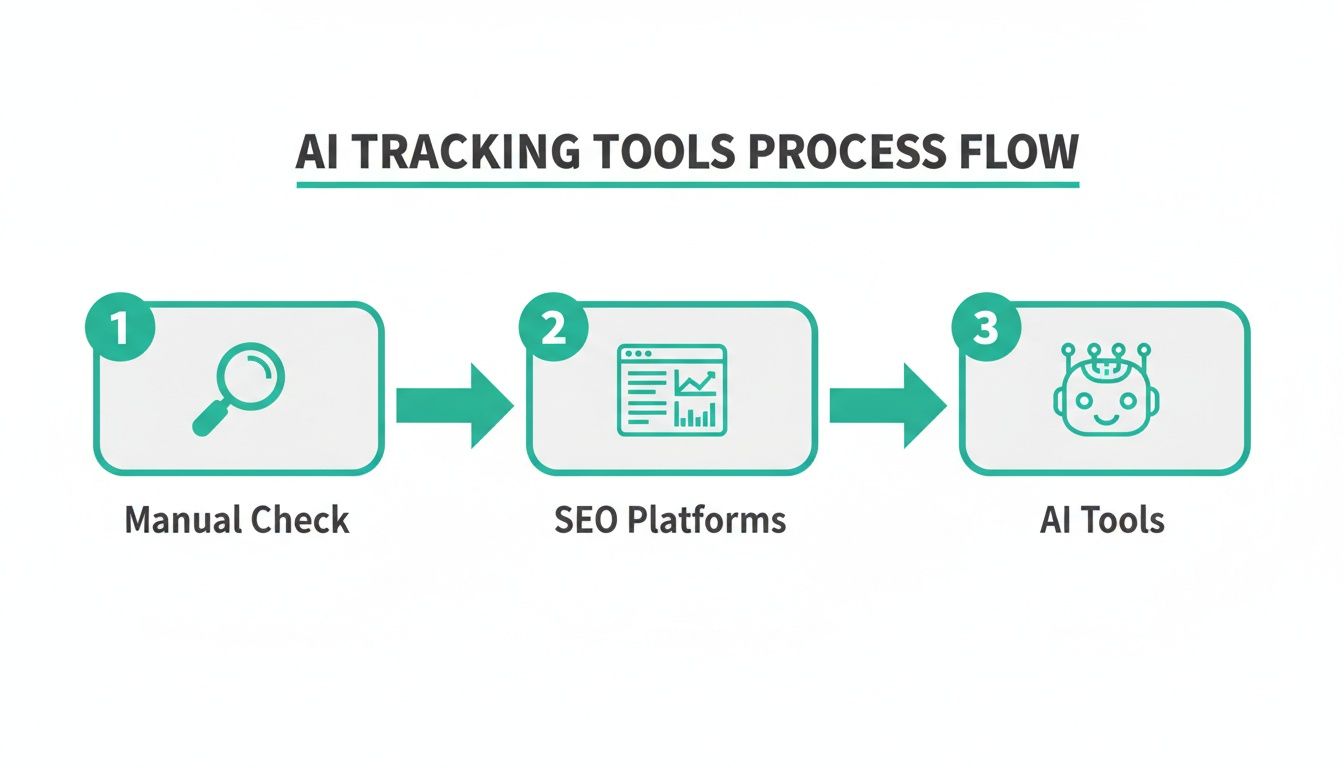
Manual checks and general SEO platforms can be a good starting point, but specialized AI tools are necessary for scalable, in depth analysis.
Establishing a Cadence for AI Overviews Tracking
Consistency is crucial for effective AI Overviews tracking. A regular schedule for reviewing data and identifying trends is essential. Sporadic checks will likely miss important shifts in AI generated results. A simple yet powerful workflow can be structured around the following rhythms:
Weekly Review: A quick check on your primary brand and product keywords to spot new negative sentiment or competitor appearances for valuable terms.
Monthly Analysis: A deeper dive into broader keyword categories, analyzing Answer Share trends, identifying citation opportunities, and benchmarking against competitors.
Quarterly Strategy Session: A high level meeting to connect AI visibility trends with business goals, using the data to plan content initiatives and refine your generative SEO strategy.
This structured cadence helps you stay on top of your AI performance without becoming overwhelmed by data.
Interpreting Data and Prioritizing Action in LLM Tracking
Data collection is only useful if it leads to action. The core of your workflow should be turning numbers into a clear to do list. When a competitor earns citations for a keyword you are targeting, trace those citations back to their source content. Analyze their page structure, data presentation, and E E A T signals to understand why the AI preferred their content. According to these search engine statistics, session times on platforms like ChatGPT are significantly longer than on Google, indicating deeper user engagement with generative answers and the urgent need for content that directly addresses these detailed queries.
"According to SEO tool reviewer thruuu, a key feature to look for is the ability to 'find keywords where your domain is used as a source, but your brand isn’t mentioned,' calling it a low hanging fruit for optimization."
By building a structured workflow, you can move from simply knowing your AI visibility score to actively shaping it.
Turning AI Tracking Insights Into Actionable Strategy
Data collection is just the beginning. The true value of tracking AI Overviews lies in translating those numbers into a marketing strategy that delivers results. This involves understanding not just if you are appearing in AI answers, but why.
By analyzing patterns in the content that earns citations, both yours and your competitors', you can build a smarter roadmap. Deconstruct what makes it effective: is it the clean structured data, strong E E A T signals, or fact dense articles that are easy for an LLM to digest? This is no longer a niche concern. As detailed in these AI statistics over at seranking.com, AI search traffic has seen explosive growth, and for many sites, tools like ChatGPT and Perplexity are already driving a significant portion of total sessions. If you are not monitoring AI mentions, you are operating with a major blind spot.
Auditing Your Content for AI Readiness
A critical part of your strategy should be a content audit conducted through the lens of an AI model. This involves reviewing your entire content library to identify pieces that are clear, factual, well structured, and provide direct answers to user questions. Your audit should categorize content into three buckets:
High Performers: Pages already earning citations. The goal is to protect and build upon their success.
Optimization Candidates: Content that ranks well in traditional search but is ignored by AI Overviews. These should be your top priority.
Content Gaps: Topics where competitors are consistently cited, but you have no content. This informs your future content calendar.
This analysis provides a prioritized to do list, ensuring your team focuses on the most impactful fixes and new content.
Connecting AI Tracking to Business Outcomes
To gain support for your generative SEO efforts, you must connect tracking metrics to real business results. It is not enough to report an increase in "Answer Share"; you need to demonstrate how that visibility translates into outcomes the C suite values. By tying AI metrics directly to your company's goals, you clarify the purpose of your work.
| Business Goal | Corresponding AI Metric | Actionable Tactic |
|---|---|---|
| Increase Brand Awareness | Answer Share, Brand Mentions | Optimize existing cited content to include the brand name. Create new content to fill identified gaps. |
| Drive Lead Generation | Citation Frequency from Product Pages | Enhance product and solution pages with clear, factual data and structured FAQs that AI can easily parse. |
| Build Thought Leadership | Citations from Informational Content | Develop comprehensive, data driven articles and guides that establish your expertise on key industry topics. |
Building this bridge demonstrates how improving AI visibility directly supports the company's bottom line, which is essential for securing the necessary budget and resources.
Summary and Key Takeaways
Effective AI Overviews tracking requires moving beyond data collection into strategic action. By analyzing citation patterns, conducting AI readiness audits, and linking your efforts to core business goals, you can develop a powerful, data informed content strategy. This approach not only increases your visibility in AI answers but also proves the real world ROI of your generative SEO work. For those looking to get started, specialized tools like Riff Analytics provide the necessary insights to compete effectively.
Frequently Asked Questions on AI Overviews Tracking
What is the best way to track AI Overview citations for free?
You can perform manual searches in Google's incognito mode for your most important keywords to spot check for citations. While this method is not scalable and provides no historical data, it is a useful way to get an initial assessment of your visibility.
How do AI tracking tools differ from traditional rank trackers?
Traditional rank trackers measure your URL's position in the classic list of blue links. In contrast, AI tracking tools monitor whether and how your brand or content is mentioned within the AI generated summary at the top of the search results, focusing on answer inclusion rather than positional rank.
Can I use Google Search Console for tracking AI Overviews?
Currently, Google Search Console does not offer a specific report or filter to isolate your performance within AI Overviews. While it provides overall click and impression data, it lacks the granular detail needed for a thorough generative SEO analysis.
How do I prioritize which content to optimize for AI Overviews?
Start with pages that already rank well in Google for high value keywords but are not featured in AI Overviews. These represent the quickest wins and offer the most significant immediate impact.
What is the best way to handle negative brand mentions in AI Overviews?
First, identify the source content cited by the AI. Then, create or optimize your own authoritative content that presents a more accurate and positive narrative. The long term goal is to displace the negative source with your own content.