12 Best AI Powered Marketing Tools to Dominate in 2026
Updated December 13, 2025
What are AI powered marketing tools? In simple terms, they are intelligent software platforms that use technologies like machine learning and large language models (LLMs) to automate, analyze, and optimize marketing tasks. By 2026, the ability to leverage these tools will not be a luxury but a necessity for competitive survival. They can predict customer behavior, generate personalized content at scale, and fine-tune campaigns in real time with a level of precision previously unattainable.
This shift is already well underway. According to a 2024 report, 73% of marketing leaders are actively investing in generative AI to gain a competitive advantage. The applications are vast, from enhancing creative workflows to optimizing media buys. This guide moves beyond the hype to provide a practical breakdown of the top platforms that will redefine your strategy, improve your AI search visibility, and deliver measurable results. We will help you navigate this complex landscape and select the right solution for your specific goals.
What You Will Find in This Guide for AI Marketing Technology
For each of the 12 tools covered, you will find:
- A concise description of its core function.
- Key use cases for SEO managers, content teams, and growth leaders.
- An honest assessment of its strengths and limitations.
- Direct links and screenshots for a clear overview.
This resource is designed to help you quickly identify which AI powered marketing tools will solve your team's most pressing challenges and integrate seamlessly into your existing workflows.
1. Riff Analytics
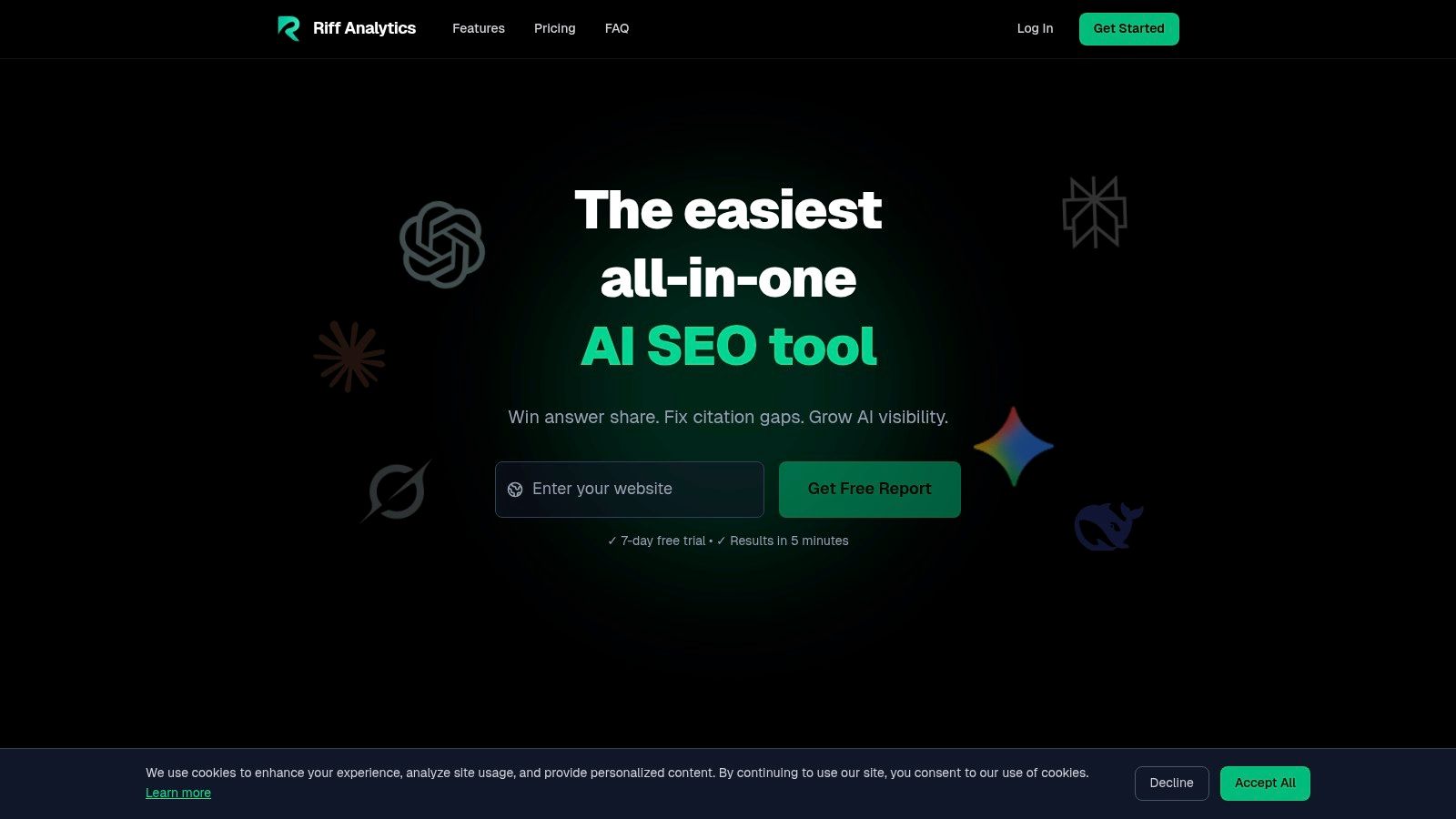
Riff Analytics stands out as a premier AI-powered marketing tool specifically engineered for the new era of generative search. It provides an essential solution for SEO, content, and brand marketing teams aiming to dominate visibility not just on traditional search engines, but within the conversational responses of major AI assistants like ChatGPT, Perplexity, Gemini, and Google’s AI Overviews. The platform moves beyond simple keyword tracking to offer deep insights into "answer share," revealing precisely how and why a brand is mentioned and cited by AI.
Understanding Generative SEO with This AI Tool
This specialization in AI search visibility makes it an indispensable asset for forward thinking marketers. Riff Analytics helps you understand and influence the sources that AI models trust, turning a black box into a strategic, actionable channel. Its ability to pinpoint specific citation sources and identify competitive gaps provides a clear roadmap for content and SEO strategies that directly impact your brand’s presence in AI-driven discovery, a practice known as generative SEO.
Key Capabilities and Use Cases for AI Search Visibility
Riff Analytics excels by focusing on actionable intelligence for generative SEO. Instead of just counting mentions, it identifies the exact URLs and third party sources that AI engines cite, which is a critical differentiator. This allows teams to prioritize optimization efforts on pages that will actually move the needle.
Primary Use Cases:
- AI Search Visibility Tracking: Monitor how often your brand, products, and key executives are mentioned across multiple AI engines in real time.
- Competitive Benchmarking: Directly compare your AI answer share against competitors to identify threats and opportunities.
- Citation Gap Analysis: Discover which third party sites and internal pages competitors are leveraging for AI citations that you are missing out on.
- Content Strategy Prioritization: Use AI readiness audits and source data to build a content plan that targets the topics and pages most likely to be cited by AI.
Why This is a Top Choice for AI Marketing
The platform's strength lies in its user friendly approach to a complex problem. Marketers can get an initial AI visibility report in minutes without needing a technical background. The dashboards are designed for clarity, translating raw data on mentions and citations into strategic trends and contextual analysis. This combination of powerful, cross engine data and an accessible interface makes it a top tier tool for any team serious about future proofing their search strategy.
- Pros: Comprehensive tracking across major AI engines, actionable citation source analysis, and instant AI readiness audits that simplify strategy.
- Cons: Pricing is not publicly listed, requiring engagement with their sales process or a free trial to understand costs.
- Pricing: A 7-day free trial is available; paid plan details are provided upon inquiry.
- Website: https://riffanalytics.ai
2. HubSpot – Marketing Hub
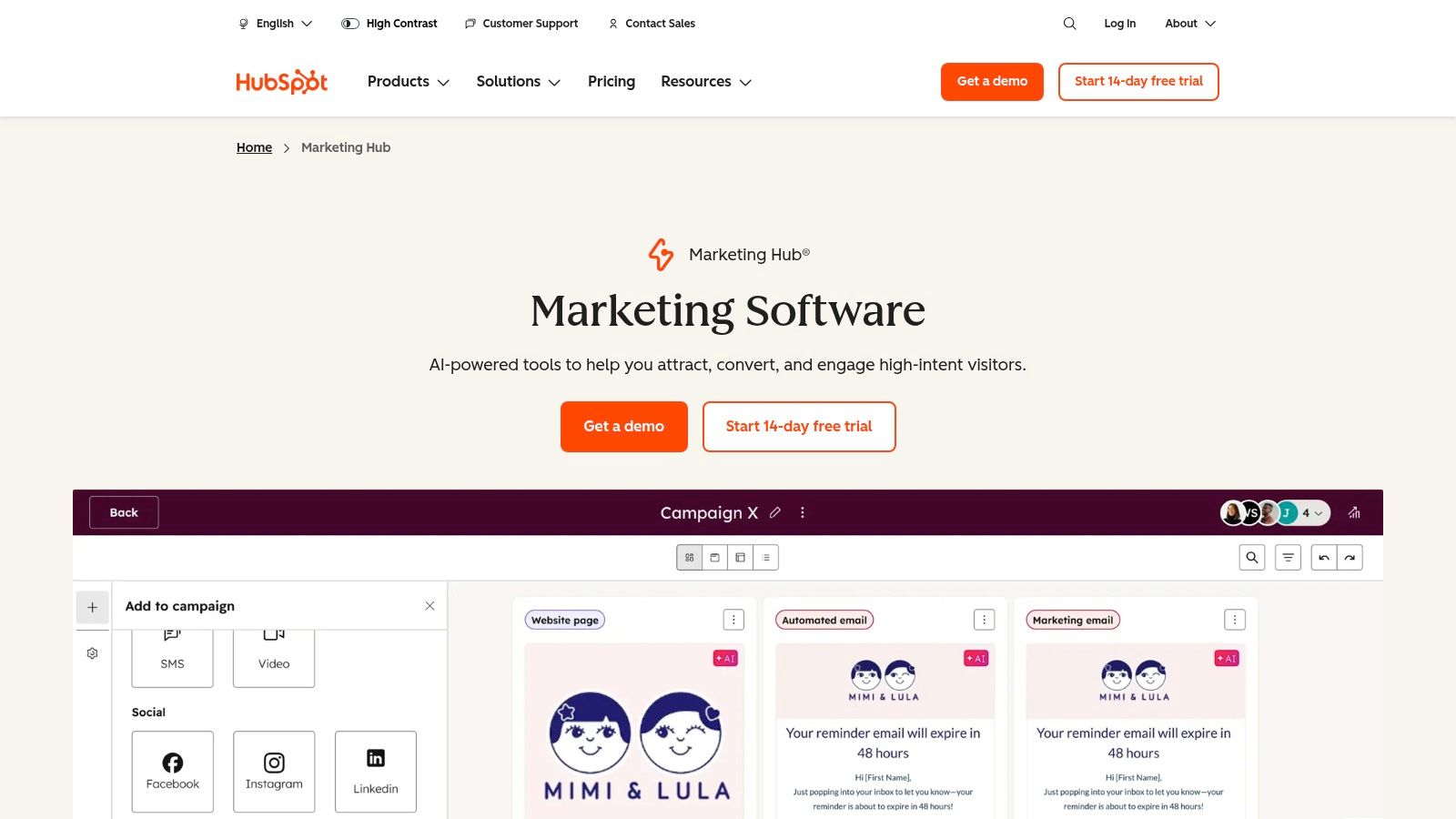
HubSpot’s Marketing Hub has evolved from a powerful marketing automation suite into a comprehensive platform integrating numerous AI-powered marketing tools. It stands out by embedding AI directly into the workflows marketers use daily, such as content creation, email campaigns, and customer segmentation, all unified within its native CRM. This consolidation eliminates the need for juggling multiple disconnected tools, providing a single source of truth for customer data and campaign performance.
HubSpot as a Centralized AI Marketing Automation Platform
For teams already invested in the HubSpot ecosystem, activating these AI features is a seamless process. The platform is particularly effective for businesses that prioritize alignment between marketing, sales, and service, as its AI capabilities leverage data from across the entire customer lifecycle. HubSpot reports that its AI content assistant helps users create content 40% faster on average.
Key AI Features and Use Cases
HubSpot’s AI assistants are designed for practical application. You can generate blog post ideas, draft entire articles, create social media copy, and even build website landing pages using conversational prompts. Its predictive AI helps score leads based on their likelihood to convert and can identify audiences for targeted campaigns with greater accuracy than manual segmentation.
Pros:
- Consolidates dozens of marketing functions, reducing integration complexity and costs.
- Extensive free educational resources through HubSpot Academy and a large partner network.
- AI features are built directly into existing workflows, making adoption intuitive.
Cons:
- Can become expensive as your contact list grows.
- Advanced features like multi-touch revenue attribution are gated in higher-priced Enterprise tiers.
- Mandatory onboarding fees for Professional and Enterprise plans can be a significant upfront cost.
Pricing: Starts with free tools, with paid plans beginning at $18/month (Starter), $800/month (Professional), and $3,600/month (Enterprise).
Website: https://www.hubspot.com/products/marketing
3. Salesforce Marketing Cloud Engagement
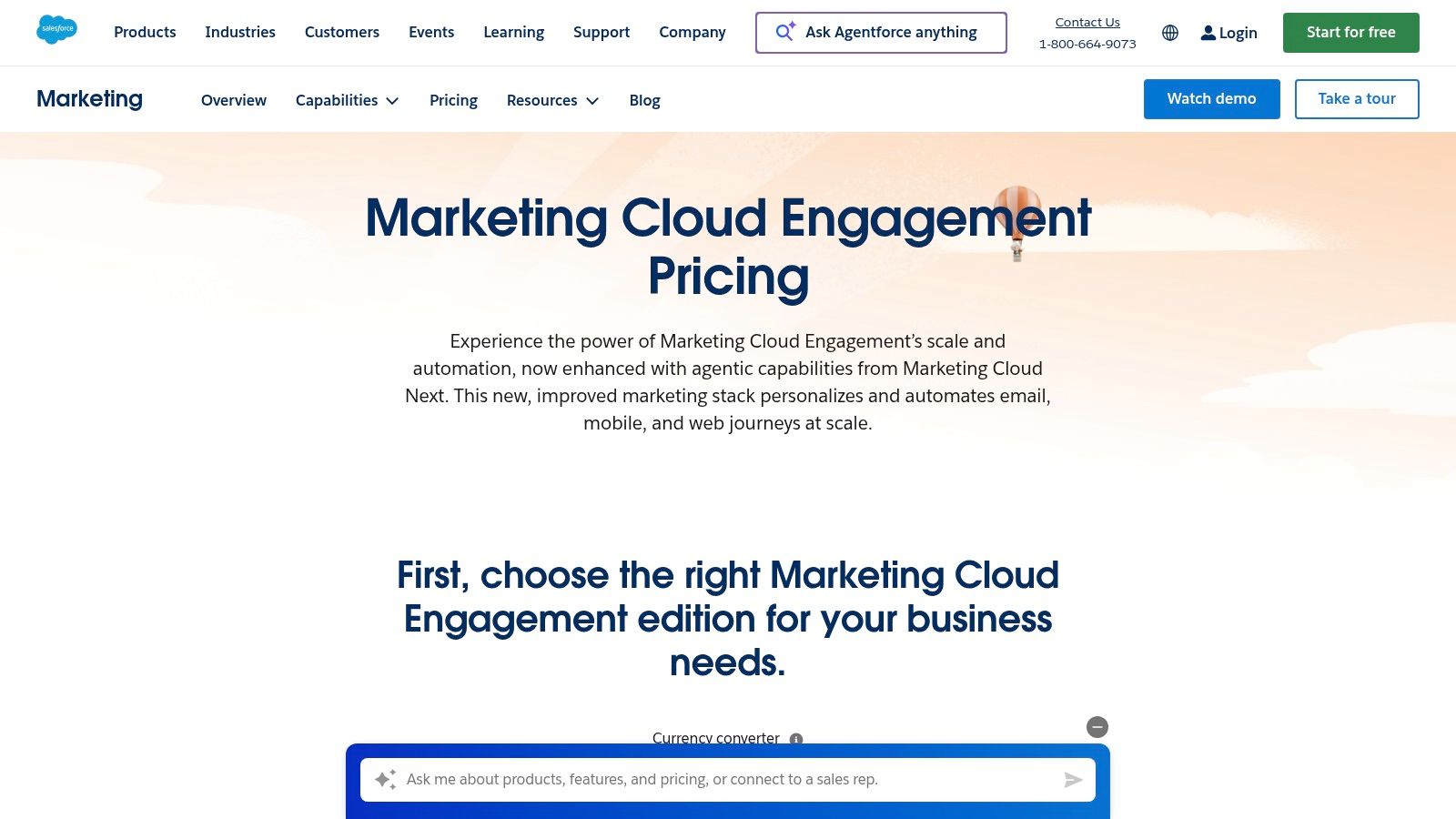
Salesforce Marketing Cloud Engagement is an enterprise-grade platform that leverages its powerful Einstein AI to orchestrate complex, cross channel customer journeys. It excels in unifying vast amounts of customer data to power personalized interactions across email, mobile/SMS, social, and advertising. The platform is designed for large organizations that require deep integration with a CRM, advanced segmentation capabilities, and robust governance to manage brand communications at scale.
Enterprise Grade AI Marketing With Salesforce
For businesses already operating within the Salesforce ecosystem, Marketing Cloud offers unparalleled data synergy. Its AI-powered marketing tools are not just add-ons; they are core components that analyze behavior, predict outcomes, and automate decision making across the entire customer lifecycle, making it a formidable choice for data driven enterprise marketing teams.
Key AI Features and Use Cases
The standout AI feature is Einstein, which offers predictive scoring, content personalization, and send time optimization. Marketers can use natural language prompts to build complex audience segments without writing SQL queries. Einstein also automates journey orchestration by predicting the best channel and message for each individual, and provides real time analytics to monitor and adapt campaigns dynamically. Native SMS and WhatsApp support are integrated directly into these automated journeys.
Pros:
- Deep integration with the broader Salesforce ecosystem and a vast partner services network.
- Mature data model and broad channel coverage including email, SMS, push, and social advertising.
- Powerful AI for predictive segmentation, content personalization, and journey optimization.
Cons:
- Pricing is sales-led and can be complex to scope, with costs escalating quickly.
- Often requires significant administrator or consultant overhead for custom implementations and ongoing management.
- The interface can have a steep learning curve for teams not already familiar with Salesforce products.
Pricing: Pricing is customized based on edition and usage. Contact Salesforce for a quote.
Website: https://www.salesforce.com/marketing/engagement/pricing/
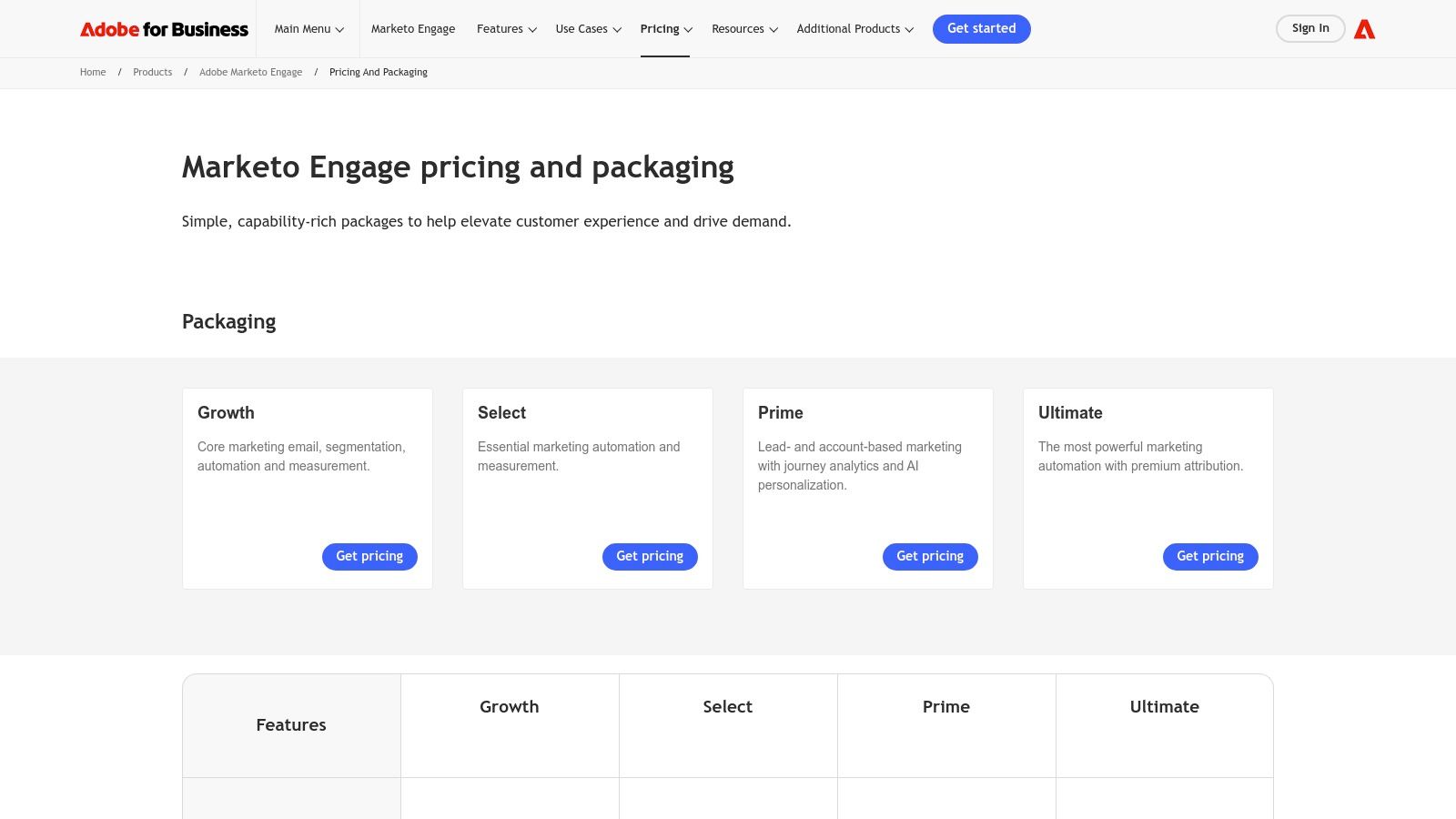
4. Adobe Marketo Engage
Adobe Marketo Engage is a mature marketing automation platform renowned for its sophisticated B2B lead management and account based marketing (ABM) capabilities. It stands out by offering deeply integrated AI-powered marketing tools designed for complex, enterprise level sales cycles. The platform's strength lies in its ability to orchestrate intricate nurture programs and personalize experiences at scale, leveraging a robust database and advanced segmentation.
Leveraging an Adobe AI Tool for Marketing
For large organizations with established marketing and sales operations, Marketo Engage provides the horsepower needed to manage complex buyer journeys. Its AI features, particularly in predictive audiences and journey analytics, are built to optimize engagement across long sales cycles, making it a frequent choice for businesses focused on high value B2B transactions.
Key AI Features and Use Cases
Marketo Engage uses AI to enhance personalization and predict customer behavior. Its predictive audiences feature analyzes historical data to identify high value segments for targeted campaigns, moving beyond simple demographic filters. The platform also offers journey analytics that can pinpoint the most effective content and channels for converting leads, allowing marketers to optimize their strategy based on AI-driven insights. It is a powerful tool for complex ABM orchestration.
Pros:
- Proven scalability for large scale B2B and ABM programs.
- Robust database architecture and segmentation options for complex nurture campaigns.
- Deep integration with the broader Adobe Experience Cloud for a unified customer view.
Cons:
- The platform has a steeper learning curve, often requiring dedicated expertise.
- Pricing is quote-based and tailored to enterprise needs, making it less accessible for smaller teams.
- Implementation can be complex and time consuming compared to more streamlined solutions.
Pricing: Offered in tiered packages (Growth, Select, Prime, and Ultimate). Pricing is quote-based and requires contacting Adobe sales.
Website: https://business.adobe.com/products/marketo/pricing.html
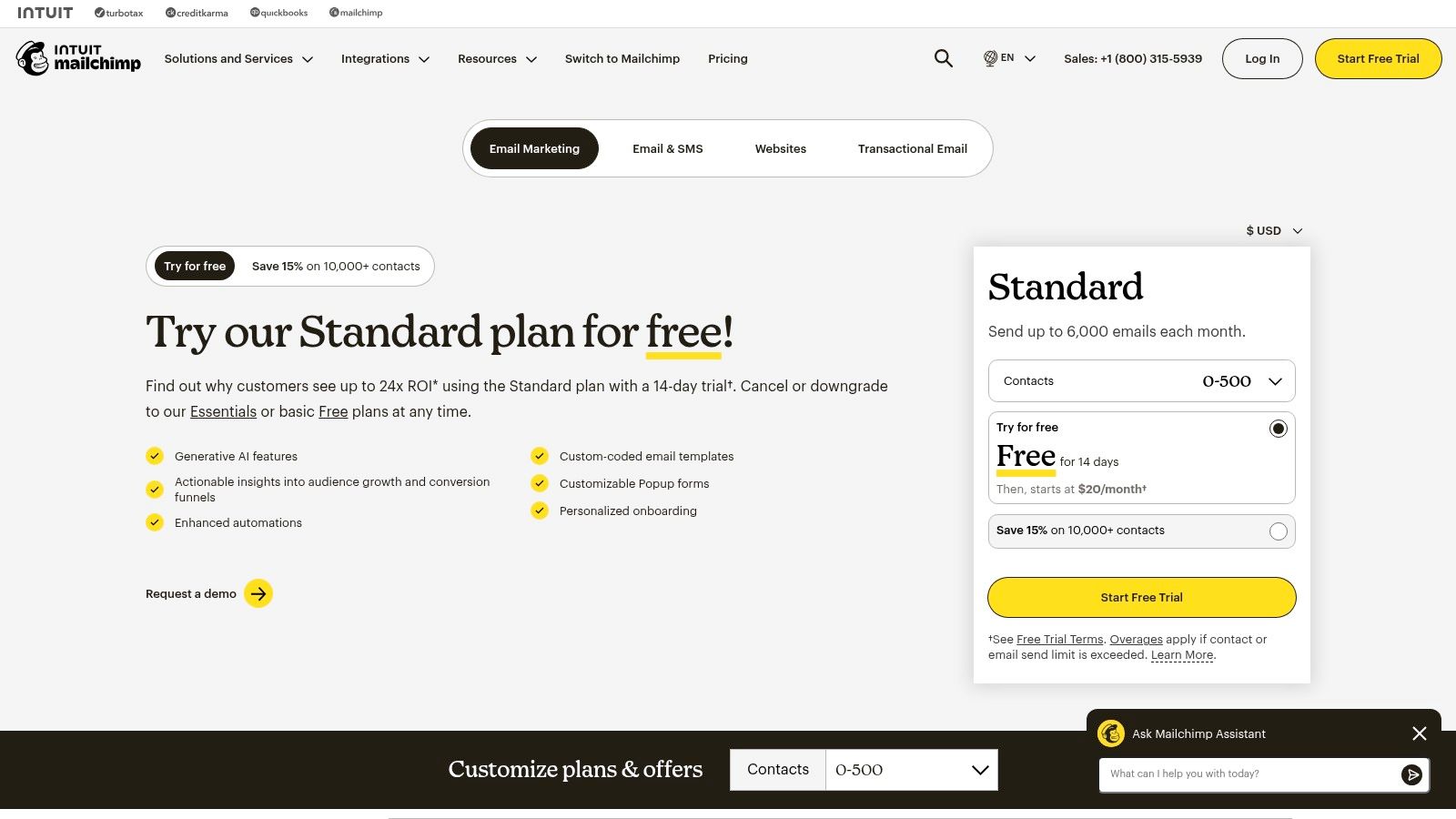
5. Mailchimp
Mailchimp has long been a go to platform for email marketing, and it has successfully integrated AI to make its accessible tools even smarter. It stands out by offering straightforward AI-powered marketing tools designed for small and medium sized businesses that need efficiency without a steep learning curve. The platform bundles email, basic automation, and a website builder, with AI features woven in to optimize content and campaign timing.
AI Enhanced Email Marketing Solutions
For businesses looking for an approachable entry point into AI driven marketing, Mailchimp offers a user friendly interface and transparent pricing. Its AI functionalities focus on practical, high impact tasks like crafting better email copy and determining the best moment to send a campaign, making advanced optimization accessible to teams without dedicated data scientists.
Key AI Features and Use Cases
Mailchimp’s AI capabilities are centered around its Creative Assistant and predictive analytics. The Creative Assistant helps generate custom designs and copy for emails and landing pages based on your brand assets and industry. Its send time optimization feature analyzes user engagement data to recommend the ideal delivery time for each contact, boosting open rates. The platform also uses AI to provide subject line suggestions and predict audience segments.
Pros:
- Extremely fast to get started with a vast library of pre built templates and an intuitive editor.
- Transparent, contact based pricing tiers make it easy to predict costs as your audience grows.
- Combines email, SMS, landing pages, and social posts into one unified platform for SMBs.
Cons:
- Advanced automation, A/B testing, and predictive segmentation are reserved for higher priced plans.
- The free plan is quite limited in terms of audience size and monthly sends.
- Can become less cost effective compared to more advanced platforms as your marketing needs become more complex.
Pricing: Offers a free plan for up to 500 contacts. Paid plans are Essentials (starting at $13/month), Standard (starting at $20/month), and Premium (starting at $350/month), with costs scaling based on contact count.
Website: https://mailchimp.com/pricing/marketing/
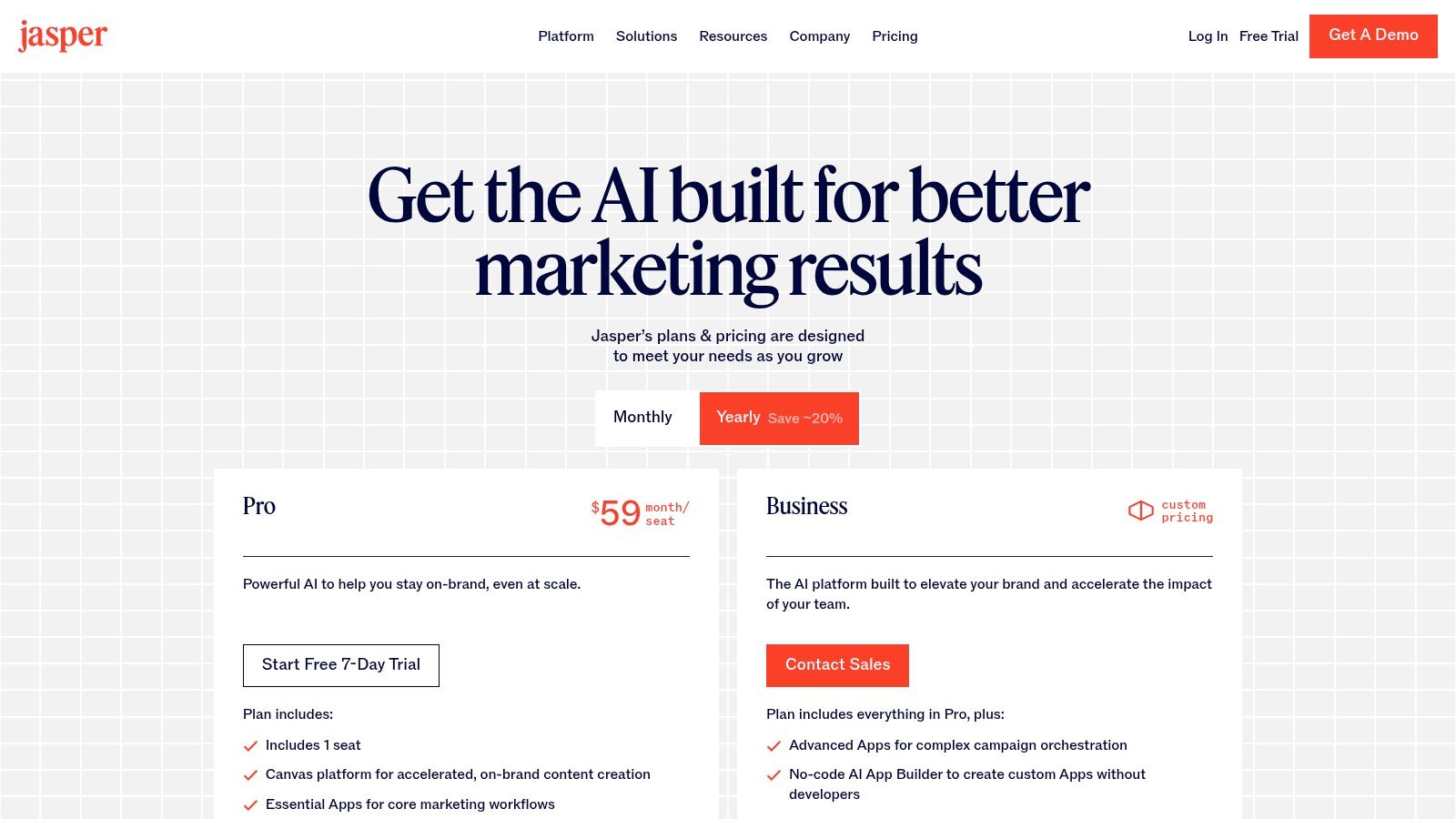
6. Jasper
Jasper has established itself as an enterprise grade AI content platform purpose built for marketing teams. It moves beyond simple text generation by offering a suite of tools focused on brand consistency, workflow automation, and governance. The platform is designed for organizations looking to standardize their AI outputs and ensure all content, from blog posts to ad copy, aligns perfectly with their established brand identity. This focus on control and scalability makes it a strong contender among AI powered marketing tools for larger teams.
AI Content Generation Tools for Marketing Teams
For businesses that need to maintain a specific tone and style across all communications, Jasper’s Brand Voice and knowledge integration features are particularly powerful. By uploading style guides, product catalogs, and company facts, marketing teams can train the AI to produce on brand, accurate content consistently, reducing the need for extensive manual edits and revisions.
Key AI Features and Use Cases
Jasper’s core is its collaborative Canvas, a flexible workspace where teams can use templates or freeform commands to create long form content. The platform's real strength lies in its advanced features like Brand Voice, which analyzes your existing content to create a repeatable tone, and its no code app builder for creating custom, repeatable marketing workflows. This allows teams to build their own internal tools for tasks like generating case studies or writing SEO optimized product descriptions, a key consideration for those interested in the future of answer engine optimization.
Pros:
- Designed specifically for marketing teams with robust collaboration and workflow tools.
- Strong emphasis on security, brand safety, and governance suitable for large organizations.
- LLM agnostic architecture provides flexibility and future proofs the platform.
Cons:
- Advanced features like agents and the no code app builder are gated in the higher tier Business plan.
- Per seat pricing can become expensive for large teams or entire departments.
- The learning curve for creating effective custom apps and workflows can be steep.
Pricing: Starts with a Creator plan at $39/seat/month, with Pro and Business plans offering more advanced features and collaboration.
Website: https://www.jasper.ai/pricing
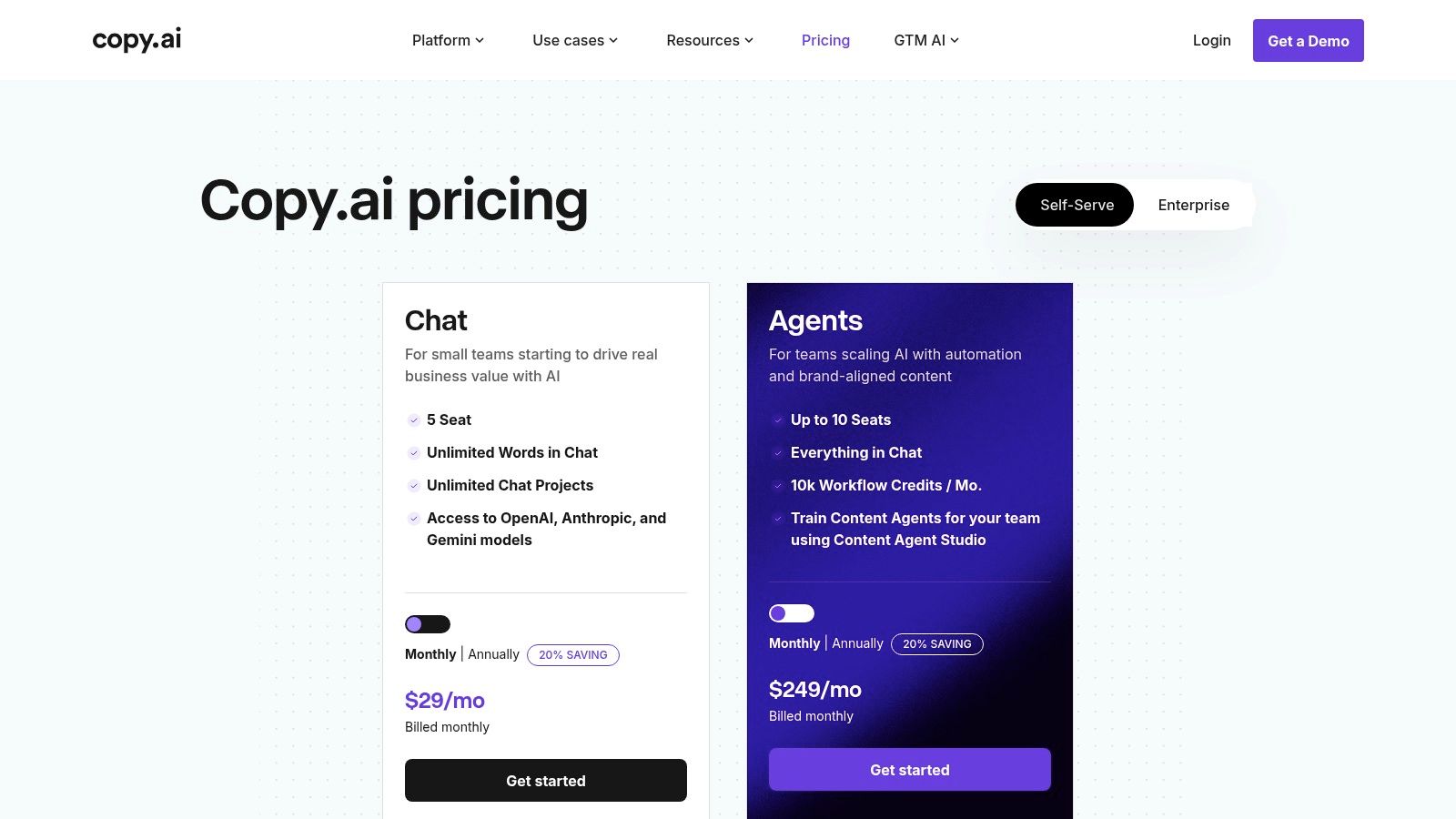
7. Copy.ai
Copy.ai positions itself as more than just a content generator; it's an AI-powered marketing and research platform designed for teams ready to build scalable workflows. It provides a practical entry point for businesses looking to experiment with AI driven content automation through its intuitive Chat interface and customizable Agents. The platform's unique advantage is its flexibility, offering access to multiple leading AI models, including those from OpenAI, Anthropic, and Google.
Exploring AI Powered Marketing Automation Workflows
This multi model approach allows marketing teams to choose the best engine for specific tasks, whether it's creative copywriting, data analysis, or long form research. For organizations aiming to integrate AI deeply into their processes without being locked into a single provider's ecosystem, Copy.ai offers a versatile and workflow centric solution.
Key AI Features and Use Cases
Copy.ai's core features are built for practical application in marketing campaigns. The AI Chat facilitates quick content generation and research, while the more advanced Agents feature allows you to build and train custom automations for repetitive tasks like content brief creation or social media post generation. Guided implementation options help teams quickly extract value from these tools.
Pros:
- Low monthly entry price with unlimited words in the Chat interface.
- Access to multiple top tier AI models provides flexibility and future proofing.
- Workflow tooling and customizable Agents enable scalable content automation.
Cons:
- The workflow credit system introduces an additional quota for users to manage.
- Costs can escalate as you add more team seats and require more advanced capabilities.
Pricing: Offers a free plan with a 2,000-word limit. Paid plans start at $36/month (Pro), with custom pricing for Team, Growth, and Scale tiers.
Website: https://www.copy.ai/prices
8. Semrush
Semrush is a comprehensive digital marketing toolkit best known for its deep SEO and competitive intelligence capabilities. While traditionally focused on search analytics, it has integrated AI-powered marketing tools to streamline workflows for content marketers and performance specialists. The platform excels at providing the vast datasets needed to inform AI driven strategies, from keyword research to content creation and performance tracking.
AI Powered SEO Tools for Marketers
For marketing teams that live and die by search engine performance, Semrush provides an essential foundation. Its AI features are designed to enhance existing SEO and content marketing processes rather than replace them entirely, making it a powerful supplement for data driven professionals. The platform helps users understand the competitive landscape and identify opportunities with greater speed and accuracy.
Key AI Features and Use Cases
Semrush leverages AI to simplify complex data analysis and content creation. Its ContentShake AI helps generate topic ideas, create article outlines, and draft content optimized for search. The SEO Writing Assistant provides real time feedback on content based on top ranking competitors. Additionally, its AI-powered tools assist in summarizing complex analytics reports and identifying emerging keyword trends. To further optimize content for emerging search formats, learn more about how to rank in Google AI Overviews.
Pros:
- Deep datasets and a comprehensive toolset for search, content, and competitive analysis.
- Mature integrations and multiple specialized toolkits for agencies and specific marketing channels.
- AI features are well integrated into core SEO and content marketing workflows.
Cons:
- Pricing increases significantly with more projects, users, and keyword tracking.
- Some of the most valuable data and tools are locked behind additional paid add ons.
- The sheer volume of features can present a steep learning curve for new users.
Pricing: Starts at $129.95/month (Pro), with higher tiers at $249.95/month (Guru) and $499.95/month (Business).
Website: https://www.semrush.com
9. Hootsuite
Hootsuite has long been a staple in social media management, and it continues to evolve by integrating AI-powered marketing tools directly into its established platform. It excels at centralizing multi channel social media marketing, offering AI driven assistance for content creation, post timing, and audience engagement. This makes it an ideal solution for teams that need to manage a complex social presence efficiently without sacrificing content quality or strategic insight.
Using an AI Tool for Social Media Marketing
For businesses looking to streamline their social media workflows, Hootsuite provides a mature, reliable environment. Its AI features are designed to enhance, not replace, the marketer's role by automating repetitive tasks and providing data backed recommendations for better performance. This focus on practical AI application within a familiar interface makes it a strong contender for teams of all sizes.
Key AI Features and Use Cases
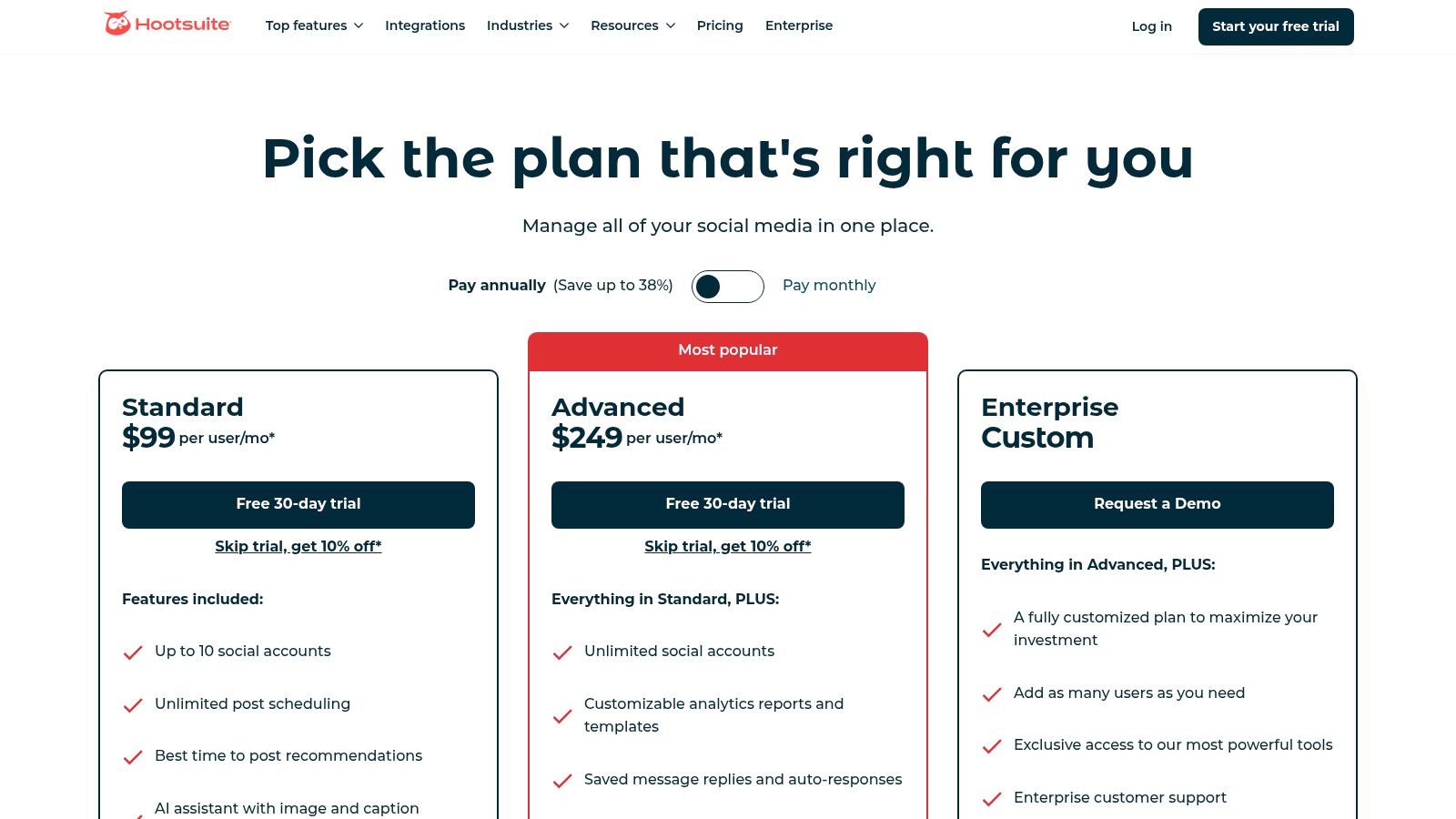
Hootsuite’s AI assistant, OwlyWriter AI, helps generate social media captions, post ideas, and repurpose top performing content in seconds. The platform also includes an AI powered "best time to publish" feature that analyzes audience engagement patterns to suggest optimal scheduling. Beyond content creation, its unified inbox and social listening tools help teams monitor brand mentions and sentiment, making it easier to manage community interactions and track brand visibility, a critical element as covered in these top 10 AI brand visibility tools for 2025.
Pros:
- Mature and reliable platform with robust scheduling, monitoring, and reporting workflows.
- Offers a 30 day free trial, allowing teams to thoroughly test the platform before committing.
- Strong multi channel management capabilities, centralizing everything in one dashboard.
Cons:
- Advanced features and unlimited scheduling are locked behind higher priced plans.
- Pricing for enterprise tiers is not transparent and requires a sales consultation.
- The interface can feel cluttered for users who only need basic scheduling features.
Pricing: Professional plan starts at $99/month, with Team and Enterprise plans available. A limited free plan is also offered.
Website: https://www.hootsuite.com/plans/business
10. Shopify App Store – Marketing AI apps
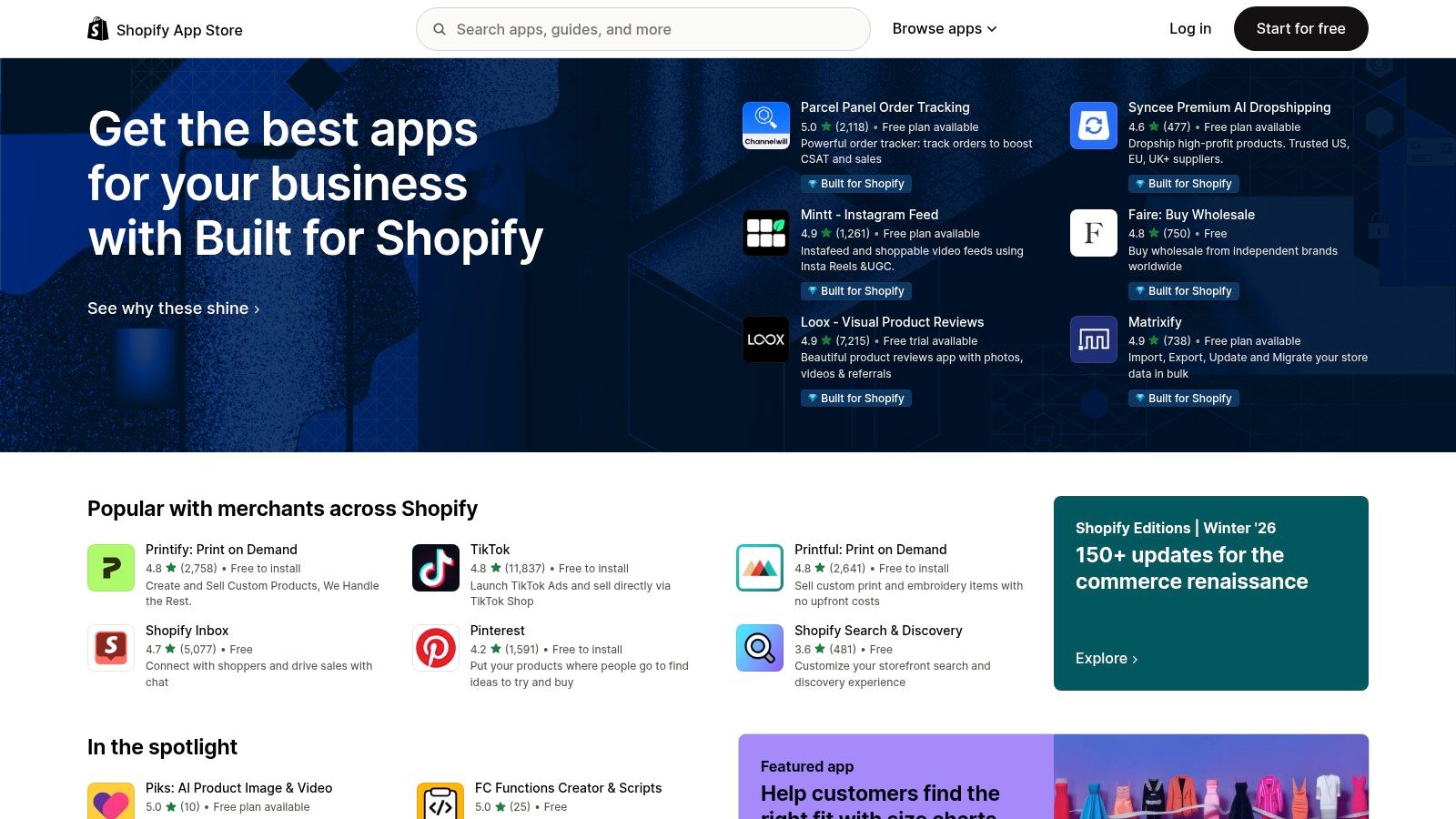
For e commerce businesses built on Shopify, the App Store serves as a direct gateway to a vast ecosystem of AI-powered marketing tools. Rather than a single platform, it is a marketplace where merchants can find, vet, and install specialized AI applications directly into their storefronts. This approach allows for a modular and highly customizable marketing stack, enabling store owners to add specific functionalities like AI driven product recommendations, automated SEO, or dynamic content generation without a complete platform overhaul.
AI Marketing Platforms for E-commerce
The key advantage is the seamless integration. These apps are designed to work natively within the Shopify environment, pulling product, customer, and order data to deliver personalized experiences. This makes it an ideal solution for merchants who need to quickly deploy targeted AI capabilities to solve specific marketing challenges, such as improving conversion rates or automating merchandising.
Key AI Features and Use Cases
The Shopify App Store hosts thousands of vetted apps, many offering sophisticated AI features. Merchants can find tools for generating compelling product descriptions, optimizing images for SEO, and creating personalized email marketing campaigns based on customer behavior. AI merchandising apps can automatically reorder product collections based on real time sales data, while recommendation engines suggest relevant products to increase average order value.
Pros:
- Fast and easy deployment with direct one click installation into Shopify.
- Extensive selection of specialized tools allows for a highly customized marketing stack.
- Transparent, per app pricing and numerous free trials make it accessible for businesses of all sizes.
Cons:
- Quality and effectiveness can vary significantly between different apps.
- Managing multiple app subscriptions can become complex and costly.
- Data privacy and app permissions must be carefully reviewed for each installation.
Pricing: Varies widely by app. Many apps offer free plans or free trials, with paid subscriptions typically ranging from $10 to over $100 per month.
Website: https://apps.shopify.com
11. AWS Marketplace – Generative AI for Marketing
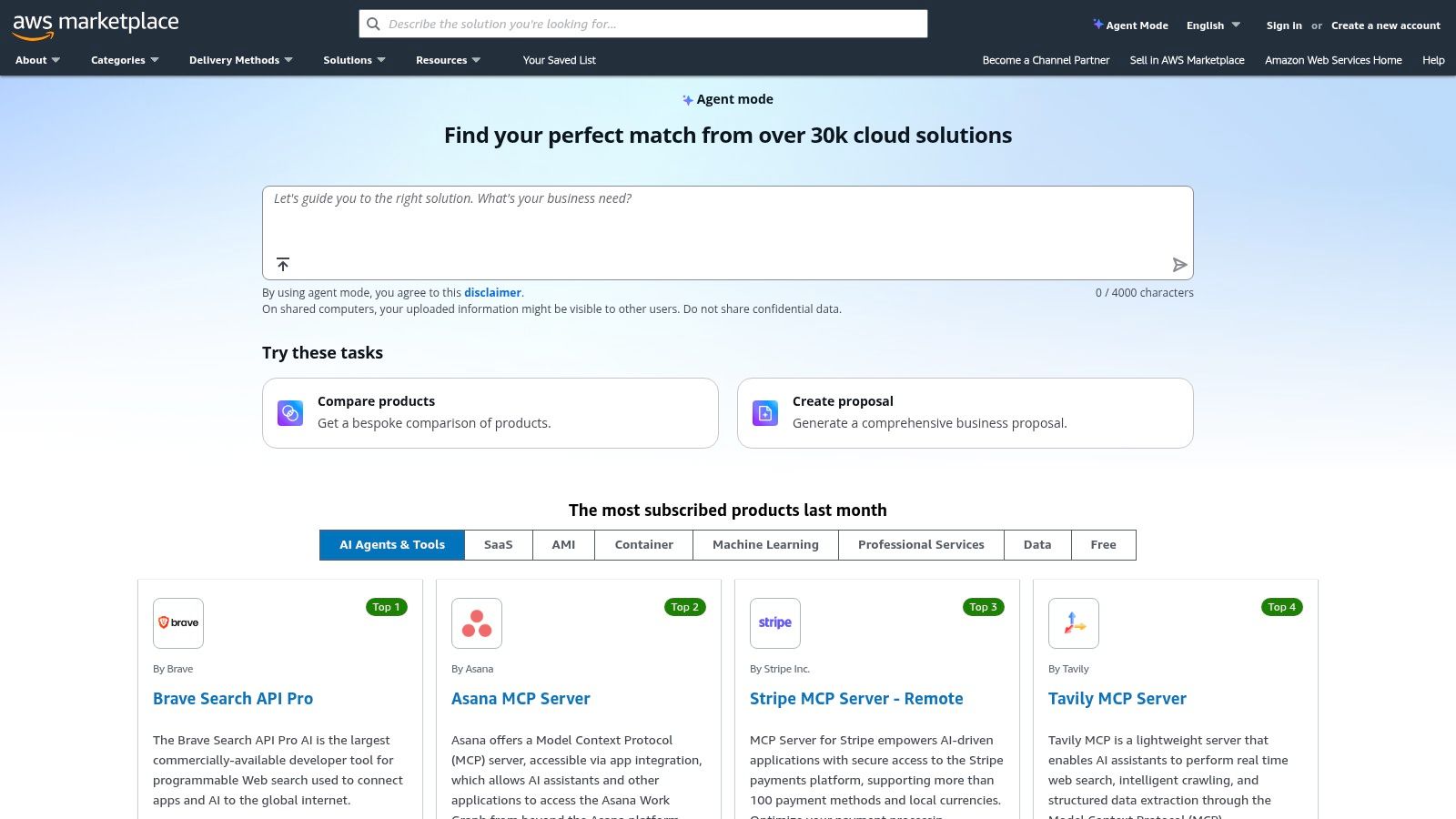
AWS Marketplace is not a single tool but a curated catalog of deployable AI-powered marketing tools from various vendors. It stands out by providing a streamlined procurement and governance framework for companies already invested in the Amazon Web Services ecosystem. This allows teams to discover, purchase, and deploy vetted generative AI solutions for personalization, campaign automation, and account based marketing using their existing AWS accounts and billing.
Finding Vetted AI Marketing Software
For organizations that prioritize centralized vendor management and IT oversight, the marketplace simplifies adopting new technologies. It consolidates everything from SaaS subscriptions to expert implementation services, ensuring that new tools meet enterprise security and compliance standards from the start.
Key AI Features and Use Cases
The marketplace offers a wide array of solutions, including tools that leverage native AWS services like Pinpoint and Lambda for advanced personalization and automation. You can find specialized applications for generating hyper targeted ad copy, automating multi channel campaigns, or enhancing lead scoring models. For a deeper dive into how these applications are reshaping search, it's useful to understand core concepts like Generative Engine Optimization, which many of these tools aim to support.
Pros:
- Streamlined vendor onboarding and consolidated billing through your existing AWS account.
- Centralizes procurement of both software and professional implementation services.
- Ensures solutions meet enterprise grade governance and security standards.
Cons:
- Pricing is often not public, with many listings requiring you to contact sales for a quote.
- Some solutions demand significant AWS expertise to properly deploy and manage.
- The sheer number of options can be overwhelming without a clear evaluation process.
Pricing: Varies widely by vendor; many solutions are quote-based or offer private pricing.
Website: https://aws.amazon.com/marketplace
12. G2
While not a tool itself, G2 is an essential platform for navigating the crowded market of AI-powered marketing tools. It is the largest B2B software marketplace, providing a centralized hub for discovering, comparing, and validating tools using verified peer reviews and detailed product data. Its value lies in offering market sentiment and real user feedback, which helps cut through marketing hype.
A Platform for Comparing AI Marketing Solutions
For marketers tasked with shortlisting and purchasing new software, G2 serves as a critical first step in the research process. The platform uses its own AI recommendation engine to suggest relevant tools based on your needs, and its structured category grids make it easy to see how different vendors stack up against each other based on user satisfaction and market presence.
Key AI Features and Use Cases
G2's primary function is to help you find other AI tools. You can filter extensive categories like "Marketing Automation" or "Content Creation" to find platforms with specific AI capabilities. The platform features verified peer reviews, detailed "best of" lists, and AI powered recommendation agents on category pages to guide your search. It centralizes buyer guides and leader grids, allowing you to quickly compare top solutions.
Pros:
- Transparent peer reviews from verified users help validate vendor claims and promises.
- Acts as a centralized place to compare features, link to pricing, and request demos.
- Filtering options allow for highly specific searches based on company size or industry.
Cons:
- Some software categories can be overly broad, requiring further research.
- Vendor provided details should always be validated on their official websites.
- G2 aggregates information, but the final purchase is completed through vendor channels.
Pricing: Free to use for browsing and comparing software.
Website: https://www.g2.com
AI Powered Marketing Tools: A Comparative Overview
| Tool Category | Example Tool | Best For | Key Metric Improved |
|---|---|---|---|
| AI Visibility & SEO | Riff Analytics | SEO & Brand Teams | AI Answer Share |
| Marketing Automation | HubSpot | SMBs & Mid-Market | Lead Conversion Rate |
| Enterprise Automation | Salesforce | Large Enterprises | Customer Lifetime Value |
| Content Generation | Jasper | Content Teams | Content Velocity |
| Social Media Mgmt | Hootsuite | Social Media Managers | Audience Engagement |
| E-commerce Apps | Shopify App Store | Shopify Merchants | Average Order Value |
Summary and Key Takeaways
The landscape of AI powered marketing tools has moved from a futuristic concept to a present day necessity. The solutions available today range from comprehensive automation suites like HubSpot to specialized platforms like Riff Analytics that solve the emerging challenge of maintaining brand visibility in generative AI search. Choosing the right tool depends entirely on your specific goals, team size, and existing technology stack.
The key to success is not adopting AI for its own sake, but identifying a clear business problem it can solve. Whether it's automating repetitive tasks, gaining deeper audience insights, scaling content production, or mastering your presence in new channels like LLM tracking, there is a tool designed to help. Start by auditing your current workflows to find the biggest opportunities for improvement, then use the resources in this guide to shortlist platforms that align with those needs. The future of marketing is not about replacing humans with AI; it's about empowering them with it.
Frequently Asked Questions
1. What is an example of an AI powered marketing tool?
A great example is a platform like Jasper, which uses generative AI to help marketing teams write blog posts, ad copy, and social media content faster. Another example is Riff Analytics, which monitors how often a brand is mentioned by AI search engines like ChatGPT and Google AI Overviews, helping teams optimize for visibility in these new channels.
2. How can I use AI tools for a small business marketing strategy?
For small businesses, tools like Mailchimp or HubSpot are excellent starting points. They use AI to help you optimize email send times, generate effective subject lines, and segment your audience for more personalized campaigns without requiring a large budget or a team of data scientists.
3. What is the difference between marketing automation and AI marketing?
Marketing automation typically follows predefined rules set by a marketer (e.g., "if a user clicks this link, send them this email"). AI marketing goes a step further by using machine learning to make its own decisions. For example, an AI marketing tool can analyze data to predict which customers are most likely to churn and then automatically enroll them in a retention campaign.
4. How will generative AI impact SEO and marketing?
Generative AI is transforming SEO by creating a new field known as Generative Engine Optimization (GEO). Instead of just ranking on a list of blue links, brands must now focus on being cited as a trusted source within AI generated answers. This requires a focus on high quality, factual content and tracking brand visibility within AI models, a process sometimes called LLM tracking.