Mastering AI Search Monitoring: A Guide for 2026 and Beyond
Updated February 10, 2026

AI search monitoring is the process of tracking how your brand, products, and content appear in answers generated by AI engines like ChatGPT, Google's AI Overviews, and Perplexity. As we look toward 2026, this is no longer about ranking on a page of links. It's about being cited as a trusted source inside the AI's direct response to a user's question. Mastering this is non negotiable for protecting your brand and capturing traffic in a world that is quickly shifting from keyword searches to conversational queries.
This guide provides a complete framework for understanding, measuring, and improving your brand's presence in the new world of AI driven search.
Why AI Search Monitoring is Critical in 2026
Think of an AI search engine as a digital concierge. When a user asks, "What's the best project management software for a small business?" the concierge doesn't hand them a phone book (a list of results). It gives them a direct, synthesized recommendation based on what it knows. AI search monitoring is how you ensure your brand is the one that concierge recommends.
This is a massive departure from traditional SEO. Classic SEO was a race to the first page. The new game is about becoming part of the answer itself. Success is now measured by citations and mentions inside a generated response, not just your ranking.
How Monitoring AI Search Visibility Protects Your Brand
User behavior has already changed. Millions of people now turn to AI first for product recommendations, troubleshooting, and complex questions. If your brand is invisible in these AI conversations, you don't exist for a growing segment of your audience.
Here’s why you can’t afford to ignore it:
Protect Your Reputation: AI models get things wrong. They can misinterpret information, leading to inaccurate mentions of your brand. Monitoring lets you spot these issues quickly.
Find Competitive Gaps: See exactly where your competitors are getting cited for topics you should own. This is a goldmine for finding content gaps and opportunities to build authority. You can learn more by exploring different AI brand monitoring strategies and tools.
Measure True Influence: Forget share of voice. The new metric is "Answer Share" which is your brand's presence within AI generated answers for your most critical topics.
A New Set of Rules for a New Engine
AI engines like ChatGPT and Claude don't "crawl" the web like Google. They build their knowledge from a vast library of data, prioritizing sources that are clear, factual, and consistently authoritative. This is a crucial distinction for anyone working on their AI search visibility.
According to research from Aidan Coleman, a study found there's less than a 1 in 100 chance of getting the exact same list of brand recommendations twice from ChatGPT or Google AI. Continuous AI search monitoring is the only way to get a true picture of your visibility over time.
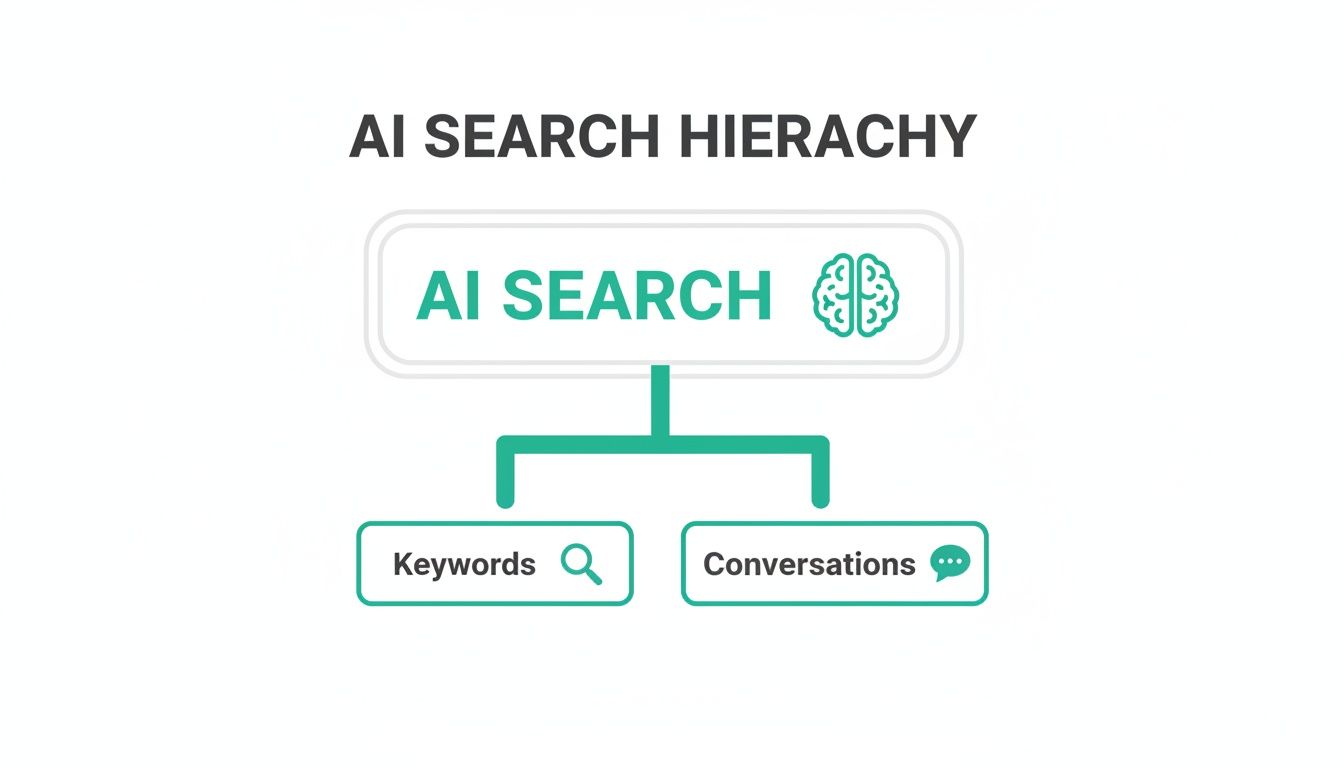
From Keywords to Conversations: Understanding Generative SEO
The ground is shifting under our feet. For decades, SEO was a game of keywords. That game is over. Today, Large Language Models (LLMs) like those inside ChatGPT and Google's AI Overviews are tearing up the old playbook. We're moving from a world of rigid keywords to one of fluid, context driven conversations.
These AI systems don’t just match words on a page. They work to understand what a user really wants and then pull together a direct, comprehensive answer. It’s the difference between a librarian pointing you to the right aisle (traditional search) and a research assistant who reads three books for you and hands you a one page summary (AI search).
Why LLM Tracking Matters for Your Strategy
To generate these summaries, LLMs construct a massive internal "knowledge graph." In this new world, they don't just care about relevance; they prioritize content that is clear, factually airtight, and consistently authoritative. This new reality forces a complete pivot in strategy. The goal is no longer just to rank. It's to become a trusted, citable source. This is the heart of generative SEO, a practice built around earning topical authority that AI engines recognize.
LLM tracking gives you the data to make this pivot intelligently. It goes beyond a simple "are we mentioned?" check and gets to the why. By seeing which sources an AI cites, you can reverse engineer what it deems authoritative. These insights feed directly into your content strategy, helping you spot competitive gaps and identify which pages need a refresh to become citation worthy.
The New Economics of AI Search Visibility
This isn't just a strategic shift; it's an economic one. The global AI search engine market is projected to grow from USD 16.28 billion in 2024 to USD 50.88 billion by 2033. This reflects a scramble by businesses to adapt to a world where AI driven discovery is the norm. For SEO managers and brand teams, monitoring AI citations is a matter of survival.
This new landscape demands a new way to measure performance. Success is less about hitting a specific rank and more about your total "Answer Share"—how often your brand is part of the conversation. You can learn more about this concept in our guide on Answer Engine Optimization.
The Metrics That Matter for Effective AI Search Monitoring
Your old SEO metrics are becoming less relevant. In the world of AI search, obsessing over keyword rankings is like bringing a map to a drone fight. When the goal shifts from climbing a list of links to becoming a trusted source inside a generated answer, you need a new way to measure success.
Effective AI search monitoring is built on a fresh set of KPIs, designed for the conversational world we live in now. This is about quantifying your brand's actual influence and authority within the AI's response. These are the numbers that prove your ROI and guide your next move.
Adopting New KPIs for AI Search Visibility
To get ahead, your team needs to adopt metrics that reflect this new reality. The single most important KPI is Answer Share, which measures the percentage of relevant AI generated answers that cite or mention your brand. It’s the direct successor to the old "share of voice" metric. If you track 100 different prompts about your industry and your brand shows up in 25 of the responses, your Answer Share is 25%.
Other key metrics that paint the full picture include:
Citation Quality: Looks at how you’re mentioned. A direct citation with a link is gold. A passing mention with no link is less valuable, but still a signal.
Response Sentiment: Tracks whether the AI's description of your brand is positive, neutral, or negative.
Competitor Answer Share: Shows you who the AI currently sees as the authority on key topics.
Source Diversity: Analyzes the variety of sources an AI uses. If an engine only cites a few major publications, it signals a massive opportunity for you to become a trusted niche source.
Comparing Traditional SEO Metrics to AI Monitoring KPIs
Making the switch from traditional SEO to generative SEO means changing how you measure what works. The old dashboards just don't cut it. This table shows the old world metrics and their new AI native counterparts.
| Focus Area | Traditional SEO Metric | AI Search Monitoring KPI |
|---|---|---|
| Visibility | Keyword Ranking Position | Answer Share (% of responses mentioning your brand) |
| Authority | Domain Authority / Backlinks | Citation Quality (Direct links vs. unlinked mentions) |
| Reputation | Brand Search Volume | Response Sentiment (Positive, neutral, or negative context) |
| Market Position | Competitor Rankings | Competitor Answer Share (Who owns the answers?) |
| Content Impact | Organic Traffic to a URL | Source Diversity (Variety of domains cited by AI) |
This new dashboard gives you a language to demonstrate the real world impact of your AI search visibility efforts. You can see how these new metrics connect to older concepts in our guide on how to calculate share of voice for today’s market.
Building Your AI Search Monitoring Workflow
Knowing the metrics is one thing, but turning them into action requires a repeatable process. A solid AI search monitoring workflow isn’t a one off task. It’s a constant loop of finding, tracking, analyzing, and acting on what you learn to keep your brand front and center in conversational search.
This kind of system is what turns raw data into a real competitive edge. It creates a feedback loop where insights from AI engines directly shape your content and PR strategy. Let's break down how to build a workflow that gets results.
Establishing Your AI Search Monitoring Framework
The first step is defining what you're going to monitor. Without clear boundaries, you’ll drown in noisy, irrelevant data. Getting this right from the start is the key to gathering intelligence you can actually use.
Here’s where to begin:
Identify Key AI Engines: You can't be everywhere at once. Start by focusing on the platforms your audience actually uses, like Google AI Overviews, Perplexity, and ChatGPT.
Define Core Topics and Entities: Make a list of your essential brand topics, products, services, and key people. Add your top competitors so you can accurately benchmark your performance against theirs.
Establish a Visibility Baseline: Before you can track progress, you need a starting point. Use a platform like Riff Analytics to run an initial audit and see what your current Answer Share is for your most important topics.
Implementing a Process for LLM Tracking and Analysis
With your framework in place, it’s time to put your tracking into motion. Manual checks are too unreliable and slow for effective LLM tracking; automated tools are necessary. The search world is splintering fast. Google's global market share has dropped below 90% for the first time since 2015, while AI Overviews appear in a significant portion of queries. With 90 million Americans projected to use AI for search by 2027, you can't afford to be reactive. You can dig into these numbers in the full analysis of AI SEO statistics.
A well defined workflow turns reactive brand defense into a powerful engine for content strategy and competitive intelligence.
How to Find and Close Your AI Visibility Gaps
AI search monitoring isn't just about watching the scoreboard; it's about running the right plays to win. The biggest threat is the "AI visibility gap"—what happens when an AI engine cites your competitor on a topic where your brand should be the authority. Picture a potential customer asking an AI for the best tool in your space, and the answer names three rivals but not you. That's a visibility gap. If they pile up, these gaps quietly hand your prospects to the competition.
Identifying Gaps in Your AI Search Visibility
The first step to closing these gaps is knowing where to look. Your AI search monitoring data is a map pointing to your biggest opportunities. The process is about systematically figuring out where you’re mentioned, where you’re missing, and where the AIs themselves are confused. Look for these three types of visibility gaps:
Competitor Citation Gaps: Your monitoring tool shows a competitor getting cited for a topic core to your business. This is a direct signal that the AI sees them as the authority.
Uncited Brand Mentions: An AI mentions your brand by name but doesn't link to your site or cite your content. This is a missed chance to drive traffic and solidify your authority.
AI Knowledge Gaps: An AI gives a weak or generic answer to a user's question. This means there's a vacuum of quality, citable content on the topic, a perfect opening for you to step in.
A Framework for Closing AI Visibility Gaps
A structured approach makes finding these gaps more efficient. The goal is a prioritized action plan. And to make sure your fix gets seen, you'll need to leverage proven ways to increase website traffic so your authoritative content gets found. According to SEO expert Andy Crestodina, AI engines are "looking for the best answer, not just the best page." This is crucial; shift from keyword focus to creating answer focused content built for clarity.
The playbook below breaks down how to turn your findings into real world improvements.
| Gap Type | The Core Problem | Your Actionable Solution |
|---|---|---|
| Competitor Citation Gap | The AI thinks your competitor's content is more authoritative. | Build a more comprehensive, fact dense resource. Use clear headings and structured data to make it simple for an AI to parse. |
| Uncited Brand Mention | The AI knows your brand name but not your official website. | Strengthen your brand's presence in the knowledge graph. Ensure company info is consistent across business directories and your "About Us" page is clear. |
| AI Knowledge Gap | There’s a lack of high quality, citable info on a topic. | Create new, targeted content that directly answers the user's question with data, expert insights, and straightforward explanations. |
Your AI Search Monitoring Action Plan
Having the right insights is one thing, but turning them into action is how you win. This plan boils everything down into a simple, repeatable checklist. The goal is to transform AI search monitoring from a passive chore into a real engine for growth.
This is your roadmap for moving from theory to execution. It’s about building a feedback loop where data from AI engines directly informs your content and PR strategy. This process lets you systematically find and close visibility gaps before your competitors even know they exist.
Phase 1 of Your Monitoring Plan: Foundation and Setup
This is all about getting your bearings and defining what matters.
Audit Your AI Footprint: First, establish a baseline. Use a tool like Riff Analytics to measure your current Answer Share for your top brand topics. You can't improve what you don't measure.
Define Core Entities: Make a list of your primary products, services, and your top three to five competitors. This focus keeps your monitoring sharp.
Select Target AI Engines: Don't try to boil the ocean. Start with the two or three platforms your audience uses most, like Google AI Overviews and Perplexity.
Phase 2 of Your Plan: Execution and Analysis
With the foundation in place, it's time to gather data and find opportunities.
Establish Key KPIs: Set clear, simple goals for Answer Share, Citation Quality, and Competitor Answer Share.
Automate Tracking: Set up automated monitoring to track your defined entities. You'll want alerts for any significant changes so you can react quickly.
Analyze and Prioritize: Review your data weekly. The goal is to pinpoint your most urgent competitor citation gaps and AI knowledge gaps.
Phase 3 of Your Plan: Optimization and Feedback
This is where you close the loop and turn data into better content.
Create a Content Action Plan: Based on your gap analysis, develop a list of existing content to optimize and new assets to create.
Implement and Measure: Execute that content plan. As you do, keep a close eye on your KPIs to see what’s moving the needle on your Answer Share.
Refine and Repeat: Use the insights you're gathering to continuously sharpen your topic focus and content strategy. This isn't a one time project; it's a cycle.
Summary and Final Recommendations
The rise of AI search represents one of the biggest shifts in digital marketing history. The old rules of SEO are being rewritten in real time, and brands that fail to adapt will become invisible. Effective AI search monitoring is no longer a niche tactic for early adopters; it is a core business function for any company that relies on online visibility.
By moving from a keyword obsessed mindset to one focused on building citable authority, you can ensure your brand is not just found but featured. A structured monitoring workflow, grounded in new metrics like Answer Share, provides the intelligence needed to protect your reputation, uncover competitive weaknesses, and create content that AI engines trust. The action plan outlined in this guide offers a clear path to turn these insights into a sustainable competitive advantage.
Frequently Asked Questions about AI Search Monitoring
1. What is the difference between AI search monitoring and traditional SEO?
Traditional SEO focuses on ranking a webpage in a list of search results. AI search monitoring focuses on getting your brand mentioned or cited directly within an AI generated answer. It prioritizes clarity, factual accuracy, and topical authority over keyword density and backlinks.
2. How can I measure the ROI of my generative SEO efforts?
Measure the ROI of generative SEO by tracking KPIs like Answer Share (your brand's visibility in AI answers vs. competitors), citation quality (linked vs. unlinked mentions), and changes in response sentiment. Connect these metrics to business outcomes like referral traffic from AI sources, lead quality, and overall brand preference.
3. What are the best tools for LLM tracking?
While manual spot checks can be useful for initial research, they are not scalable or reliable for ongoing analysis. Specialized platforms like Riff Analytics are designed for LLM tracking. They automate the process of monitoring your brand across multiple AI engines, providing competitive benchmarks and identifying visibility gaps systematically.
4. How often should I monitor my AI search visibility?
For your most critical brand terms and high priority topics, weekly monitoring is recommended to react to changes quickly. For broader industry keywords and topics, a bi weekly or monthly check is usually sufficient to identify meaningful trends. Automated alerts from a monitoring tool can help you stay on top of major shifts without constant manual review.