How to Use an AI Search Visibility Checker in 2025
Updated February 7, 2026
An AI search visibility checker is a specialized tool that reveals how often your brand, products, and content appear in the answers generated by AI engines like ChatGPT, Perplexity, and Google's AI Overviews. As we head into 2025, traditional search engine rankings are becoming less relevant. Visibility is no longer about being number one on a list of links; it's about being featured directly in the single, synthesized answer a user receives. This shift makes tracking your presence within AI-generated responses a critical brand metric for the future.
Forget ranking on a list. This is about your share of voice inside the direct, synthesized answers users now get. It's the new benchmark for brand relevance.
Why Tracking AI Search Visibility Is Your New Core Metric
The entire customer discovery process is being rebuilt from the ground up. For years, marketers chased the top spot on a list of ten blue links. But today, generative AI is becoming the front door for information, and that changes everything. Instead of clicking through multiple websites, people now get a single, curated answer. In this new world, your brand is either mentioned, cited as a source, or it is completely invisible. It’s a massive risk, but also a huge opportunity. Ignoring this shift is like opting out of the new customer journey entirely.
Understanding Generative SEO with an AI Visibility Checker
This is not just another buzzword. The move from traditional SEO to generative SEO (or LLM tracking) is about measuring your presence where it matters most now: inside AI generated conversations. Your goal is not just to rank anymore; it is to become a trusted, citable source that AI models depend on. This requires a different way of thinking and a whole new set of tools. An AI search visibility checker is your command center, showing you exactly where you stand in this new conversational search environment. You can get a deeper dive into this by exploring how AI brand visibility is explained in detail.
The High Cost of Invisibility in AI Search
Think about this scenario for a second. A prospect asks an AI assistant, “What is the best project management software for small teams?” The AI spits out a detailed comparison, naming three of your competitors, but your brand is nowhere to be found. Research shows that 77% of AI generated answers do not link back to their sources, making direct mentions mission critical. If you are not named, you effectively do not exist for that user's query. This is happening across millions of queries a day, which is why tracking your AI search visibility has become a non negotiable metric for any forward thinking marketing team.
What an AI Search Visibility Checker Actually Measures
For the last twenty years, SEO was all about climbing a ranked list of blue links. Now, that entire model has been compressed. In AI search, visibility is not about your position on a page, it is about your presence inside a generated answer. An AI search visibility checker gives you the data to compete in this new world. It stops the guesswork and measures what models like Gemini, Claude, and Grok are actually telling people about you. These tools track whether you are a primary source, a quick mention, or totally invisible.
The New KPIs for Generative SEO Performance
A good AI visibility checker does way more than just count mentions. It’s built around three core pillars that define your brand’s real footprint in AI generated answers. Forget simple keyword rankings; these new metrics paint a much richer picture of your actual influence.
Mention Frequency: This is the most direct measure of awareness. It simply tracks how often your brand, products, or services are named in an AI response.
Citation Share: This is your authority score. It measures how often AI models cite your content as a source for their answers. A high citation share means the AI sees you as trustworthy.
Contextual Sentiment: This analyzes the story being told about your brand. Are you mentioned favorably, neutrally, or negatively? This is crucial for managing your reputation.
How an AI Visibility Checker Tracks Performance
These platforms systematically query dozens of different AI engines using prompts relevant to your business and your customers. They then collect all the generated answers, pull out the key data points, and organize them into a dashboard you can actually use. This kind of visual data lets you spot trends in mention volume and sentiment at a glance, making it much easier to connect your content efforts to real world results. If you want to see how these features work in a live platform, you can explore tools like the listingbooster.ai homepage.
Comparing Traditional SEO vs. AI Visibility Metrics
The fundamental shift from traditional SEO to AI visibility becomes crystal clear when you put the metrics side by side. This table highlights the change in performance measurement, comparing familiar SEO KPIs with the new metrics essential for generative SEO.
| Metric Category | Traditional SEO Metric | AI Visibility Metric |
|---|---|---|
| Visibility | Keyword Rank Position | Mention Frequency in Answers |
| Authority | Domain Authority (DA) | Citation Share (Cited as a Source) |
| Reputation | Online Reviews | Contextual Sentiment Analysis |
| Content Goal | Rank #1 on SERP | Become the Primary Source for AI |
This comparison shows we are moving from a game of ranking to a game of influence. Your content has to be an unimpeachable source of truth that an AI can easily understand and trust.
How to Conduct Your First AI Visibility Audit
Your first AI visibility audit is all about setting a baseline. It is the stake in the ground that tells you exactly where your brand stands today, so you can map out a smarter generative SEO strategy for tomorrow. An AI search visibility checker makes this surprisingly straightforward, boiling down a complex analysis into a few simple steps that deliver real insights in minutes. The goal is not just to see if you are mentioned. It is to understand the full context of your presence across different AI models.
Defining the Scope for Your AI Visibility Analysis
Before you run any AI visibility audit tool, you need to decide what you are actually measuring. A focused audit gives you much cleaner, more actionable data. Start by identifying the core pillars of your brand's search presence.
Brand and Competitor Tracking: At a minimum, list your brand name and your top two or three direct competitors. This is non negotiable for understanding your share of voice.
Core Business Topics: Pinpoint the essential topics and user problems your business solves. Do not just track "project management software." Get specific with queries like "best collaboration tools for remote teams" or "agile software for startups."
AI Engine Selection: Choose a mix of AI models to analyze. A good starting point is a major model like Gemini, a conversational one like ChatGPT, and a research focused engine like Perplexity.
Running Your Initial Scan with an AI Performance Checker
Once you have plugged your brand, competitors, and topics into an AI search visibility checker, running the analysis is usually just a one click process. The tool gets to work querying the AI engines you selected, collecting and parsing all the responses. The report it generates is your first real look at how you are performing. The process flow below shows the key data points a good checker gathers and analyzes during this scan.
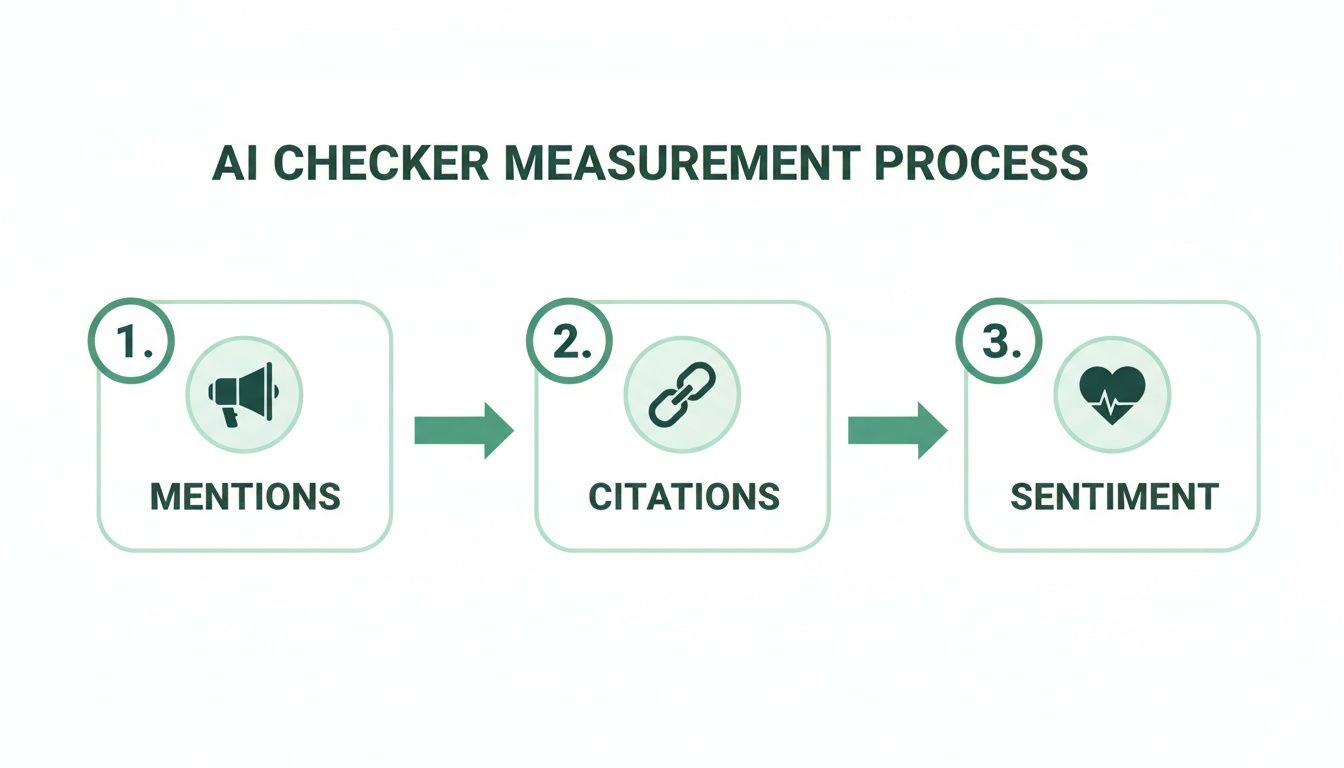
This visual breaks down how an audit moves from simple awareness (mentions) to establishing authority (citations) and finally to gauging reputation (sentiment). Learning to read this flow is a critical skill. To get a feel for structuring these findings, it helps to review a quality SEO audit report sample and adapt its principles to this new context. This first audit provides the foundational data you need to build a winning strategy.
Interpreting Your AI Visibility Report
Getting your first AI visibility report is an eye opening moment. The raw data is in your hands, but the real magic happens when you translate those numbers into a clear story about your brand. This is where you graduate from just measuring things to building actionable intelligence. Think of the report as less of a scorecard and more of a strategic map. It shows you where you are strong, where you are weak, and exactly where the opportunities are hiding.
Decoding Mention Trends with Your AI Visibility Tool
The mention trend dashboard is your 30,000 foot view. It answers the most basic question: are we becoming more or less visible in AI answers over time? You are looking for patterns here. A sudden spike might correlate with a product launch, while a slow decline could signal a competitor's new content push is gaining traction. According to recent market studies, the AI search engine market is projected to grow from USD 16.28 billion to USD 50.88 billion by 2033, underscoring the urgency of tracking these trends now.
Uncovering Insights from Citation Source Analysis
This is where you find out who the AI really trusts. The citation analysis pinpoints the exact third party articles, studies, and websites that AI models are referencing to answer questions about your industry. For you, this is a roadmap to building genuine authority. Look at the domains that pop up most often. Are they big industry publications, niche blogs, or user driven platforms like Reddit? Comparing these findings with insights from tools like Surfer SEO's timeline data can also add another layer of clarity.
Acting on Competitive Gaps in Your AI Visibility Audit
The competitive gap analysis is the most actionable part of the entire report. It flags the specific queries where your rivals get mentioned or cited, but your brand is nowhere to be seen. Every single one of these gaps is a clear cut opportunity to steal answer share. Systematically closing these gaps allows you to shift the AI’s perception of authority from your competitors to you, one query at a time. This methodical approach is key to improving your long term generative SEO performance.
Building Your Action Plan to Win in AI Search
Insight without action is just trivia. Once you have run an ai search visibility checker and digested the results, the real work begins: building a focused plan to steal mention and citation share from your competitors. This is not about guesswork. It’s about methodically closing the gaps your audit uncovered. Your report showed you exactly where competitors are getting cited. Now, you can build a roadmap to systematically target those same queries, create better content, and upgrade existing pages to become the resource AI engines cannot ignore.
Prioritizing Your Strategy with Citation Gap Analysis
Your citation gap analysis is ground zero. It’s a literal cheat sheet showing you which topics AI engines already trust your competitors for. Forget brainstorming your next blog post. You now have a data backed hit list. If a competitor’s article on "B2B lead generation tactics" keeps getting cited, your mission is clear: create a more thorough, factual, and better structured guide on that exact topic. This is the most direct path to claiming their answer share and boosting your generative SEO.
Upgrading Your Content for AI Readiness
Creating new content is only half the battle; you also need to tune up your existing assets. LLMs favor content that is factual, declarative, and easy to parse. Long, fluffy paragraphs are liabilities. Clear, structured information gets the citation. Go through your key pages and rewrite them to be more direct. A product page filled with vague marketing copy should be replaced with crisp, factual bullet points detailing features and specs. Optimizing your content for AI search is how you make your existing pages more "citable."
Choosing Your Action Plan with an AI Visibility Checker
Deciding where to start can feel overwhelming. The table below breaks it down into a simple framework for prioritizing actions based on the insights from your ai search visibility checker.
| Priority | Action | Primary Goal | Example Task |
|---|---|---|---|
| High | Close Citation Gaps | Become the new primary source for high value topics. | Create a definitive guide to replace a competitor's cited article. |
| Medium | Optimize Existing Content | Make your key pages more citable and AI friendly. | Rewrite a product page using factual bullet points and an FAQ schema. |
| Ongoing | Digital PR on Authoritative Sites | Build brand presence on domains AI engines already trust. | Secure a guest post on a top industry publication identified in your report. |
This structured approach helps you put your resources where they’ll have the biggest impact. Every action is tied directly to improving your mention and citation share.
Summary and Key Questions
Ultimately, an AI search visibility checker measures your influence in the new era of conversational search. It swaps outdated ranking reports for dynamic metrics like mention frequency, citation share, and contextual sentiment. By tracking these KPIs, you gain a clear, data driven view of how AI perceives your brand, enabling you to build a strategy that ensures you are not just found, but featured. According to Forrester, by 2026, over 50% of commercial B2B queries will be initiated through conversational AI, making mastery of this space essential for survival.
Frequently Asked Questions
How does LLM tracking differ from brand monitoring?
LLM tracking is laser focused on your visibility inside the answers from Large Language Models like ChatGPT or Gemini. Brand monitoring is much broader and usually includes social media chatter and news mentions. LLM tracking zeroes in on the specific answers that are replacing traditional search results.
What is the best way to check AI search visibility for my brand?
The only scalable way is to use a dedicated AI search visibility checker. These platforms automate the entire process by querying dozens of AI engines, tracking changes over time, and benchmarking your performance against competitors. Trying to do this manually is a recipe for incomplete and inaccurate data.
Why is citation share important for my generative SEO strategy?
Citation share is a direct measure of your content's authority in the eyes of an AI. When an AI engine cites your article, it is explicitly endorsing your information as a factual source. This builds credibility and dramatically increases the odds of you being mentioned again for similar questions.
How often should I check my AI search visibility?
Begin with a deep dive audit to set your benchmark, but after that, continuous monitoring is crucial. We recommend setting up automated checks to run weekly or bi weekly. This cadence helps you track trends, spot competitor movements, and measure the real impact of your optimization efforts without getting lost in daily noise.