Your Guide to an AI Search Visibility Monitor
Updated February 8, 2026
An AI search visibility monitor is your brand’s navigation system for the new era of generative search. In simple terms, it tracks how often and in what context your brand appears in answers from AI engines like ChatGPT, Gemini, and Google’s AI Overviews. As we head into 2025 and 2026, where users increasingly ask questions instead of typing keywords, this tool isn't just helpful; it's essential for survival.
Think of it as the scorecard for a new discipline: generative SEO. While traditional SEO focused on getting you onto a list of search results, an AI search visibility monitor tells you if you are the definitive answer.
What is an AI Search Visibility Monitor?
Imagine your brand is a product on a store shelf. For years, you mastered getting prime placement on the main aisles, which was Google's classic list of blue links. That was traditional SEO. Now, your customers are using personal shoppers, AI assistants, that bypass the aisles and deliver a single, summarized recommendation. An AI search visibility monitor tells you if your product is the one being chosen by these new AI gatekeepers.
This isn't a future concept; it's a critical tool for today. According to Gartner, by 2026, search engine volume will drop by 25% as consumers lean more on AI chatbots. Traditional SEO metrics are like counting foot traffic in an aisle. AI visibility tells you if you are making it into the shopper's cart.
Why Monitoring Generative SEO with a Tool Matters Now
Getting this right is about more than just visibility. It’s about capturing high intent users, protecting your brand's reputation, and outmaneuvering your competition. The goal is no longer just to rank, but to be cited as an authoritative source inside the AI's answer. This requires a fundamental shift in both strategy and measurement. To understand how AI is reshaping search, platforms like Sitecore Discover show how intelligence is being woven into the user experience.
Good monitoring helps you answer the questions that matter to the business:
Are we being recommended for our core products?
Which competitors are dominating AI driven conversations in our niche?
What specific content do AI engines trust the most?
Is the information shared about our brand accurate and positive?
Key Differences from Traditional SEO Tracking
The biggest change is what you are actually measuring. Traditional SEO is a game of lists and rankings. Generative SEO is about owning the singular, definitive answer. Tracking your visibility inside these Large Language Models (LLMs), or LLM tracking, gives you the data you need to adapt. It’s how you ensure your brand stays influential as user behavior shifts from searching to asking.
Key Metrics for Measuring AI Search Visibility
To win in this new world of AI search, you need a different scoreboard. Old school KPIs like keyword rankings do not cut it anymore. Visibility is no longer about climbing a list of ten blue links; it’s about becoming the single, authoritative answer. This is where a specialized tool for AI search visibility comes in. It flips the script, focusing on metrics that measure your brand's influence and authority inside these generated responses.
The hierarchy is simple: the AI Assistant shapes how we approach Generative SEO, and the AI Monitor is how we measure if it's working.
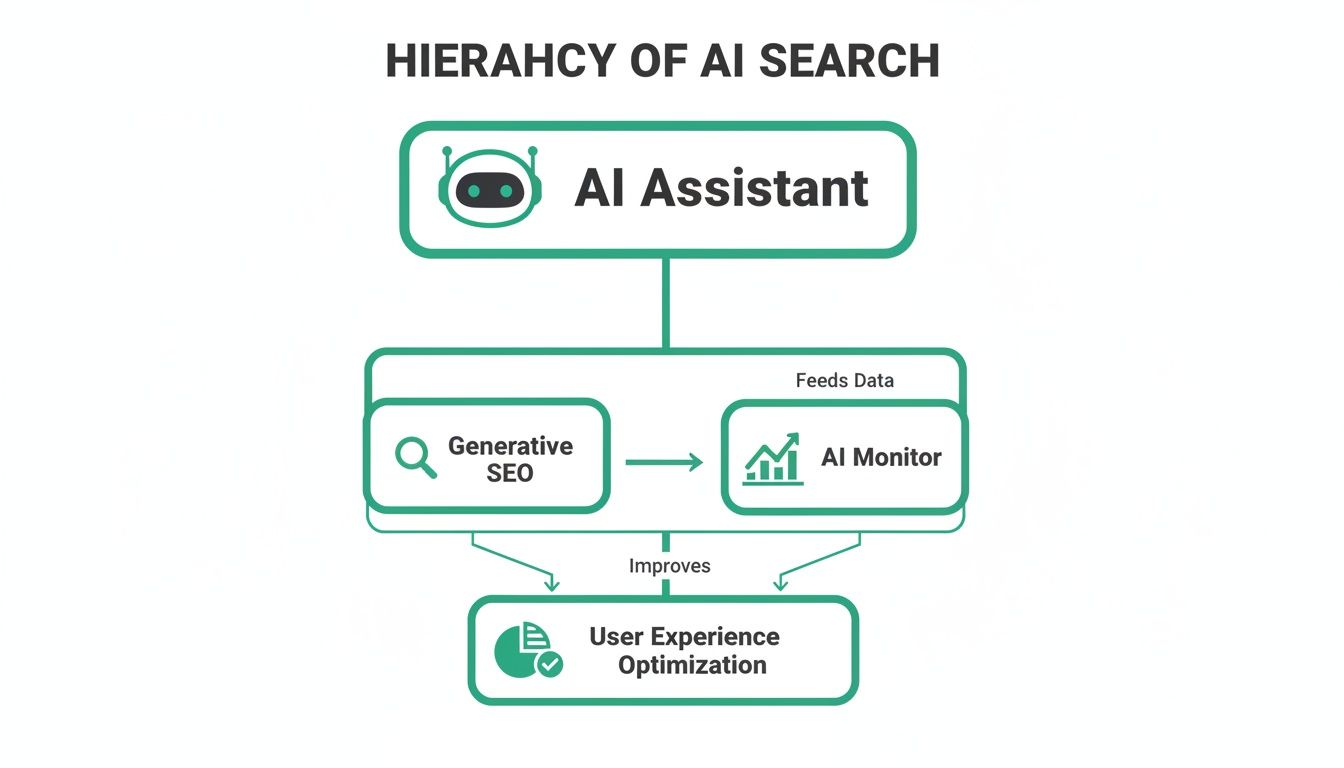
As you can see, monitoring is not a side task. It’s the foundation of a smart generative SEO strategy. These new metrics give you a clear, honest picture of how your brand is performing, helping you prove the ROI of your answer engine optimization work.
How AI Visibility Metrics Compare to Traditional SEO
The game has changed, and so have the rules. This table breaks down the shift from old world metrics to the ones that matter for AI search.
| Focus Area | Traditional SEO Metric | AI Search Visibility Metric |
|---|---|---|
| Competitive Landscape | Share of Voice (Impressions) | Share of Answer (% of Citations) |
| Content Reach | Organic Traffic | Citation Volume (Raw Count) |
| Content Performance | Top Ranking URLs | Source Dominance (Top Cited URLs) |
| Brand Perception | Brand Mentions | Response Sentiment (Positive/Negative) |
This is not just a change in terminology; it's a fundamental shift in what success looks like. We are moving from counting clicks to measuring influence.
Measuring Influence With Share of Answer
The single most important metric for any AI search visibility monitor to watch is Share of Answer. It measures how often your brand gets cited compared to competitors for the topics you care about most. Think of it as the new share of voice for the age of AI. It answers the fundamental question: "For the queries that truly matter, who does the AI trust?" This metric is powerful because it goes beyond simple mentions to track contextual dominance. A high Share of Answer means AI models see your content as the go to source for a specific concept. If you want to dive deeper, check out our guide on how to calculate share of voice.
Tracking Citation Volume and Source Dominance in AI Search
Next up is Citation Volume, which is the raw count of how many times your domain is referenced as a source across different AI platforms. While Share of Answer gives you the competitive angle, Citation Volume provides a baseline measure of your total AI footprint. It’s a direct signal of your content's reach inside AI ecosystems. A close cousin is Source Dominance, which helps you figure out which specific pieces of content are your heavy hitters. This metric pinpoints the exact URLs that AI engines are citing most often, letting you double down on what’s already working.
How to Effectively Monitor Your AI Search Visibility
Setting up a solid monitoring process for AI search visibility is about having a clear strategy. You have to start by knowing what ground you want to own. The first step is to lock down the core topics and business questions that define your brand and what your customers need. Forget long keyword lists for a moment and think in concepts.
Once you’ve defined your conceptual territory, the next step is pinpointing who you’re really up against in that space. Spoiler: it’s probably not your usual search rivals. In the world of AI, your competitors are any sources the models trust more than you on a given topic. That could be industry publications, forums, or individual experts.
Establishing Your AI Search Monitoring Workflow
With your topics and competitors defined, you can get into the nuts and bolts of monitoring. Trying to do this manually by querying engines one by one is not scalable and gives you wildly inconsistent results because of how variable AI responses can be. Using a platform like Riff Analytics automates the heavy lifting by querying multiple AI engines like ChatGPT, Perplexity, and Google AI Overviews at scale to deliver reliable, aggregated data. This automated workflow is the only way to spot real patterns over time.
The Riff Analytics dashboard below shows how this data comes to life, tracking mention trends and your competitive share of voice.
This kind of view lets you see at a glance where you stand and how your visibility is shifting from one month to the next.
Analyzing Results and Identifying Citation Gaps
The real payoff from an AI search visibility monitor comes from the analysis. Your most urgent task is to find “citation gaps”, those moments where competitors are getting mentioned for your core topics, but your brand is nowhere to be seen. These gaps are your biggest and most immediate opportunities for content and optimization. A huge part of this process is digging into the source URLs the AI cites. This tells you exactly which content formats and structures are getting rewarded.
According to Benjamin Houy, an entrepreneur who built and later shut down a generative engine optimization tool, "The AI models are trained on the same content that builds your brand everywhere else. They cite the same authoritative sources. They reference the same trusted publications."
That insight hammers it home: the path to AI visibility is paved with high quality, authoritative content that models can easily understand and trust.
Analyzing Competitor Performance in AI Search
Understanding what your competitors are doing in AI search is essential. In 2025 and beyond, winning means knowing exactly how your rivals are shaping the conversation inside AI answer engines. An AI search visibility monitor is your key to unlocking that intelligence.
Think of it as your periscope. A good monitoring tool lets you benchmark your performance against key players on high value commercial topics. The main goal here is to measure your ‘Share of Answer’, who’s getting the most trust and citations from Large Language Models (LLMs)? This kind of data moves you from guesswork to strategic action. You can learn more about this by reading our guide on how to do competitive analysis in SEO.
Uncovering Competitor Citation Strategies with an AI Monitor
A huge piece of the puzzle is figuring out why your competitors are winning. It’s not enough to know they’re getting cited; you need to know which specific sources and content strategies are getting them there. An effective monitor will show you the exact URLs the AI engines are referencing.
This helps you answer the important questions:
Are their blog posts or technical docs getting the most love?
Are they leaning on data heavy reports or expert opinion pieces?
Is their content structured in a way that’s easy for an AI to parse?
Digging into these citation patterns is the secret to building a preemptive strategy. If a competitor is crushing it with a particular content format, you can adjust your own plan to compete head on.
Identifying Strategic Gaps and Opportunities in Generative SEO
Finally, a truly deep competitive analysis looks at the sentiment and context of your rivals’ mentions. This is where you find their strategic positioning and potential weaknesses. For instance, if a competitor is mentioned often but the context is always just neutral or factual, you might have an opening to create content with a stronger, more persuasive point of view.
By tracking these elements, your team can go from just knowing who your competitors are to understanding exactly how they influence conversations within AI ecosystems. This insight lets you build a smarter, more targeted generative SEO strategy and claim your rightful share of the answers.
Turning AI Insights Into an Actionable SEO Strategy
Just collecting data from an AI search visibility monitor is not enough. The real magic happens when you turn those raw numbers into a clear, repeatable process that actually gets results. It's all about bridging the gap between monitoring and doing, creating a workflow built for this new world of generative SEO.
The heart of this process is citation gap analysis. It's a simple idea: find the topics where AI engines consistently cite your competitors, but your brand is nowhere to be seen. These gaps are your biggest, most immediate opportunities.
Building an AI Readiness Content Plan with LLM Tracking
Once you've spotted a citation gap, the next move is to build a content plan to close it. Before you start writing, you need a baseline. Learning how to conduct an SEO audit is crucial, but this time with a specific focus on "AI readiness", prioritizing the things Large Language Models (LLMs) love.
Your audit should zoom in on existing pages, checking for key signals of trust and clarity:
Factual Accuracy: Can every claim be verified and is it properly sourced?
Clear Structure: Are you using logical headings (H2s, H3s) and lists?
Schema Markup: Is structured data in place to help crawlers understand your content?
These elements make your content much easier for an AI to parse, interpret, and trust as a citable source. A solid LLM tracking process will tell you which pages need this audit most urgently.
Prioritizing Actions Based on AI Visibility Data
Not all opportunities are created equal, and your AI monitoring data is the map that guides your priorities. Here’s a simple framework for sorting through the insights you’ll find and deciding what to do next.
| Insight Category | Description | Recommended Action | Priority Level |
|---|---|---|---|
| Citation Gaps | Competitors are cited, but you are not. | Create new, comprehensive content targeting the topic. | High |
| Weak Citations | You are cited, but the source is not ideal. | Optimize the cited page for clarity and E-E-A-T. | Medium |
| Negative Mentions | You are mentioned in a negative context. | Address inaccuracies and create positive content. | High |
| Source Dominance | A single URL is performing very well. | Analyze its structure and replicate its success. | Low |
This kind of structured approach turns monitoring from a passive chore into a proactive strategy. Research shows that AI optimized pages can rank well, but they also tend to be volatile after major algorithm updates. That volatility is exactly why continuous visibility monitoring is no longer optional for modern SEO.
Accelerating Your Impact with Riff Analytics
Trying to track your brand’s visibility across AI engines manually is not scalable. Riff Analytics gives you a complete solution, automating the entire process with an AI search visibility monitor that’s built to turn a mountain of confusing data into your new competitive edge.
Our platform keeps an eye on your brand's mentions and citations across seven of the leading AI engines, plus Google’s AI Overviews. We deliver it all in clean, straightforward dashboards that finally take the guesswork out of the equation.
A Simplified Workflow for Your Generative SEO Strategy
Riff Analytics is designed to make your life easier with powerful, built in tools. Our competitor benchmarking shows you exactly where you stand against the competition, while our citation source analysis reveals which content the AI engines actually trust and pull from.
The platform also comes with AI readiness audits that help you optimize the assets you already have for better performance with LLMs. This creates a clear, direct path from spotting a problem to actually implementing the fix. We built Riff Analytics to be incredibly easy to use. Teams can jump on a free trial and start seeing initial results in minutes. That accessibility makes it the essential AI search visibility monitor for any brand serious about winning in generative SEO.
If you are ready to get full control over your brand's presence in AI search, learn more about our ChatGPT visibility tracker and see how it can work for you.
Summary and Key Takeaways
As we move firmly into 2025 and 2026, succeeding in search means more than just ranking. It means becoming a trusted, cited source within AI generated answers. An AI search visibility monitor is the only way to measure and improve your performance in this new landscape. By focusing on metrics like Share of Answer and Citation Volume, you can identify gaps, analyze competitors, and build a content strategy that earns the trust of both humans and AI models. This proactive approach, powered by automated monitoring, is the foundation of a durable and effective generative SEO strategy.
Frequently Asked Questions
What is the difference between an AI search visibility monitor and SEO tools?
Traditional SEO tools track your ranking on a list of search results. An AI search visibility monitor tracks if your brand is cited as a source within the single, summarized answer that AI engines provide. It measures influence, not just position.
What are the key metrics for AI search visibility?
The most important metrics are Share of Answer (your percentage of citations versus competitors), Citation Volume (the total number of times you are cited), Source Dominance (which of your specific URLs are cited most), and Response Sentiment (the context of your mentions).
How can I improve my brand's visibility in AI search?
Start by using an AI search visibility monitor to identify "citation gaps" where competitors are mentioned but you are not. Then, create high quality, factually accurate, and well structured content that addresses those topics. Focus on demonstrating strong E-E-A-T signals to build trust with AI models.
Why can't I just track AI visibility manually?
Manual tracking is not scalable or reliable. AI responses are highly variable, and checking hundreds of prompts across multiple platforms by hand leads to inconsistent data. An automated tool provides the stable, aggregated data needed to spot meaningful trends and make strategic decisions.