The 12 Best AI Search Visibility Tools to Master SEO in 2026
Updated February 5, 2026
What happens when a customer asks ChatGPT, Perplexity, or Google’s AI for advice in your industry? Does your brand appear in the answer, and is it cited as the source? That is now a measurable performance problem, not a theoretical SEO trend. AI search visibility is the discipline of tracking where your brand shows up inside generated answers, which sources those systems rely on, and where competitors are taking the mention or citation you expected to win.
This is why classic rank tracking is no longer enough. Traditional SEO tools were built for blue-link positions, not for answer share, source attribution, or citation loss across multiple LLM interfaces. The market has moved quickly: Position Digital’s 2026 review notes that the category grew 145% from 2024 to 2025, with 92% of surveyed digital marketers in the US, UK, and Germany calling AI visibility tracking essential. In our review, the most useful platforms were the ones that turned raw mentions into diagnosis: which prompt triggered the answer, which competitor was cited, and what source likely influenced the model.
This guide compares the leading ai search visibility tools for teams that need to find visibility gaps in ai search results, benchmark answer share, and monitor SEO performance in ai search over time. Instead of treating every platform as equally good, we focus on fit: which tool is strongest for citation-gap analysis, which one works best inside an existing SEO suite, which options suit agencies, and which products are built for enterprise competitive intelligence.
Decision Aid: Which AI Search Visibility Tool Fits Your Situation?
If you need a fast answer before reading the full list, use this shortlist:
- You want the fastest way to find visibility gaps and missed citations: Start with Riff Analytics. It is strongest when the job is diagnosing why competitors are being cited and which source pages are shaping AI answers.
- You already run most of your SEO workflow in one suite: Choose Semrush or SISTRIX. They make the most sense when you want AI visibility data next to rankings, audits, and broader search reporting.
- You run client accounts and need reporting discipline: Pick SEOmonitor. Its agency workflow, shared keyword strategy, and reporting integrations are better suited to recurring client delivery than standalone niche tools.
- You need broad competitive and market benchmarking for leadership teams: Look at Similarweb, Profound, or Evertune. These are better for executive reporting, category share, and enterprise answer engine optimization performance.
- You need a lower-cost starting point: ZipTie.dev is the budget pick. It will not replace an enterprise platform, but it gives smaller teams a practical way to track ai search visibility without a large commitment.
What stood out most in testing this category is that buyer fit matters more than raw feature count. Some teams need a best search visibility tracker for weekly trend reporting; others need the best ai visibility checking tools for source-level diagnosis on a small set of high-value prompts. A product can be excellent for one job and inefficient for another.
Before you buy, ask four practical questions: how many prompts can you track, how far back does the history go, which engines are covered consistently, and how easy is it to export findings into the reports your team already uses? Those details determine whether a tool helps you improve visibility share in competitive search landscapes or just gives you another dashboard to glance at.
1. Riff Analytics
Riff Analytics is best understood as a visibility-gap and source-diagnosis platform rather than a generic monitoring dashboard. Its strongest use case is showing where your brand is absent, which competitors are being cited instead, and which underlying sources appear to influence that outcome. For teams trying to improve answer engine optimization performance, that distinction matters: a raw mention count tells you that you lost visibility, but source-level diagnosis gives you something to fix.

Why Riff Analytics Offers an Edge in AI Visibility Tracking
In our review, this stood out most for citation-gap detection. Riff does more than log whether your brand appeared in ChatGPT, Gemini, Perplexity, Claude, Grok, or Google AI Overviews. It helps teams trace the answer back to likely source pages, compare those source patterns against competitors, and spot prompts where another brand consistently owns the citation. That makes it especially useful for content, SEO, and brand teams that need to prioritize remediation instead of collecting broad but vague visibility stats. You can find a more in-depth discussion on their blog about what constitutes a top-tier AI search visibility tool.
Riff is also well suited to ongoing trend tracking. If your objective is to track ai search visibility over time, the important question is not only whether your answer share changes, but whether the change came from stronger owned content, better third-party citations, or a competitor gaining ground on a prompt cluster. Riff’s combination of response context analysis, readiness auditing, and trend dashboards is more actionable than many tools that stop at brand mention detection. In our assessment, that makes it a strong fit for mid-market B2B teams that need practical diagnosis without an enterprise implementation cycle.
Before buying, teams should verify four things carefully. First, prompt coverage: does the tracked prompt set reflect the commercial questions that matter in your category, or is it too shallow to reveal true visibility gaps in ai search results? Second, historical depth: some tools are good at snapshots but weaker for longitudinal reporting. Third, export and reporting limits: if your leadership or clients need recurring reports, CSV/API access and dashboard flexibility matter more than a polished homepage. Fourth, recommendation quality: a platform should not just say “competitor X is cited more often”; it should help explain whether the issue is source authority, content format, missing topic coverage, or weak citation pathways.
Compared with other major products, Riff’s advantage is diagnosis and usability rather than suite breadth. Semrush is stronger if you want AI data tightly connected to your wider SEO stack. Ahrefs Brand Radar is excellent for fast visibility checking and share-of-voice snapshots, especially when custom prompts matter. Similarweb is stronger for enterprise benchmarking and market-level reporting. Riff is the better fit when the immediate job is identifying citation gaps, understanding why they exist, and giving a leaner team a realistic path to fix them. For a direct starting point, you can explore riffanalytics.ai.
- Key Features: Citation source tracking, competitor citation gap analysis, AI readiness audits, response context analysis, and trend dashboards.
- Ideal Use Case: B2B growth and marketing teams needing to measure and improve their brand's authority and visibility within generative AI responses to drive qualified traffic and leads.
- Pricing: A 7-day free trial is available. For specific plan pricing, you must view the plans after signing up or contact their team.
- Pros: Broad AI engine coverage, highly actionable citation gap insights, and a user-friendly interface designed for rapid deployment.
- Cons: Pricing is not publicly listed on the marketing site, and its effectiveness in very niche industries may depend on how frequently AI engines cite external sources for those topics.
2. Semrush
Semrush stands out by integrating AI search visibility features directly into its well-established SEO platform. For marketing teams already using its suite for keyword research, site audits, and competitor analysis, this integration makes it easier to begin optimizing for generative AI without adding another standalone tool to their stack.
The platform allows users to track their visibility within Google's AI Overviews (formerly SGE) right alongside traditional organic rankings. This unified view helps explain how generative AI impacts classic SEO efforts. Semrush’s "Sensor" feature is particularly useful, as it tracks the volatility and prevalence of AI Overviews across different industries, helping you gauge how aggressively you need to adapt your strategy.
Leveraging Semrush for AI Search Performance Measurement
- Integrated AI Overviews Tracking: Monitor your domain's appearances in Google's AI-generated answers directly within your position tracking campaigns.
- AI Traffic Channel Analysis: The Traffic Analytics report now segments traffic from AI sources, offering a clearer picture of referral value.
- Enterprise AI Optimization: For larger organizations, Semrush offers extended coverage that includes visibility tracking in Microsoft Copilot and other LLMs, providing a more comprehensive view of your brand’s presence.
While powerful, the most advanced AI features are often part of higher-tier plans (Pro, Guru, and Business). The platform’s breadth can also present a learning curve for newcomers. However, for teams seeking an all-in-one solution that connects traditional SEO with emerging AI visibility metrics, Semrush is a top-tier choice. To better understand how these tools fit into a broader strategy, you can find more information on the evolving state of AI search visibility.
Website: https://www.semrush.com
3. Ahrefs Brand Radar
Ahrefs Brand Radar is a specialized, zero-setup solution for monitoring brand presence across generative AI platforms. Unlike integrated suites, this standalone product is built for speed and focus, offering rapid insights into how your brand is mentioned and cited across major LLMs like ChatGPT, Perplexity, Gemini, and Google's AI Overviews. This makes it an ideal starting point for teams wanting immediate data without a complex setup process.
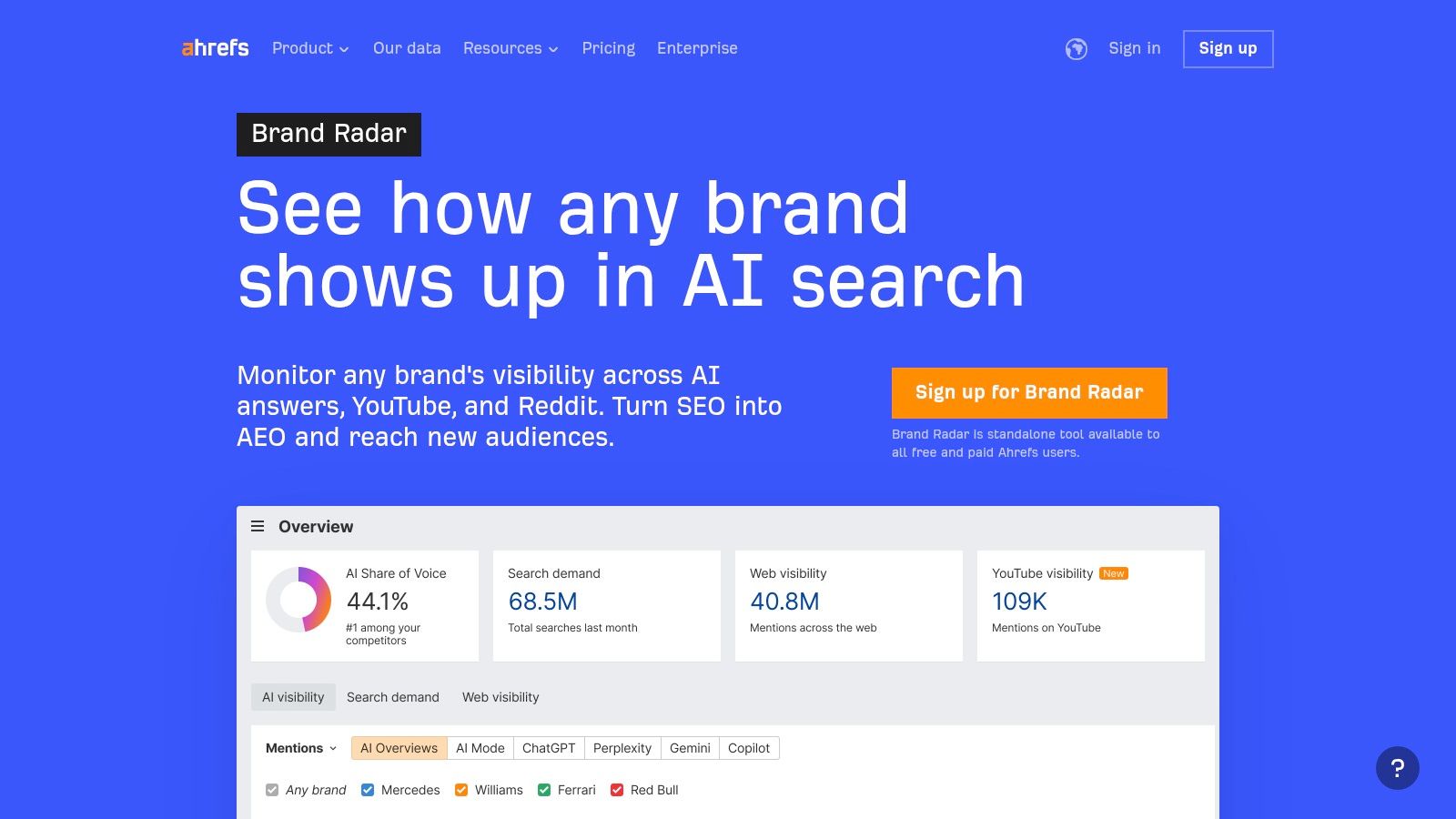
The platform provides clear, actionable metrics such as impressions, citation counts, and "AI Share of Voice," which helps you benchmark your visibility against competitors. A key differentiator is its ability to use custom prompts, allowing you to simulate specific, high-intent buyer questions and see if your brand appears in the answers. While it is a separate product from the core Ahrefs toolkit, its free AI Visibility Checker offers a valuable, no-commitment diagnostic for any domain.
Measuring AI Search Visibility with Ahrefs
- Cross-LLM Coverage: Track your brand’s citations and mentions across a wide array of AI engines, including ChatGPT, Perplexity, Gemini, Copilot, and AI Overviews.
- AI Share of Voice: Quantify your brand’s visibility in generative responses relative to your direct competitors, providing a clear competitive benchmark.
- Custom Prompt Analysis: Go beyond generic queries by testing how your brand surfaces for specific, buyer-focused questions relevant to your business (this feature may incur additional costs).
Brand Radar is one of the most accessible ai search visibility tools for teams that prioritize fast time-to-value and broad engine coverage. Its main limitation is that deeper on-site SEO analytics require a separate subscription to the core Ahrefs platform. However, for brand and content marketers focused purely on measuring and improving their generative AI footprint, it provides an exceptional level of clarity and focus.
Website: https://ahrefs.com/brand-radar
4. Similarweb Gen AI Intelligence
Similarweb positions its Gen AI Intelligence as an enterprise-grade solution focused on competitive and market-level insights. Rather than just tracking your own domain, the platform excels at benchmarking your AI visibility against key competitors and the broader industry. This makes it a powerful tool for strategic planning, allowing teams to understand their share of voice within AI-generated answers and identify opportunities where rivals are gaining traction.
The platform provides a distinct view of AI Brand Visibility, analyzing not just citations but also the sentiment and topics associated with brand mentions in AI responses. It also offers a unique AI Chatbot Traffic module, which estimates the volume of referral traffic coming from various chatbots. This is invaluable for marketing leaders needing to quantify the ROI of their generative SEO efforts and justify further investment in optimizing for these new channels.
Analyzing Competitor AI Visibility with Similarweb
- AI Brand Visibility Module: Track brand mentions across AI answers, analyzing prompts, citation sources, associated topics, and overall sentiment.
- AI Chatbot Traffic Estimates: Gain insight into page-level referral data, estimating how much traffic is being driven from interactions with AI chatbots.
- Competitor and Category Benchmarking: Compare your AI visibility and chatbot traffic against a set of competitors or an entire industry category with daily data refreshes.
- Campaign and Workflow Management: Set up regional and language-specific campaigns to monitor visibility in different markets.
Because Similarweb is geared toward enterprise clients, its pricing is not publicly available and requires a demo. The feature set might exceed the needs of a small business or solopreneur. However, for large organizations that need to integrate AI visibility into their competitive intelligence workflows, Similarweb offers a unique, detailed perspective. Understanding the traffic implications of these platforms is important, as detailed in guides on AI Overviews tracking.
Website: https://www.similarweb.com/corp/search/gen-ai-intelligence/ai-brand-visibility/
5. SISTRIX
SISTRIX is a well-regarded SEO platform, particularly known for its strong data quality in European markets, that has adeptly expanded its suite to include comprehensive AI search visibility tools. It stands out by integrating AI monitoring directly into its established SEO toolbox, allowing users to track performance in AI Overviews and other chatbots alongside traditional SERP data. This approach is ideal for professionals who need reliable, integrated data without leaving their primary SEO environment.
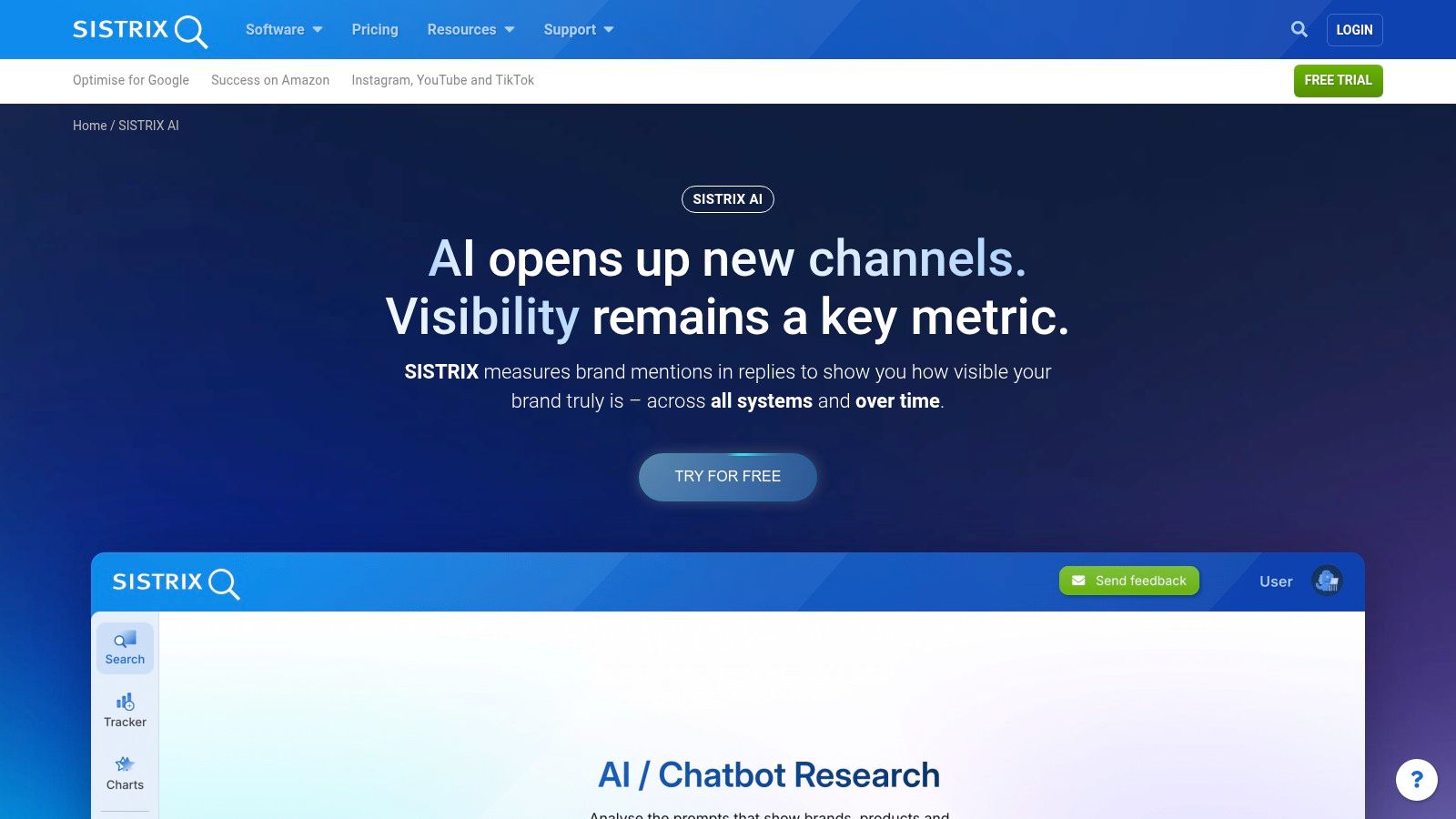
The platform empowers users to identify when their domains are cited in Google's AI Overviews and provides filters to analyze this data across different countries. SISTRIX extends its tracking beyond Google, offering mention and citation monitoring in models like ChatGPT, Perplexity, and DeepSeek. This multi-engine coverage helps brands aiming to understand their complete AI footprint.
Core Functions of This AI Search Visibility Platform
- Multi-Engine Mention Tracking: Monitor brand mentions, citations, and sentiment across Google AI, ChatGPT, Perplexity, and DeepSeek for a comprehensive view of your AI presence.
- AI Overviews Integration: Use dedicated filters and SERP archive analysis to see exactly when and where your content appears in AI Overviews, complete with historical data.
- Generous AI Reply Quotas: Paid plans include a set number of monthly AI prompts and replies, encouraging active use and exploration of the AI monitoring features.
- Strong International Data: Leverage country-level coverage to analyze how your AI visibility differs across global markets, a key benefit for international SEO campaigns.
While its depth of non-Google LLM tracking is still growing and some of its resources have a Europe-centric feel, SISTRIX’s transparent packaging and trial availability make it an accessible yet powerful option. It is an excellent choice for SEOs who value high-quality data and want to merge generative SEO metrics into their core workflows.
Website: SISTRIX AI
6. SEOmonitor
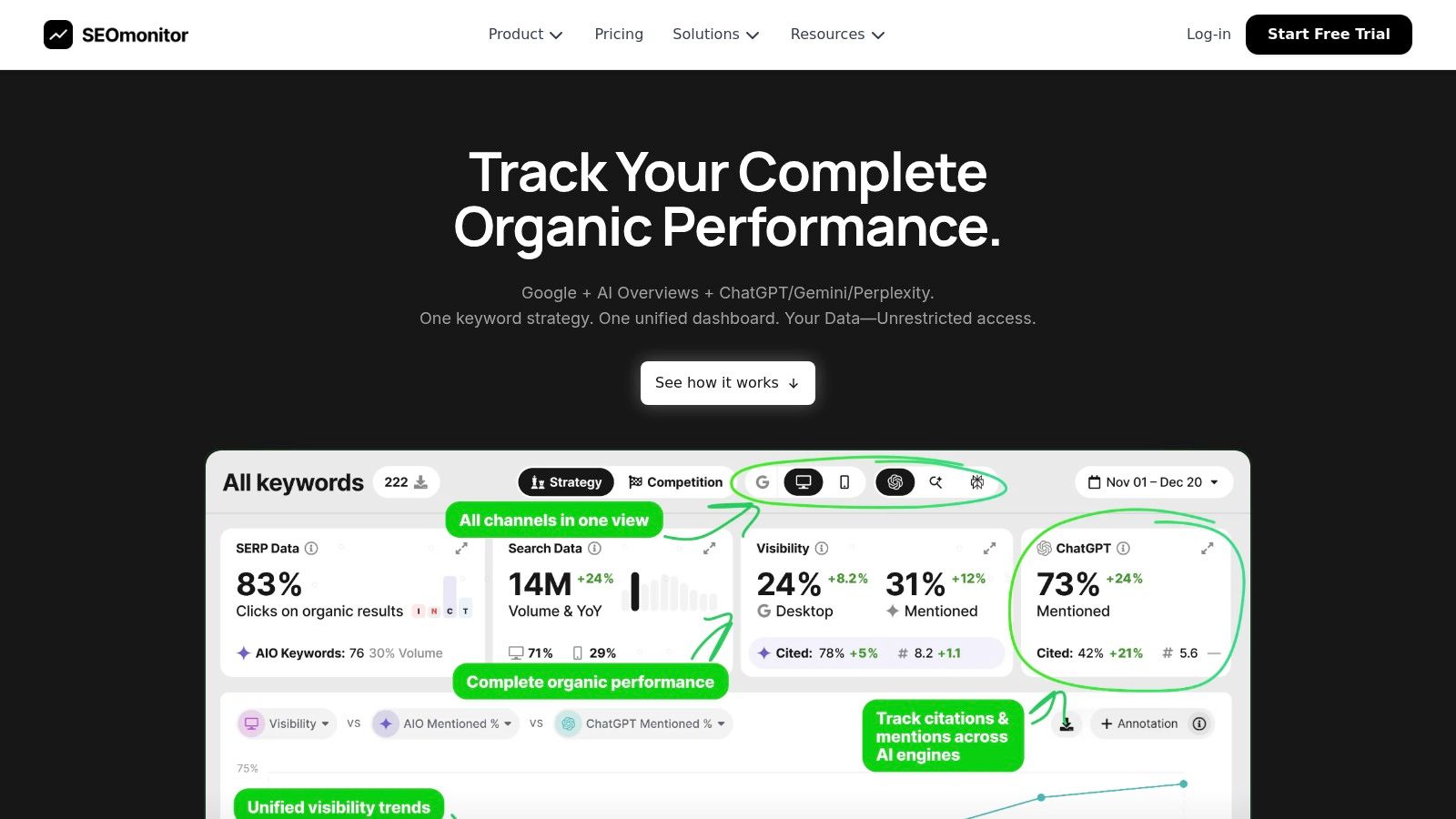
SEOmonitor excels by offering a unified platform designed specifically for SEO agencies to track both traditional rankings and AI search visibility in one cohesive workflow. It streamlines the process of measuring performance in Google's AI Overviews and major AI chatbots by connecting them to a single keyword strategy. This agency-centric approach simplifies client reporting and internal analysis, ensuring that AI-driven metrics are an integral part of the overall SEO picture, not a separate, disjointed dataset.
The platform provides daily AI Overview detection, capturing the full text and identifying both direct brand mentions and competitor citations within the generated content. This level of detail is critical for agencies needing to prove the value of their content strategy in the new generative environment. Its focus on structured, scheduled snapshots allows for consistent trend analysis over time, which is perfect for client reporting cycles.
A Unified AI Visibility Tool for Agencies
- Unified AI and SEO Tracking: Monitor your performance in AI Overviews and chatbots like ChatGPT, Gemini, and Perplexity using the same keyword set as your traditional rank tracking.
- Agency-Focused Reporting: Built with agency workflows in mind, it offers unlimited users, API access, and seamless Looker Studio integration for custom dashboards.
- Comprehensive Citation Analysis: Track not just your own domain’s mentions but also how often competitors are cited in AI Overviews, providing valuable competitive intelligence.
While its chatbot coverage updates weekly by design, which may not suit those needing real-time data, SEOmonitor’s transparent methodology and solid documentation make it a reliable choice. For agencies looking for one of the best agency-focused ai search visibility tools that elegantly combines classic SEO with generative AI analytics, SEOmonitor is a powerful and coherent solution.
Website: https://www.seomonitor.com
7. SE Ranking AI Search Add-on
For digital marketers already integrated into the SE Ranking ecosystem, the AI Search Add-on provides a logical and powerful extension for monitoring generative AI performance. Instead of adopting a new standalone platform, existing users can enhance their current workflows with dedicated AI tracking capabilities, making it a highly efficient choice for teams looking to expand their SEO efforts into this new frontier.
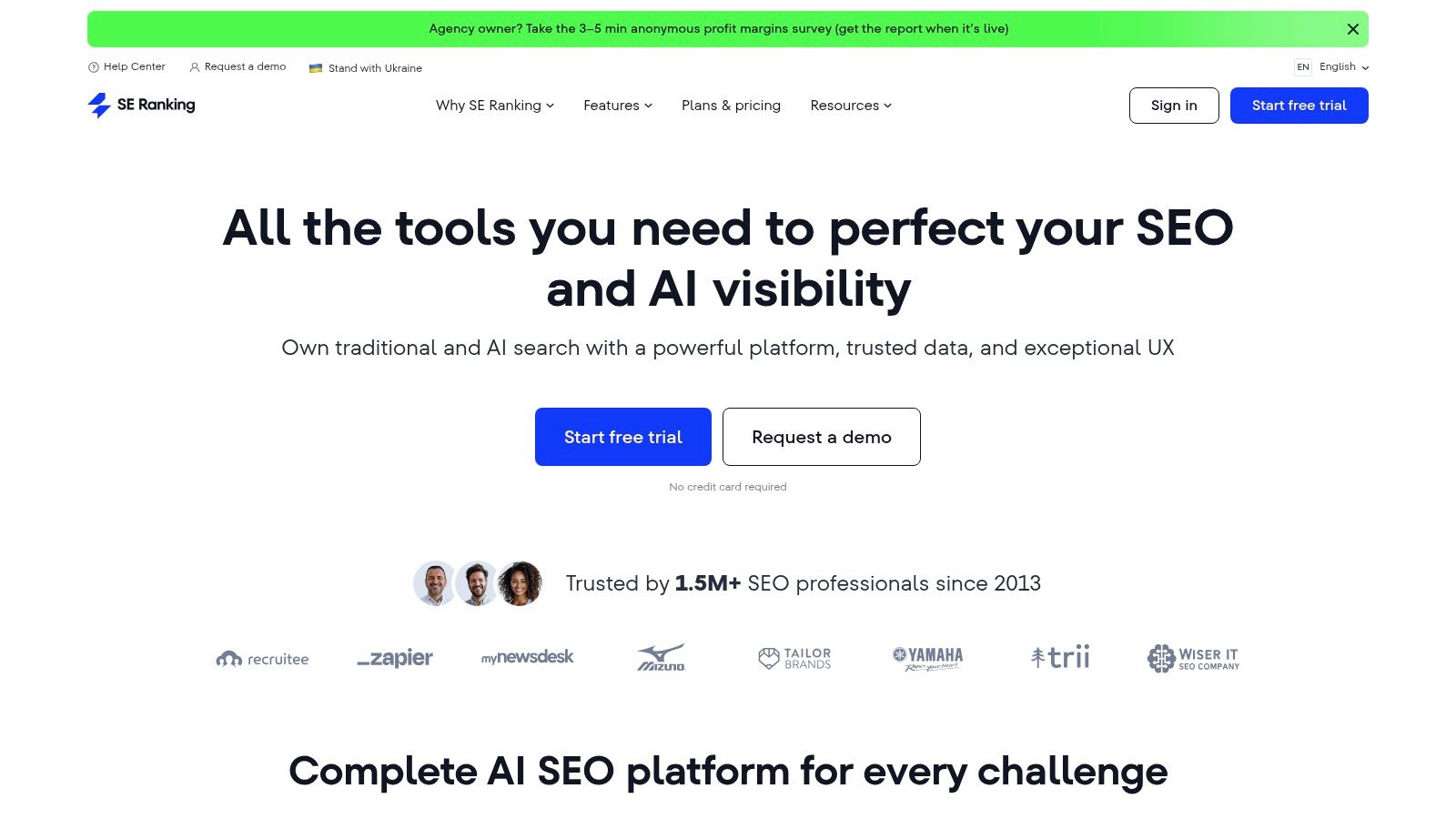
The add-on introduces an AI Results Tracker that seamlessly monitors your domain's presence in Google’s AI Overviews and other chatbots. Its competitive research function is particularly strong, allowing you to see how rivals are performing across various AI platforms. This focus on extending a familiar toolset makes it one of the more accessible ai search visibility tools for current subscribers.
Extending LLM Tracking within Your SEO Workflow
- Integrated AI Results Tracking: Monitor your inclusion in AI Overviews and major chatbots directly within the SE Ranking interface you already use.
- Competitive AI Research: Analyze competitor visibility across multiple AI platforms to identify opportunities and threats in the generative search ecosystem.
- Scalable "Checks" Model: The flexible pricing model allows you to purchase "checks" (one keyword, one search engine, one location) for scalable tracking across many prompts and platforms.
- Early Access to SE Visible: Subscribers get a first look at SE Ranking’s upcoming strategic AI visibility product, offering a roadmap for broader AI platform coverage.
While the add-on is an extra cost on top of a core subscription, its clear, per-check pricing model offers scalability. Budgeting for "checks" requires some planning to avoid overages, but for SE Ranking customers, this is an excellent, integrated path to mastering AI search optimization without a steep learning curve.
Website: https://seranking.com
8. Authoritas
Authoritas is an enterprise-grade SEO and AI search platform designed for technical teams that require deep, programmatic access to SERP data. It distinguishes itself by providing highly granular data on AI Overviews, including expanded and initial views, citation tracking, and carousel analysis, making it a powerful tool for organizations building custom analytics solutions.

The platform’s strength lies in its API-first approach. The SERPs API captures detailed AI Overview data, allowing developers and data scientists to pipe this information directly into internal systems like Google BigQuery or Looker Studio. This capability is ideal for large-scale analysis, historical SERP comparisons using pixel analysis, and creating bespoke dashboards that merge AI search visibility metrics with other business KPIs.
An Enterprise-Level AI Search Visibility Solution
- Granular AIO Data Extraction: Detects the presence of AI Overviews and extracts their full content, including all citations and carousel links.
- High-Volume SERPs API: Offers programmatic access to SERP data, complete with AI Overview expansion support for building custom tracking and reporting tools.
- BigQuery & Looker Integration: Provides Looker Studio templates and facilitates data exports to BigQuery for advanced, custom analysis of AIO versus traditional SEO performance.
- Historical SERP Analysis: Captures historical SERP and AI Overview screenshots, enabling pixel-by-pixel analysis to track changes over time.
Authoritas is best suited for enterprise or technically proficient teams that need more than a standard dashboard. Its complexity and sales-led access model make it less accessible for smaller businesses or beginners. However, for organizations that require comprehensive data and custom integration capabilities, Authoritas is one of the most advanced ai search visibility tools available.
Website: https://www.authoritas.com
9. Nozzle
Nozzle offers a highly flexible and data-rich rank tracking solution designed for deep analysis of SERP features, including Google's AI Overviews. It distinguishes itself by providing granular segmentation and historic data storage, allowing SEO professionals to conduct detailed comparative analysis of their AI visibility over time. For teams that need more than just a simple "yes/no" on AI Overview inclusion, Nozzle delivers the raw data and visualization tools necessary to dissect performance.
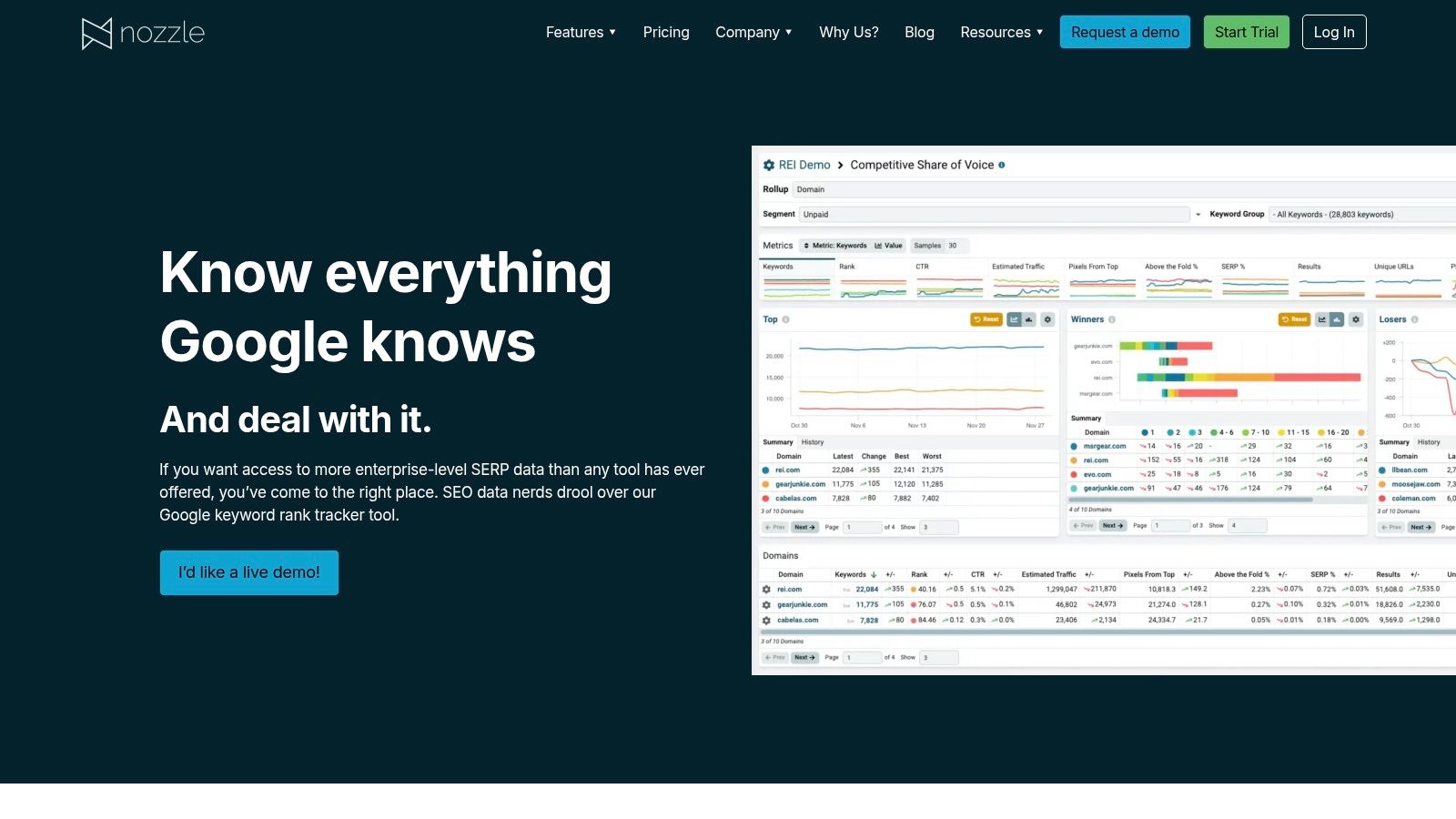
The platform’s strength lies in its configurability. Users can create custom dashboards that segment AI Overview data by keyword groups, brand versus non-brand terms, and even calculate a "Share of Voice" metric specifically for AI-generated answers. This capability is essential for understanding the competitive environment in AI Overviews and identifying which domains are dominating the conversation.
Using This AI Visibility Tool for Deep Analysis
- AI Overview Share of Voice: Calculate your brand’s visibility share within AI Overviews for specific keyword sets, providing a clear competitive benchmark.
- Historic SERP Storage: Nozzle captures and stores complete SERP HTML, allowing you to visually compare changes to AI Overviews and other features over time.
- Granular Data Segmentation: Filter and analyze AI Overview appearances across dashboards by brand, domain, keyword tags, and other custom dimensions.
- SERP Visuals and Content Extraction: View exact screenshots of the SERP and see the specific text and tables extracted from the AI Overviews your site is featured in.
While Nozzle is a powerhouse for Google AIO analysis, its focus is narrower than all-in-one platforms, with less coverage of other LLMs. Its pricing is also less transparent, often requiring contact for a custom quote. However, for SEOs who need deep, customizable data and historical context on Google’s AI features, Nozzle is an invaluable specialized tool among the growing list of ai search visibility tools.
Website: https://nozzle.io
10. ZipTie.dev
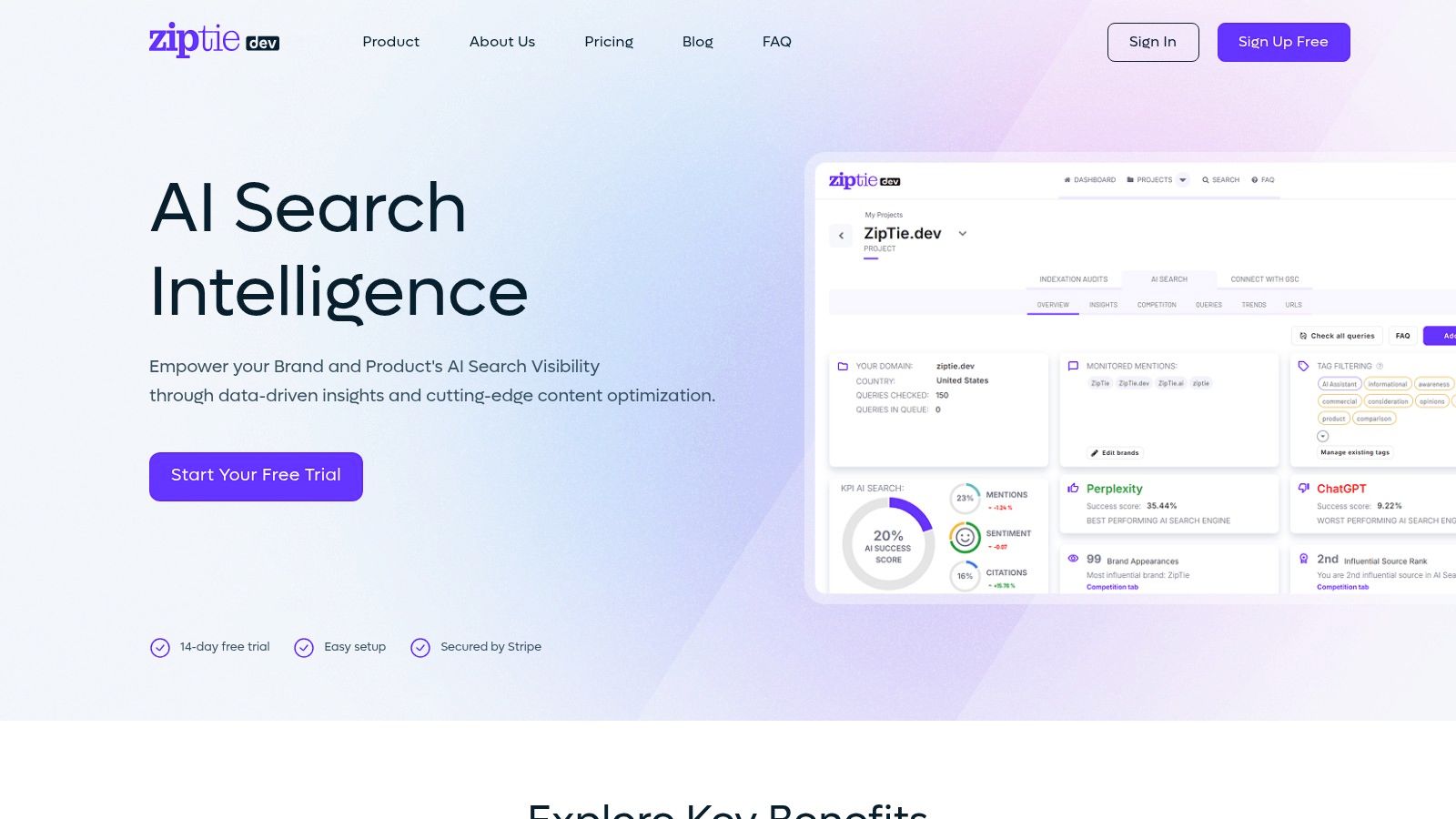
ZipTie.dev carves out a niche as a budget-friendly option among AI search visibility tools. It is specifically designed for small teams, freelancers, and agencies that need to monitor their presence in generative AI without committing to a complex, high-cost enterprise platform. Its primary value lies in a focused approach, offering core tracking capabilities across key AI engines like Google AI Overviews, ChatGPT, and Perplexity.
This lightweight tool prioritizes ease of use and rapid deployment. Users can quickly set up projects to track keyword visibility, identify where their content is being cited, and gain insights from AI-generated summaries. By concentrating on essential monitoring functions and offering multi-country support, ZipTie.dev provides an accessible entry point for organizations beginning to measure and adapt their generative SEO strategies.
A Focused AI Search Tool for Smaller Teams
- Multi-Engine AI Tracking: Monitor your brand's inclusion and citations within Google AI Overviews, ChatGPT, and Perplexity from a single dashboard.
- Content Optimization Tips: The platform offers prompt suggestions and actionable tips to help you refine content for better visibility in AI answers.
- Affordable Tiered Plans: ZipTie.dev structures its pricing around a set number of AI checks, making it predictable and scalable for small to medium-sized businesses and agencies.
- Global Monitoring: Track your AI search visibility across different regions and languages to understand your international footprint.
While it lacks the extensive integrations and deep analytical features of larger suites, its straightforward interface and affordability make it an excellent choice for targeted monitoring or as a supplementary tool. For those needing quick competitive snapshots and foundational AI visibility data without a steep learning curve or significant investment, ZipTie.dev is a practical and effective option.
Website: https://ziptie.dev
11. Profound
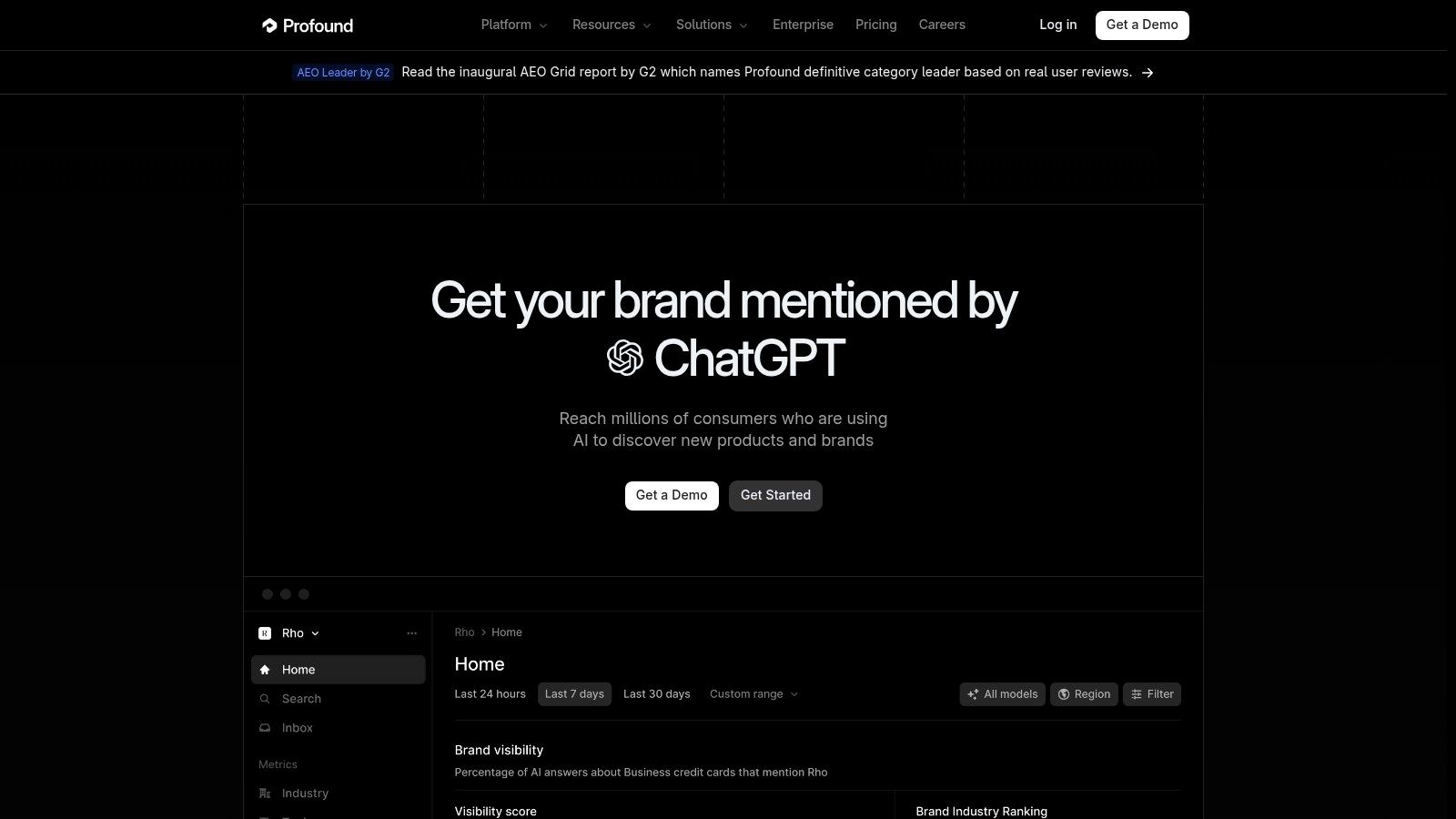
Profound positions itself as an enterprise-grade platform specifically designed for "answer engine optimization." It moves beyond just tracking, offering a full suite for analyzing visibility and creating AI-optimized content for engines like ChatGPT, Perplexity, and Google AI. For large organizations, its focus on benchmarks, security, and deep data analytics makes it a powerful strategic asset.
The platform's standout feature is its enterprise focus, offering services and datasets that go deeper than many other AI search visibility tools. The public "Profound Index" provides valuable category-level benchmarks, while its Agent Analytics offer a rare glimpse into AI crawler behavior and attribution. This makes it ideal for competitive intelligence and understanding the nuances of how AI models source and present information.
Key Features of this Answer Engine Optimization Tool
- Answer Engine Insights: Track mentions, citations, and sentiment across major answer engines to manage brand reputation and visibility.
- Prompt and Conversation Datasets: Access real conversation data and prompt volumes to inform content strategy and understand user intent in generative AI.
- Agent Analytics: Analyze AI crawler behavior to optimize how your content is discovered and attributed by different large language models.
- Shopping Visibility: Monitor product mentions and citations within conversational commerce environments like ChatGPT Shopping.
Due to its enterprise positioning, Profound operates on a demo-led onboarding model with pricing based on organizational needs, which may place it outside the budget of smaller teams. However, for corporations requiring strong security (SOC 2, SSO) and in-depth, actionable data on their AI search visibility, Profound is a leading choice.
Website: https://www.tryprofound.com
12. Evertune
Evertune positions itself as a strategic Generative Engine Optimization (GEO) platform, specifically designed for large brands aiming to master their visibility across a wide array of LLMs. It moves beyond simple tracking to offer a more advisory-focused approach, combining brand monitoring with actionable playbooks to guide enterprise content and partnership strategies. This makes it a strong choice for teams who need not just data, but a clear roadmap for execution.
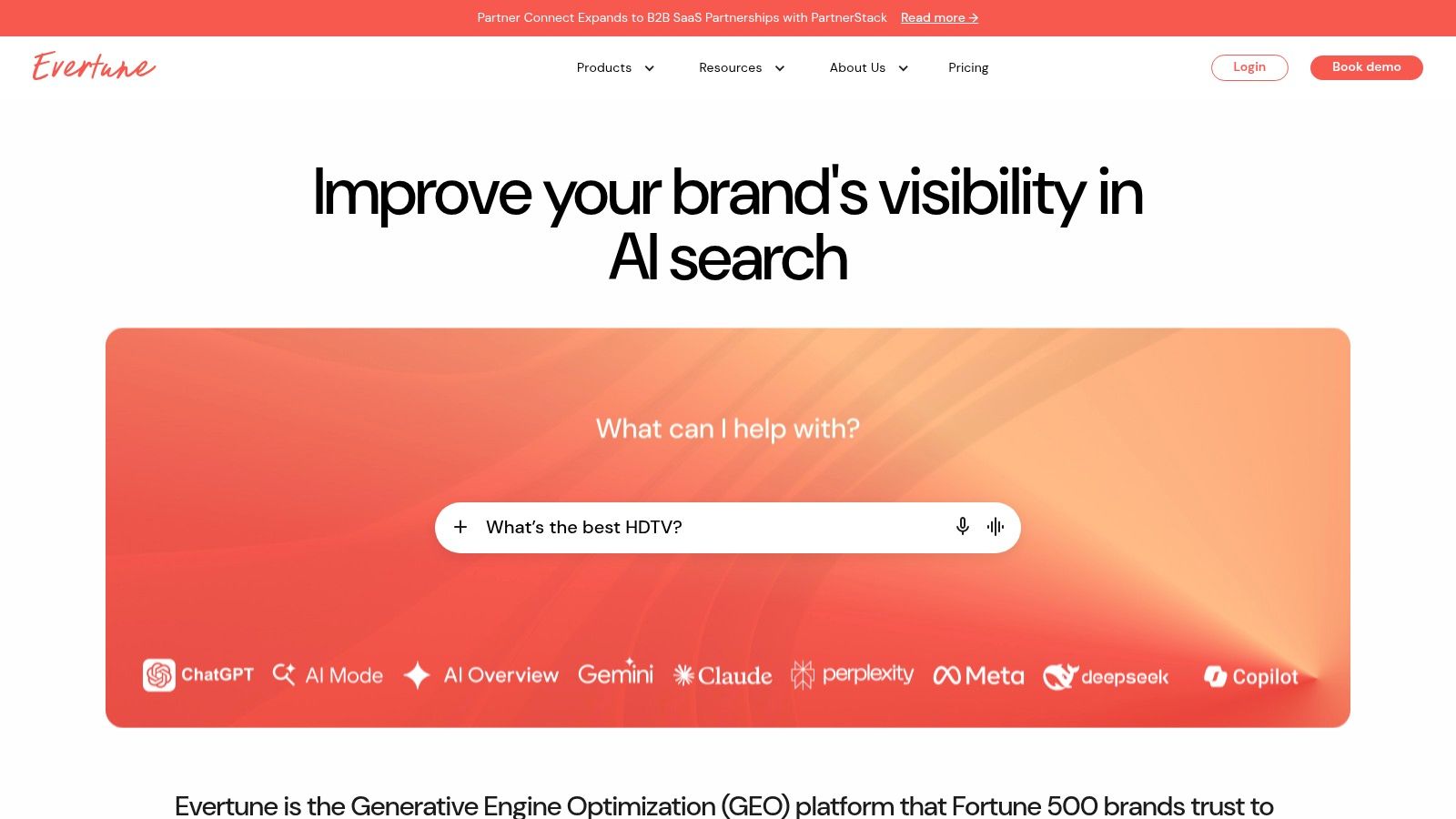
The platform’s core strength lies in its ability to benchmark performance and identify high-impact opportunities. The AI Brand Index and AI Brand Score provide a competitive baseline, showing how your brand stacks up against others in your category within engines like ChatGPT, AI Overviews, Gemini, and Claude. By mapping source influence, Evertune helps prioritize which third-party sites and platforms are most critical for earning positive mentions and citations.
A Strategic Generative Engine Optimization Platform
- LLM Monitoring: Tracks brand mentions, sentiment, and citations across major generative AI platforms to provide a complete view of your AI narrative.
- AI Brand Index & Score: Benchmarks your brand’s performance against competitors, combining mention frequency with the prominence of those mentions.
- Source Influence Mapping: Identifies the key sources and publications that LLMs rely on for information, helping to focus PR and content partnership efforts.
- Actionable Playbooks: Delivers concrete, prioritized recommendations on what to fix and how to improve your content strategy for better AI visibility.
Evertune is geared towards mid-market and enterprise clients, with pricing and onboarding handled through a sales-led demo process. This focus on larger organizations means smaller businesses might find it out of scope. However, for enterprise teams seeking a strategic partner among ai search visibility tools to manage the complex LLM ecosystem, Evertune’s playbook-driven methodology offers a distinct advantage.
Website: https://www.evertune.ai
How AI Search Visibility Tools Identify Gaps and Track Performance Over Time
The best search visibility tools do not merely scrape whether your brand name appeared in an answer. They usually start with a prompt set: a structured list of commercial, informational, branded, and competitor prompts that represent how buyers ask questions inside AI systems. The platform runs those prompts across supported engines, captures the answers, detects mentions and citations, and then attributes the sources that appear to influence the output. That is the foundation for finding visibility gaps in ai search results.
From there, the stronger products add competitive benchmarking. If a rival is cited on prompts where your content should plausibly win, the tool can flag that gap, cluster the prompts by topic, and show whether the competitor advantage comes from their own pages, third-party reviews, documentation, or media mentions. In practical terms, this is how teams move from “we are underrepresented” to “we need stronger source coverage on these five topic areas.” In our view, that source-attribution layer is what separates useful platforms from dashboards that only generate anxiety.
Historical tracking is the next requirement. To monitor seo performance in ai search, you need repeatable measurements: how often your brand is mentioned, how often it is cited, how often a competitor owns the answer, and whether those patterns change after publishing, digital PR, or on-site updates. Some tools refresh daily, others weekly, and enterprise products may support larger recurring datasets. That reporting cadence matters because answer engine outputs change fast, especially around fresh topics.
The broader market is moving in this direction quickly. Frase’s 2026 tool review reported that more than 78% of SEO managers in North America and Europe were already integrating at least one visibility platform into weekly workflows by mid-2026, and organizations using dedicated tools saw a 45% average increase in AI voice share within six months. For context on the underlying models shaping those answers, this overview from Contesimal is a useful companion read.
The most advanced platforms go further by connecting visibility data to workflow decisions. They may group prompts by funnel stage, distinguish mention from citation, compare standalone versus suite-level reporting, and show whether performance is improving because of owned content changes or broader authority signals. That is what makes them relevant for improving visibility share in competitive search landscapes, not just measuring it.
Feature Comparison of Top AI Search Visibility Tools
Here is a breakdown of the key features, target users, and unique strengths of the leading AI search visibility platforms.
| Tool | Key AI Engines Covered | Best For | Unique Strength |
|---|---|---|---|
| Riff Analytics | ChatGPT, Perplexity, Gemini, AIO | SEO & Content Teams | Identifies competitor citation gaps |
| Semrush | Google AI Overviews, Copilot | Existing Semrush Users | Integrates AI data with full SEO suite |
| Ahrefs Brand Radar | ChatGPT, Perplexity, Gemini, AIO | Brand Marketers | AI Share of Voice & custom prompts |
| Similarweb | AIO, Chatbot Traffic | Enterprise/Market Intel | Competitor traffic & sentiment analysis |
| SISTRIX | Google AI, ChatGPT, Perplexity | SEO Teams (EU Focus) | High-quality data & historical SERPs |
| SEOmonitor | AIO, ChatGPT, Gemini | SEO Agencies | Unified SEO & AI agency reporting |
| SE Ranking | AI Overviews, Chatbots | Existing SE Ranking Users | Add-on with scalable "checks" pricing |
| Authoritas | Google AI Overviews | Technical/Data Teams | API-first for custom analytics |
| Nozzle | Google AI Overviews | Deep SEO Analysts | Granular AIO data segmentation |
| ZipTie.dev | AIO, ChatGPT, Perplexity | Small Teams/Freelancers | Affordable and easy to set up |
| Profound | ChatGPT, Perplexity, Google AI | Enterprise Teams | Answer Engine Optimization focus |
| Evertune | ChatGPT, AIO, Gemini, Claude | Large Brands | Strategic playbooks & source mapping |
Two extra comparison points matter when choosing among the top ai search visibility tools: reporting cadence/history and product type. Riff, Ahrefs Brand Radar, and ZipTie.dev are easier to think of as dedicated visibility products. Semrush, SISTRIX, SEOmonitor, and SE Ranking are better viewed as broader SEO suites or add-ons where AI data is one part of the stack. Similarweb, Profound, Authoritas, and Evertune lean more enterprise, where benchmarking depth, exports, security, and workflow integration matter as much as the visibility score itself.
If your main priority is finding visibility gaps, Riff Analytics and Ahrefs Brand Radar are the strongest starting points because they quickly surface where competitors are being cited and where your brand is missing. If your main priority is to track ai search visibility over time inside a broader SEO program, Semrush, SISTRIX, and SEOmonitor make more sense because they connect AI outputs to rank tracking, reporting, and adjacent SEO signals.
For agencies, SEOmonitor is the cleanest fit because recurring reporting and shared keyword workflows are built into the product design. For enterprise competitive benchmarking, Similarweb, Profound, and Evertune are stronger because they provide a wider lens on answer share, market movement, sentiment, or source influence. For smaller teams that need the best search visibility tracker without enterprise pricing, ZipTie.dev is the budget pick. In our review, the biggest buying mistake was choosing on feature volume alone instead of deciding whether you need a standalone diagnostic tool or a broader suite with AI reporting built in.
Summary: Choosing Your AI Search Visibility Toolkit
Here is the practical shortlist.
- Best overall: Riff Analytics for teams that want the clearest mix of citation-gap analysis, source-level diagnosis, and usable trend tracking.
- Best for visibility-gap analysis: Ahrefs Brand Radar if you want quick share-of-voice checks and custom prompt testing with minimal setup.
- Best for tracking over time: Semrush for organizations that want AI visibility measured alongside established SEO reporting and workflow data.
- Best for agencies: SEOmonitor because client reporting, unified keyword tracking, and repeatable delivery are built into the platform.
- Best for enterprise market intelligence: Similarweb for category benchmarking, and Profound if answer engine optimization performance is a board-level or cross-functional initiative.
The right choice depends on what you need to improve first. If your problem is “we do not know where we are losing citations,” buy for diagnosis. If your problem is “leadership wants monthly proof that AI visibility is moving,” buy for historical reporting and exports. If your problem is “we need to benchmark our category, not just our domain,” buy for competitive intelligence. That sounds obvious, but it is the clearest way to avoid overbuying.
To improve visibility share in competitive AI search landscapes, focus on a repeatable four-step loop: track citation sources, benchmark answer share against competitors, prioritize prompts where rivals are consistently cited, and re-measure after publishing or promotion changes. The teams that win here are not guessing what LLMs prefer; they are monitoring source patterns, fixing coverage gaps, and measuring whether those fixes change outcomes. That is exactly where the best ai visibility checking tools earn their keep.
Frequently Asked Questions
What are AI search visibility tools?
AI search visibility tools are specialized software platforms designed to measure, track, and analyze a brand's presence within the answers generated by AI search engines like Google's AI Overviews, ChatGPT, Perplexity, and Gemini. Unlike traditional SEO tools that track keyword rankings on a results page, these tools focus on monitoring brand mentions, citations, and overall share of voice inside AI-generated responses.
How do I improve my AI search visibility?
Improving AI search visibility involves a strategy often called Generative Engine Optimization (GEO). Key tactics include creating clear, factual, and well-structured content that directly answers common user questions; earning citations and mentions from authoritative third-party sources that LLMs trust; and ensuring your brand information is consistent and accurate across the web. Using an AI visibility tool helps identify which content is performing well and where competitors have an advantage.
Why is tracking LLM visibility important for SEO?
Tracking LLM visibility is critical because a growing number of users receive answers directly from AI instead of clicking through to websites. If your brand is not mentioned or cited in these AI answers, you lose visibility and potential traffic. A recent study by the future of SEO, AI, and digital growth in 2026 highlights that adapting to AI-driven search is essential for future digital growth. Tracking this visibility helps you adapt your SEO and content strategy to remain relevant.
Can these tools track my competitors in AI search?
Yes, a core function of most leading ai search visibility tools is competitive analysis. They allow you to track how often your competitors are mentioned or cited for your target keywords across various AI platforms. This helps you identify content gaps, understand which sources are driving their visibility, and benchmark your "answer share" against theirs.