A Practical AI SEO Tools Comparison for 2025
Updated January 9, 2026
What exactly are AI SEO tools? In simple terms, they are specialized platforms designed to measure, track, and improve a brand's visibility within AI-driven search engines like ChatGPT, Perplexity, and Google's AI Overviews. As we head into 2025 and 2026, understanding this is critical. Traditional search is evolving into a world of direct, generated answers, and if your brand isn't part of that conversation, it's becoming invisible. The old playbook of just tracking keyword rankings is obsolete; the new goal is to win "answer share" and ensure your brand is cited as an authority by the AI itself.
Why a New Breed of AI SEO Tool is Essential
The search landscape is undergoing its most significant transformation in a decade. Classic blue-link results are steadily being replaced by conversational AI assistants that provide direct answers, fundamentally altering how brands connect with their audiences. This new reality demands a new set of tools. We must move beyond tracking keyword positions to understanding our brand's presence within the answers that large language models (LLMs) generate. This is where modern AI SEO platforms become indispensable.
These platforms are a necessary adaptation for any forward-looking marketing strategy. They help map your brand’s footprint across this new frontier, revealing not just if you rank, but how you appear in the direct answers people receive.
Understanding the AI Search Visibility Shift with Real Data
The market is reacting swiftly to this change. According to research from Grand View Research, the global AI in marketing market size is projected to grow at a compound annual growth rate (CAGR) of 29.7% from 2024 to 2030. This growth reflects a tectonic pivot in digital strategy, with businesses recognizing the urgent need for tools that can navigate this new terrain of generative SEO. Analysts are forecasting a significant drop in traffic from traditional search engines by 2026, with much of that volume shifting to AI assistants. To see how artificial intelligence fundamentally changes search engine optimization, check out this guide on effective AI and SEO Strategies.
Comparing Core Functions of AI-Powered SEO Tools
Choosing the right platform begins with understanding the fundamental differences between traditional tools and their AI-focused counterparts. While they might appear similar, their core objectives are miles apart, which our AI SEO tools comparison will clarify.
| Feature | Traditional SEO Tools | AI SEO Tools |
|---|---|---|
| Primary Metric | Keyword Rankings | Answer Share & Citations |
| Main Focus | Ranking on a SERP | Appearing in AI Answers |
| Data Sources | Search Engine Crawlers | LLM Response Analysis |
| Success Indicator | Top 10 Link Position | Brand Mentions & Context |
This distinction is crucial. Traditional tools help you climb a list of links. AI visibility platforms tell you if your brand is part of the direct answer, a far more powerful position to hold in 2026 and beyond. This guide will walk you through a detailed AI SEO tools comparison to help you select the right platform to secure your brand’s future.
How to Evaluate and Compare AI SEO Platforms
Not every AI SEO tool is built for the same purpose. A platform designed for content generation will likely lack the sharp analytics needed for LLM tracking or understanding how your brand appears in AI search results. To properly compare AI SEO tools, you need a clear evaluation framework. You must get past the marketing hype and choose a tool that delivers tangible results, ensuring your investment pays off by aligning its capabilities with your business goals.
Establishing Core Criteria for Your AI SEO Platform Comparison
When stacking up AI SEO platforms, focus on five key areas. These criteria will help you differentiate between tools that have simply added a few AI features and those built from the ground up for the new era of generative SEO. The single most important function is tracking your AI search visibility. This metric measures your "answer share", or how often your brand is cited in responses from engines like ChatGPT, Gemini, and Google’s AI Overviews. A solid tool must pinpoint the exact sources these models are using.
According to Gartner, “Generative AI is forcing a reset in how brands think about getting found online. Visibility within AI-generated answers is becoming the new benchmark for brand authority.” This brings us to the second point: data sources and accuracy. Is the tool only pulling data from one large language model, or is it monitoring answers across multiple platforms? The best tools aggregate data from a wide range of AI engines to give you a complete picture of your brand's presence. You can learn more about establishing these key metrics by exploring different SEO benchmarking tools.
A Deeper Comparison of AI SEO Tool Capabilities
Beyond just visibility, look at the platform's feature depth. A tool might offer content optimization, but does it connect those recommendations to actual AI citation patterns? The goal is to find a platform that specializes in the tasks that matter most, whether that's competitive analysis inside AI answers or auditing your content to see if it's AI ready. Integration capabilities are also a big deal. The right tool should slide right into your existing workflow, connecting with platforms like Google Search Console, your CMS, or project management software. A platform that works in a silo just creates more work, not less.
Finally, look closely at the pricing model. You want scalable options that can grow with you. A good pricing structure should be based on the value it provides, like the number of competitors you can track or the volume of AI responses you can analyze. By using this structured approach in your AI SEO tools comparison, you can confidently pick a platform that lines up with your strategic goals for 2025 and beyond.
A Detailed AI SEO Tools Comparison
The ground is shifting under our feet. An estimated 66% of consumers now expect AI to completely replace traditional search engines within five years. This is not a future trend; it's happening right now. To stay visible, you need tools built for this new reality. This guide breaks down the three main types of AI SEO tools to help you decide which one actually fits your needs. Here's a simple flow for how to think about evaluating these tools, moving from core tracking capabilities to features and finally, how they fit into your day to day work.
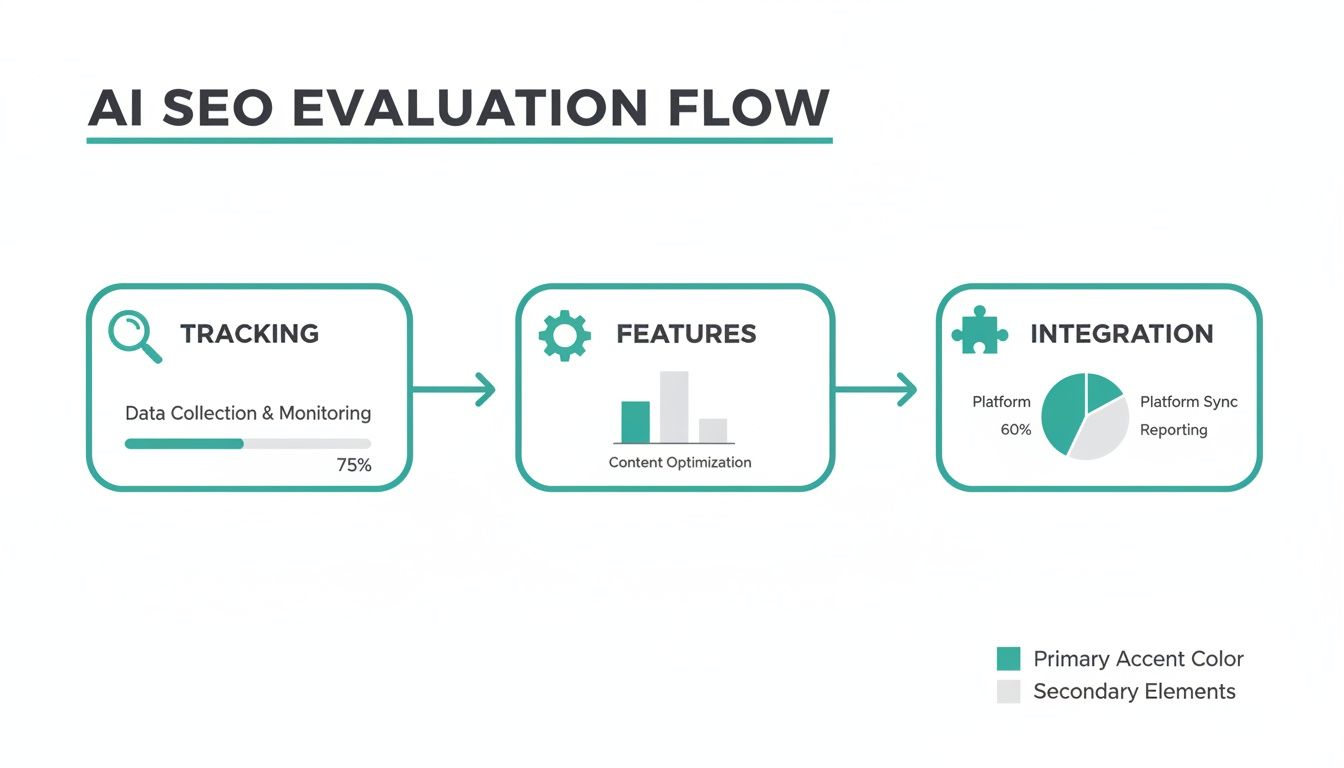
As you can see, a solid evaluation starts with tracking, moves into feature depth, and ends with how seamlessly a tool can integrate into your existing workflow.
Review of Dedicated AI Visibility Platforms
A new breed of tool has emerged, built from the ground up for the age of generative search. These dedicated AI visibility platforms focus on one core job: measuring your brand's presence and answer share inside AI engines like ChatGPT, Gemini, and Google AI Overviews. Tools in this category are all about LLM tracking and citation analysis. They don't just tell you if your brand was mentioned; they show you the exact context of the mention and what sources the AI used to come up with its answer. This is their superpower. These platforms are perfect for brand marketers and SEO managers who need to prove their impact in this new channel.
Analysis of Traditional SEO Suites with AI Features
The big, established SEO suites like Semrush and Ahrefs are not sitting on the sidelines. These industry workhorses, long known for their deep keyword research, rank tracking, and backlink data, are now bolting on AI features to their existing platforms. You'll now find functionalities like tracking brand mentions in Google's AI Overviews or AI powered writing assistants. This means you can see some AI visibility data right alongside your classic keyword rankings. The main draw here is convenience. If your team is already living in one of these platforms, you get access to new AI metrics without adding another subscription to your tech stack.
Examining AI Content Optimization Tools
The third category is all about creating content that's built to perform from day one. AI content optimization tools like Surfer SEO are designed to help you produce articles and pages that are primed for both traditional and AI driven search. They work by analyzing top ranking content and giving you data backed advice on everything from structure and keyword use to topic depth. These tools are a lifesaver for content heavy teams focused on scaling production without sacrificing quality. Their strength is in making the content creation process more efficient and data driven. It's also worth noting that some platforms in the broader SEO space have carved out niches as dedicated SEO competitor analysis software, focusing entirely on dissecting your rivals' strategies.
Comparison Table of AI SEO Tool Categories
This table offers a side by side look at what each tool category is built for. Use it to align your strategic goals, whether it’s tracking AI visibility, optimizing content, or managing traditional SEO, with the right type of platform.
| Tool Category | Example Tools | Primary Focus | AI Visibility Tracking | Citation Source Analysis | Content Generation & Optimization |
|---|---|---|---|---|---|
| AI Visibility Platforms | Riff Analytics | Measuring brand presence in AI answers | Core Feature | Core Feature | Limited/None |
| Traditional SEO Suites | Semrush, Ahrefs | All-in-one traditional SEO management | Integrated Feature | Limited | Integrated Feature |
| Content Optimization | Surfer SEO | Creating search-optimized content | None | None | Core Feature |
Each category fills a distinct and critical role in a modern SEO strategy. The right choice really comes down to what you need to achieve right now: measuring your AI footprint, creating optimized content, or getting a bit of everything in a familiar package.
Picking the Right AI SEO Tool for Your Business
The "best" AI SEO tool is not the one with the longest feature list. It’s the one that clicks perfectly with your team’s workflow, structure, and what you’re actually trying to achieve. Choosing the right platform is about matching its core purpose to your specific business problems. This guide is designed to cut through the noise with practical, scenario based advice. And making this choice is becoming non negotiable. Recent surveys show that over 86% of SEO professionals are already using AI in their day to day work. You can find more data on the rapid adoption of AI in SEO strategies here.
Comparing AI SEO Tools for Different Business Roles
Different roles and business models have completely different needs. A content publisher’s daily grind looks nothing like that of a B2B brand marketer obsessed with competitive intelligence. Grasping these distinctions is the first step to making a smart investment. Take a B2B SaaS company, for example. Their main goal might be to own their brand’s story inside AI generated answers. For them, a platform specializing in AI search visibility and LLM tracking is mission critical. They need to monitor mentions, see what sources competitors are getting cited from, and make sure their own messaging shows up correctly in AI responses.
A high volume digital publisher, on the other hand, is focused on scaling article production without sacrificing quality. Their priority is an AI content optimization tool. Their entire workflow is built around creating search optimized content efficiently, so features like AI assisted outlining and content scoring are what they live and die by.
Selecting Your AI SEO Platform Based on Business Goals
To make the right call in your AI SEO tools comparison, start with your primary objective. Are you trying to measure your brand's footprint in AI, create content faster, or maybe a bit of both? Your answer immediately narrows the field to the right category of tool. This table breaks down my recommendations by role and objective, helping you map a tool's strengths to your team's needs.
| Role | Primary Business Goal | Recommended Tool Category | Key Features to Prioritize |
|---|---|---|---|
| B2B Brand Marketer | Own the brand narrative in AI answers | AI Visibility Platform | Answer Share Tracking, Competitor Citation Analysis |
| SEO Manager | Improve organic presence in AI engines | AI Visibility & Traditional Suite | LLM Tracking, AI Overview Monitoring, Keyword Data |
| Content Publisher | Scale high quality article production | AI Content Optimization Tool | AI Assisted Briefs, Content Scoring, SEO Suggestions |
| Agency Professional | Deliver AI SEO services to clients | Hybrid Stack (All Categories) | Scalable Pricing, White-Label Reporting, API Access |
Ultimately, your choice should be a strategic one. An SEO manager at a mid sized e-commerce company might take a hybrid approach, using a traditional SEO suite for rank tracking while layering on a specialized AI visibility tool to keep an eye on product mentions in AI answers. If you define your use case first, you can filter out the irrelevant options and pick a platform that will actually deliver a return on your investment.
Getting Your New AI SEO Workflow Off the Ground
Picking the right platform from our AI SEO tools comparison is a great start, but its real value comes from weaving it into your team's daily rhythm. Rolling out a new tool successfully is more than just handing out logins. It’s a deliberate process of integration, training, and measurement to make sure it delivers real results for your 2025 and 2026 goals. A structured rollout avoids confusion and gets your team finding valuable insights faster. This is not about adding another dashboard; it’s about evolving how your team thinks about search, shifting from old school rankings to modern metrics like AI visibility and answer share.
A Strategic Framework for AI Tool Implementation
Adopting a new tool without a plan is a recipe for low usage and wasted budget. A phased approach ensures your team not only learns the features but actually understands how to apply them strategically. For a deeper dive, check out our guide on how to integrate AI SEO with existing SEO workflows to ensure a smooth transition. We can break this strategic rollout into four essential stages.
First, book dedicated onboarding and training sessions with the tool provider. Second, get the tool monitoring your primary brand terms, key product categories, and top competitors. Third, let the tool run for at least 30 days to collect initial data. This is crucial for establishing your baseline answer share and AI visibility before you make any strategic changes. Finally, launch a pilot program by picking a small, focused project to test the tool's impact.
Comparing Implementation Workflows for AI SEO Tools
Not every team follows the same script. Your approach will look different if you’re adopting your first AI SEO tool versus migrating from another platform. Each scenario has its own hurdles. This table maps out two distinct workflows to guide you.
| Workflow Step | New Tool Adoption | Platform Migration |
|---|---|---|
| Phase 1: Data | Establish baseline AI visibility from scratch. | Export and archive historical data from the old tool. |
| Phase 2: Onboarding | Focus on foundational concepts and features. | Train the team on key differences and new features. |
| Phase 3: Integration | Connect the tool to your existing SEO stack. | Reconfigure API connections and reporting dashboards. |
| Phase 4: Validation | Run a pilot to prove ROI and get buy in. | Compare new data with historical trends for consistency. |
According to Forrester Research, teams that run structured pilot programs for new marketing technology are 55% more likely to report successful long term adoption and a positive return on investment.
Summary and Final Recommendations
As we close out this comparison, one thing is crystal clear: the search world has changed for good. Sticking to old school keyword rank tracking is like navigating with a paper map in the age of GPS. AI engines are the new gatekeepers, and for any business serious about winning into 2026, adapting your strategy and tools is not optional, it's about survival. This shift demands a new North Star metric. We're moving from rank position to answer share. Success is now defined by whether your brand shows up inside the direct, generated answers users see.
The biggest difference between the tools we've looked at boils down to their starting point. Dedicated AI visibility platforms, like Riff Analytics, start from a completely different place. They ask, "Is my brand actually showing up in the answer?" This focus on measurement and LLM tracking gives you the clearest picture of your performance. It directly measures the outcome of all your hard work. You can't improve what you don't measure. A dedicated AI visibility platform is the scoreboard for this new game.
Our Top Pick for Monitoring AI Search Visibility
If your team is focused on actually measuring and improving your presence in AI generated answers, a specialized AI visibility platform is not just nice to have; it's a necessity. While many teams will end up using a mix of tools, the foundation of any modern AI SEO strategy has to be a tool built specifically to monitor AI search visibility. Without it, you're just creating content and hoping it connects with the models. You're flying blind. A dedicated platform gives you the data driven feedback loop you need to turn that hope into a deliberate, repeatable strategy.
Frequently Asked Questions (FAQ)
How do I choose an AI SEO tool for a small business?
For a small business, prioritize affordability and core function. Start with a tool that solves your biggest immediate problem, whether that's creating content more efficiently or tracking local brand mentions in AI Overviews. Look for platforms with flexible, entry-level pricing so you avoid paying for enterprise features you don't need.
What is the best AI SEO tool for B2B SaaS companies?
B2B SaaS companies should focus on dedicated AI visibility platforms. These tools are specifically designed to track brand mentions, monitor competitor citations, and analyze the context of AI-generated answers. This capability is crucial for owning an industry narrative and conducting competitive intelligence in the age of generative SEO.
Can I use a free AI SEO tool to start?
Absolutely. Many platforms offer free trials or limited free plans, which are perfect for getting a feel for the workflow and data accuracy. It's a great, no-risk way to test the waters. However, for ongoing, deep analysis, you will almost certainly need a paid plan to get truly actionable insights for your AI SEO strategy.
Which type of AI SEO tool provides the best ROI?
A dedicated AI visibility platform usually delivers the highest ROI. By directly measuring your answer share and competitor citations, it provides actionable data that ties directly to brand authority and market presence. Its impact is often easier to see and quantify compared to tools focused solely on content creation.
What's the most important metric in an AI SEO tools comparison for 2026?
Without a doubt, it's answer share. This metric tells you how often your brand is part of the direct answer an AI provides. In the emerging search landscape, being the cited authority within the answer is the ultimate goal, making answer share the key performance indicator.