How to Master Calculating Share of Voice in 2025 and Beyond
Updated February 14, 2026

What is share of voice? In simple terms, it's a measure of your brand's visibility compared to your competitors. But in 2025 and 2026, its meaning has evolved far beyond old-school ad spend comparisons. Today, calculating share of voice means understanding your presence across every critical channel, from traditional Google search results to the AI-generated answers that are rapidly becoming the new front door to the internet. Getting this right isn't just a marketing task; it's a strategic imperative for brand survival in an AI-driven world.
Why Your Method for Calculating Share of Voice Is Critical
The old way of measuring Share of Voice (SOV) is officially broken. It used to be a straightforward game of comparing advertising budgets, but that model is completely obsolete in a world dominated by AI powered search and infinite social feeds. Today, SOV is about understanding your brand's actual visibility wherever your customers are looking.
This modern approach goes way beyond paid media. It demands you look at your entire digital footprint, from traditional search engine results pages to the new frontier of generative SEO.
A Modern Definition for Measuring Brand Visibility
Modern SOV calculation requires a much broader perspective. It is about tracking your brand’s presence across a whole network of interconnected channels to get a true read on your market authority. The key battlegrounds now include:
AI Search Visibility: Your presence in Google's AI Overviews and answers from models like ChatGPT.
Organic Search Footprint: Your rankings and visibility for core commercial and informational keywords.
Social Media Presence: Your mentions, hashtag usage, and how you dominate conversations on key platforms.
Content and PR Mentions: How often you are cited as an authority in industry publications and news.
Imagine a B2B SaaS company that has always prided itself on strong organic rankings. If that same company is totally invisible in AI generated answers, it is quietly losing ground to a competitor who has mastered "citation dominance." This is the kind of blind spot that can slowly but surely erode your market position.
The Proven Link Between Visibility and Growth
The importance of accurately calculating share of voice is not just talk; it is backed by extensive research. According to LinkedIn's B2B Institute, there is a direct, causal link between a brand's visibility and its market growth, a principle known as Excess Share of Voice (ESOV).
For every 10 percentage points that a brand's Share of Voice exceeds its Share of Market, it gains approximately 0.5% in market share annually. Decades of data show that brands decline when their SOV falls below their market share, while those that sustain a higher SOV achieve consistent, long term growth. You can read more about the findings on how SOV drives market growth.
This principle has never been more relevant. As consumers turn to AI for direct answers, establishing a high SOV within these new platforms is absolutely essential for capturing tomorrow's customers. Understanding and acting on your holistic share of voice is the key to securing a real competitive edge.
A Practical Framework for Calculating Your True SOV
Let's move from theory to action. Calculating a modern Share of Voice (SOV) is not just about counting mentions anymore; it is about understanding your visibility where it actually matters today, from the top of Google to the inside of an AI generated answer.
This framework is a roadmap to a clear, defensible, and actionable SOV score that blends traditional metrics with the new reality of AI search.
Defining Your Competitive Set for an Accurate SOV Measurement
The first and most common mistake in calculating SOV is getting the competition wrong. In 2025, your competitor is not just the company with a similar product. It is any entity, from a niche blog to an industry publication, that owns the conversation around your core topics.
Think about your competitive set in tiers:
Direct Competitors: The obvious ones. Brands offering similar products or services.
Topical Competitors: These are the silent killers. Websites or publications that consistently rank for your most important keywords, even if they don't sell a thing. They are often the sources AI models love to cite.
Aspirational Competitors: The market leaders you are chasing. They provide a benchmark for what excellence looks like.
With your competitors defined, map out the core topics you absolutely must own. These are the keyword clusters and conversational themes that connect directly to your customer's problems and your solutions. This gives you a tight, focused list of terms to track across every channel.
How to Calculate Share of Voice Across Channels
Once you know who you are up against and what you are fighting for, the next step is to gather data and apply a simple formula. At its core, the SOV formula is always the same: Your Brand's Metric / Total Market Metric x 100. The trick is picking the right metric for each platform.
To truly get this right, you need a robust AI SEO strategy. This includes a practical framework for AI SEO to ensure your content is actually visible to both traditional search engines and the new AI models. That visibility is the raw material for your SOV calculations.
Creating a Weighted Model for a Composite SOV Score
Let's be honest: not all channels are created equal. A single mention in a Google AI Overview could be worth more to your business than a hundred impressions on social media. This is why a simple average of your SOV across channels is often misleading.
A weighted model gives you a much more accurate, holistic view of your true market presence. To build one, just assign a weight to each channel based on its importance to your business goals. For a B2B SaaS company, that weighting might look something like this:
AI Search Visibility (40%): Reflects the massive importance of getting cited in AI answers.
Organic Search (30%): Your foundational authority and source of high intent traffic.
Social Media (20%): Measures brand conversation and community pulse.
PR/Media Mentions (10%): Captures third party validation and authority signals.
By multiplying each channel's individual SOV score by its assigned weight and adding them all up, you get a powerful composite score. This single number provides a strategic snapshot of your market presence and helps you decide where to invest your resources for the biggest impact.
Picking the Right Tools for Calculating Visibility
Let's be blunt: your old tech stack is not ready for what is coming. The tools you have relied on for years were built for a world of simple, blue link SERPs, not the conversational, answer driven landscape of 2025. Accurately calculating share of voice today means blending established platforms with a new generation of software built for this new reality.
The entire process boils down to a clear, repeatable workflow: you define your turf, gather the right data, and then score your visibility. Your toolkit has to support every step.
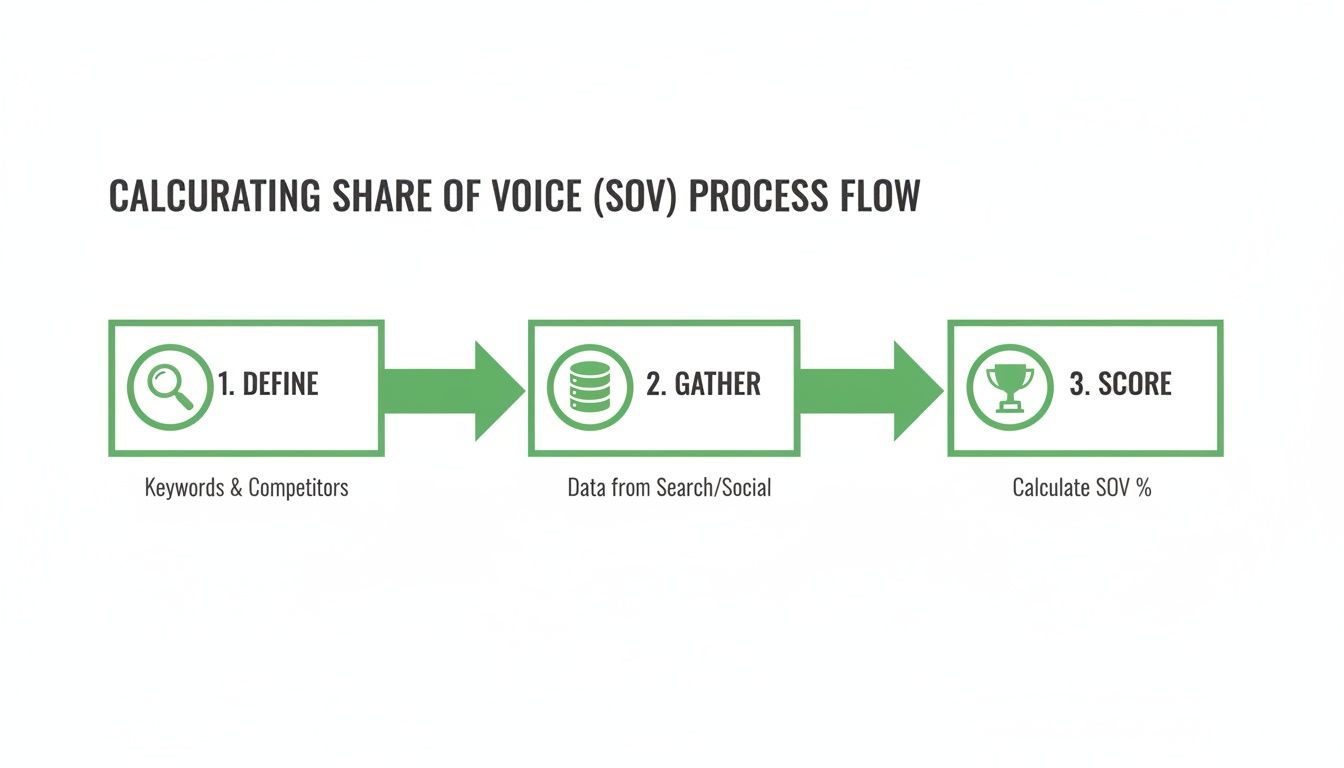
This is not just a theoretical model. It is a practical map for building a defensible SOV program, starting with clear definitions and ending with hard numbers.
How to Select Your SOV Monitoring Tools
The tools you choose will make or break the accuracy of your SOV calculations. It is that simple. Your foundation still rests on traditional SEO platforms. Tools like Semrush are fantastic for tracking organic keyword rankings and impression share. They give you a rock solid baseline for understanding your performance in classic search.
Next, you need to layer in social listening platforms like Brandwatch. They offer a completely different and equally vital lens on your brand, tracking mentions, sentiment, and the volume of conversation across social media. This is where you gauge public perception and your brand’s resonance in broader industry chatter.
But here is the critical part: neither of those toolsets was designed for LLM tracking. This is the blind spot where specialized platforms like Riff Analytics come in. These tools are purpose built for the AI era, focusing on metrics like answer share and citation dominance within AI generated responses. They can pinpoint the exact sources AI models cite, analyze the sentiment of the answers they generate, and benchmark your visibility inside models like Gemini and ChatGPT. You can see a full breakdown of how these platforms compare in our guide to AI SEO tools.
A Comparison of Tools for Measuring Share of Voice
To build a complete picture, you need to understand what each tool category brings to the table. The right mix depends entirely on your goals. Are you trying to win organic rankings, manage brand reputation, or secure your place in AI generated answers? The answer dictates your stack.
| Tool Category | Primary Use Case | Key Metrics | Example Tools |
|---|---|---|---|
| Traditional SEO Platforms | Measuring organic search visibility and competitor keyword performance. | Keyword Rankings, Impression Share, Backlink Profile, Traffic Estimates. | SEMrush, Ahrefs, Moz |
| Social Listening Platforms | Monitoring brand mentions, sentiment, and conversation volume online. | Mention Volume, Sentiment Analysis, Reach, Engagement Rate. | Brandwatch, Talkwalker |
| AI Visibility Platforms | Tracking brand presence and citations within AI generated answers. | Answer Share, Citation Count, Response Sentiment, Source Analysis. | Riff Analytics, BrightEdge |
As the table makes clear, a holistic view of share of voice requires a multi tool approach. Your SEO platform cannot tell you about your visibility in ChatGPT, and your social tool will not track your organic impression share. They are different ecosystems that demand different measurement tools. Integrating data from these different platforms is the only way to get a true, 360 degree view of your brand’s share of voice. Without it, you are flying blind, making strategic decisions based on an incomplete and dangerously skewed picture.
How to Turn Your Share of Voice Data into Action
Collecting share of voice data is one thing. Turning those numbers into a winning strategy is where the real work begins. Your SOV report is not just a scorecard; it is a diagnostic tool that shows you exactly where your brand is winning, where it is falling behind, and what to do next.
This is your playbook for tying SOV metrics directly to your most important business goals.
Let's walk through some real world scenarios. The goal here is to move past simply calculating share of voice and start using the insights to make smarter decisions that actually drive growth.
Interpreting Your Insights for Calculating SOV
A common situation for brands in 2025 is a massive disconnect between their traditional SEO performance and their visibility in AI search. You might have a killer SOV in organic rankings for your top keywords, but then discover you have almost zero presence in Google's AI Overviews or answers from other LLMs.
This is not an SEO failure. It is a clear signal of a content format gap. AI engines prioritize content that is conversational, well structured, and directly answers a user’s question. A high organic ranking no longer guarantees high AI search visibility.
Another classic challenge pops up on social media. A brand might see a high SOV and celebrate that their mention volume crushes competitors. But when you dig in, you find 80% of those mentions are driven by negative sentiment from a customer service meltdown. That is not a marketing win; it is a reputation crisis that demands an immediate PR and operational response.
Turning SOV Scenarios into a Strategic Action Plan
Every data point in your SOV report tells a story and points toward a specific action. The trick is to diagnose the problem correctly and apply the right fix. A solid grasp of SEO competitive intelligence is non negotiable here, as it gives you the context to read your SOV data accurately. A solid mindset is everything. Do not get paralyzed by the numbers. Just find one or two critical gaps or opportunities and build your next move around them.
The table below breaks down how different SOV scenarios translate into specific, actionable strategies. It is a clear path from data to decision.
| Scenario Analysis | Strategic Action Plan |
|---|---|
| High Organic SOV, Low AI SOV | Revamp top performing content to be more AI friendly. Implement comprehensive structured data (like FAQ and HowTo schema) to make information easier for models to parse and cite. |
| High Social SOV, Negative Sentiment | Launch a targeted PR and customer support campaign to address the root cause of the negative feedback. Use social listening tools to identify and engage with key detractors directly. |
| Low SOV in a Key Product Category | Increase ad spend strategically on platforms where competitors are weak. Partner with influential creators in that niche to build third party credibility and generate positive buzz. |
| Competitor Dominates Citations in AI | Identify the specific publications and sources that AI models are citing for your core topics. Launch a digital PR campaign to secure backlinks and mentions from those exact high authority domains. |
How to Prioritize Actions from Your SOV Calculation
With so many potential actions, prioritization is key. You cannot fix every gap at once. Use your weighted SOV score to guide your focus. If AI visibility has the highest weight in your model, then the gap between your organic and AI SOV is your number one priority.
Start by tackling the highest impact, lowest effort initiatives. For example, updating existing blog posts with structured data is almost always faster and cheaper than creating a dozen new articles from the ground up.
Ultimately, turning data into action requires a shift in mindset. Treat your share of voice report not as a final grade but as the starting point for your next marketing sprint. It is a continuous loop of measuring, analyzing, and acting that separates market leaders from everyone else.
Common SOV Measurement Pitfalls You Cannot Afford to Make
Getting share of voice right is a massive strategic advantage. But a lot of brands stumble into the same traps, completely undermining their data. As we barrel toward 2025 and 2026, with AI search defining who gets seen, these mistakes are more than just academic; they are expensive. The point is not just to get a number; it is to get a number you can actually trust to make smart decisions.
Nail your measurement framework from the jump, and you will not waste time chasing phantom trends or dumping budget based on flawed reports. This is the insider knowledge you need to build a defensible, precise SOV program from day one.
Overlooking Context When Calculating Your Voice Share
This is the big one. Too many people just count the number of times their brand is named and call it a day. That is a dangerously misleading approach. A huge spike in mentions could easily be a viral customer complaint, turning what looks like a win into a full blown reputation crisis.
True SOV measurement has to account for the quality and sentiment of every single mention. This is especially critical when it comes to LLM tracking. A mention of your brand in a negative or just plain wrong context inside a Google AI Overview can do serious damage. You need a weighted scoring system that prioritizes positive, authoritative mentions over the noise.
Using Inconsistent Definitions Across Channels
Another classic mistake is using different sets of keywords or competitors across different channels. If you are tracking one group of rivals on social media but a completely different list for organic search, you are not building a unified SOV metric. You are just creating siloed data points that tell you nothing when put together.
Before you even think about calculating share of voice, define a single, unified list of direct and topical competitors. Do the same for your core keywords. This list should be your source of truth across every platform, from traditional search to AI driven conversations. Consistency is the bedrock of reliable analysis.
The marketing analytics experts at Pacvue put it well: "Share of Voice isn't just one metric but a suite of metrics... The concept can be applied to impressions, clicks, traffic, sales, and more." This is why a consistent framework is so important; it ensures all those metrics are telling a coherent story.
The Myth of 100 Percent Data Coverage
Finally, a lot of teams get paralyzed trying to capture every single mention across the entire internet. Let's be real: a 100% comprehensive view is not just impractical, it is unnecessary.
The goal is not to boil the ocean. It is to establish a reliable, consistent benchmark you can track over time. Focus on creating a representative sample of the channels and conversations that actually matter to your audience. This gives you actionable insights without the impossible cost and complexity of trying to track everything, everywhere.
The Future of SOV Measurement in an AI Driven World
For years, calculating share of voice was a fairly straightforward marketing task. Today, it has become a strategic imperative for brand survival. As we push into 2025 and beyond, your success hinges on understanding this new reality. The game has decisively shifted. It is no longer just about ranking on a page; it is about earning a place inside an AI generated answer.
This means mastering metrics like answer share and achieving citation dominance is no longer optional. When AI engines become the new front door to information, the only way to win is by measuring and influencing your presence within their responses. This is the heart of modern AI brand monitoring.
Why Your AI Share of Voice Calculation Matters
The connection between visibility and real business results is impossible to ignore. We see it time and again. When a brand strategically grows its SOV, the business impact follows. Take one real world example: a personal care brand that boosted its Amazon SOV by 92% through a smart paid and organic strategy. The result? A 63% jump in conversion rates and a massive 213% revenue increase. Visibility directly fuels dominance. You can read more on how voice commerce is impacting market dynamics here.
Adopting a modern SOV framework is simply your roadmap to securing a competitive edge in this new landscape. Ultimately, the future of brand visibility lies in your ability to be the answer, not just a search result. By embracing a holistic approach that weaves together traditional SEO with dedicated LLM tracking, you can transform your share of voice data from a passive metric into an active growth engine. The time to adapt your strategy is now.
Summary and Final Recommendations
Calculating your true share of voice is not optional anymore. It demands a clear framework that blends traditional methods with modern necessities like AI visibility tracking and sentiment analysis. Start with an intelligent definition of your competitors and topics. Apply consistent formulas across the channels that matter and use a weighted model to create a composite score that reflects your brand's real world visibility. This data driven approach transforms SOV from a vanity metric into a strategic guide for winning your market. Sidestep common pitfalls like ignoring context and using inconsistent definitions to ensure your data is accurate and actionable.
Frequently Asked Questions About Calculating Share of Voice
How Do You Calculate Share of Voice in AI Search?
You calculate SOV in AI search by tracking what we call "answer share." This means querying models like ChatGPT or Google's AI Overviews for your core topics and counting how many times your brand is mentioned or cited compared to your competitors. New tools are emerging to automate this LLM tracking process, which is a game changer for generative SEO.
What Is a Good Share of Voice Percentage?
A "good" SOV is entirely relative. It depends on your industry, market maturity, and goals. For a startup, hitting a 10% SOV in a crowded market could be a massive win. For an established leader, dropping below 40% might be a red flag. The most important rule of thumb is that your SOV should be higher than your actual Share of Market to fuel growth.
How Do You Measure SOV with a Limited Budget?
If you are on a tight budget, focus your efforts on one or two high impact channels. Start by manually tracking your organic search visibility for your top five commercial keywords in a simple spreadsheet. You can also set up free Google Alerts to monitor brand mentions and use the native analytics on social platforms to track conversation volume. It is about being smart, not spending big.
Will traditional SEO still be relevant for calculating SOV in 2026?
Absolutely, but its role has evolved. Strong organic rankings and high quality content are the raw materials AI models use to formulate answers. Think of it this way: traditional SEO practices are essential for building the authority and trust signals that lead directly to high AI search visibility and citation dominance.
What is the difference between Share of Voice and Answer Share?
Share of Voice is the classic, broad measure of your brand's overall visibility across every channel you can think of. Answer Share is a critical, modern subset of SOV. It specifically measures your brand’s presence inside the answers generated by AI search like Google’s AI Overviews and platforms like ChatGPT.