Why a Competitive Intelligence Strategy is Your Secret Weapon
Updated December 10, 2025

In the world of search, competitive intelligence for SEO is no longer a "nice-to-have." It's the core discipline of identifying what your online rivals are doing, understanding why it works, and using that insight to systematically outmaneuver them. Think of it as having a complete playbook of your competitors' strategies before the game even starts. As we look toward 2026, where AI-driven search and generative SEO are the new norms, this proactive analysis is the only way to secure and grow your digital market share.
Why a Competitive Intelligence Strategy is Your Secret Weapon
Competitive intelligence for SEO means tracking the sites that repeatedly outrank you, understanding which pages and formats are winning for them, and using that evidence to decide what to update, publish, or defend next. In practice, it helps teams do three things well: identify competitors’ best-performing pages, spot keyword and content gaps, and prioritize the opportunities most likely to improve rankings or share of voice.
A simple example: if two rival domains keep winning comparison keywords with recently updated pages, own the featured snippet, and show up in AI Overviews, the next move is not “publish more.” It’s to refresh your outdated comparison page, add a concise snippet-ready answer block, and monitor whether those rivals keep earning citations and links. That is the core value of SEO and competitive intelligence: turning scattered competitor signals into a concrete publishing and optimization queue instead of guessing what to work on next.
The Real-World Impact of Analyzing SEO Competitors
The practical payoff is faster decision-making. A solid review shows which pages are pulling visibility away from you, which topics your site barely covers, and which SERP features are worth pursuing. Recent guidance from Industry Lens recommends monitoring 5 to 10 direct competitors and reviewing 50 to 100 core buyer-intent keywords on a weekly basis so teams can catch changes in rankings, traffic patterns, backlinks, and publishing velocity before those shifts compound.
In my experience, the biggest win is not some dramatic “spy on competitors” moment. It’s cutting waste. Teams stop updating pages no one is searching for and start working on topics where a clear gap already exists in the market. The most reliable insights usually come from repeated patterns—three competitors investing in the same topic cluster, the same source type linking to multiple rivals, or the same page format winning snippets across a segment. For another example of how focused growth teams operationalize these insights, see babylovegrowth.ai.
A Modern Framework for Gaining a Competitive Edge
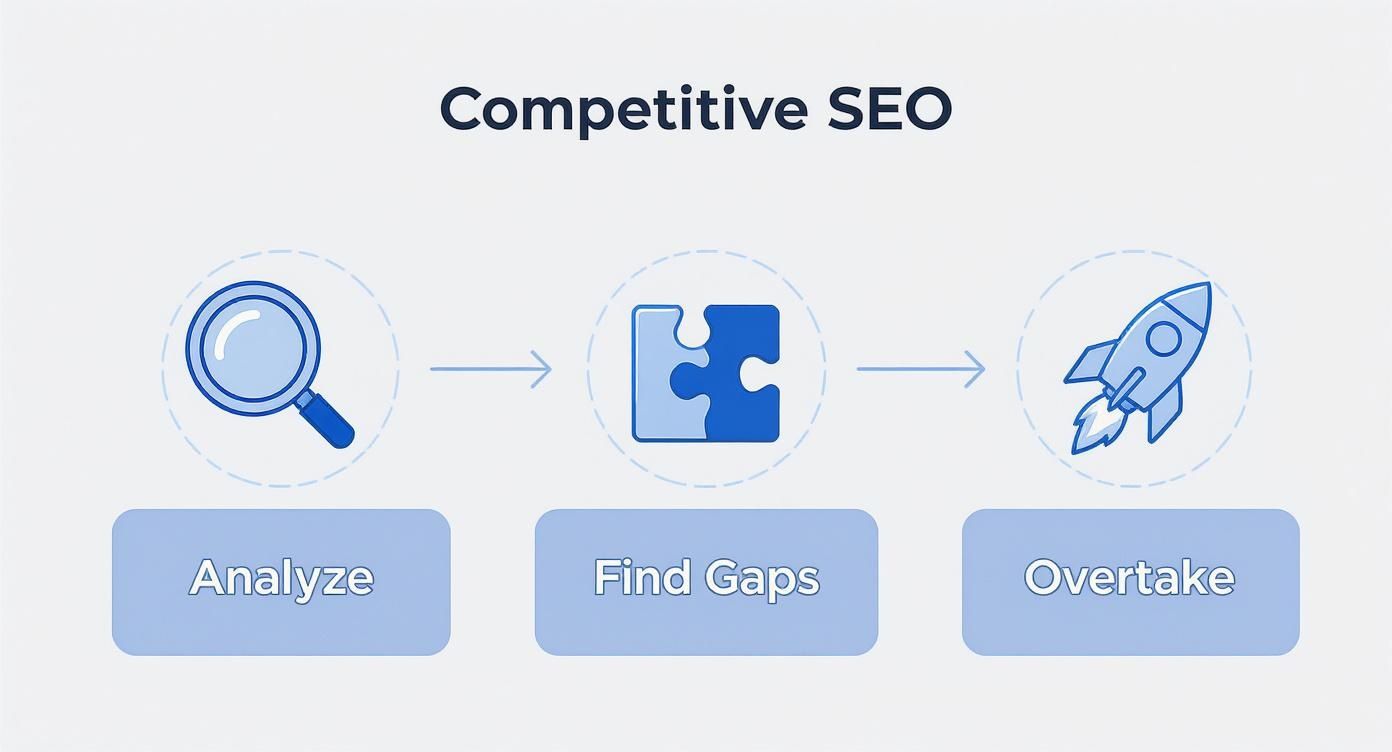
The goal is to build a repeatable loop: define the market you care about, identify the sites competing with you in search, collect comparable data, score what matters, and review the results on a fixed cadence. According to Backlinko’s CTR data, the #1 organic result still captures a disproportionate share of clicks, which is why the work is not just about “knowing competitors” but about choosing the next page-level actions with the highest expected return. That workflow includes how to evaluate signal versus noise and how to extend classic competitor analysis into AI-driven search environments.
How We Evaluate SEO Competitive Intelligence Opportunities
Not every competitor insight deserves action. Opportunities can be evaluated using seven signals: ranking overlap, content depth, backlink quality, SERP feature presence, AI citations, recency, and business relevance. Ranking overlap tells you who your real search competitors are. Content depth shows whether a rival is winning because they cover a topic better or got there first. Backlink quality matters more than raw link counts; one relevant editorial link can matter more than dozens of low-value mentions. SERP feature presence and AI citations help show where visibility is shifting beyond the classic blue links.
I usually disqualify an insight if it fails one of three tests: the keyword is low-intent for the business, the competitor page ranks because of brand strength rather than page quality, or the gap is impossible to close without a disproportionate amount of effort. A good process compares data from rankings, page-level content, referring domains, and AI or answer-engine mentions before making a recommendation. As a working cadence, weekly checks are enough for core keywords and high-value pages, while a deeper strategic review each month is where patterns become clear. That rhythm keeps the work grounded in trend lines instead of overreacting to one-day ranking noise.
What You Can Learn From SEO Competitive Intelligence
A proper review tells you much more than who ranks above you. It shows which keywords competitors win consistently, where your coverage is shallow, what kinds of pages attract links in your market, and which search features are shaping clicks before users ever reach a standard result. You can also see how competitors position their content: whether they rely on original data, glossaries, product-led pages, category comparisons, calculators, or concise expert answers.
The useful outputs are usually straightforward. You get a list of competitor keywords worth targeting, a map of content gaps by cluster, a shortlist of backlink sources that repeatedly cite others in your space, and a view of SERP features such as snippets, People Also Ask, video packs, review elements, and AI citations. I prioritize these outputs because they answer the operational questions teams have: what should we publish, what should we refresh, what can we realistically win, and what should we stop spending time on.
Building Your SEO Intelligence Framework
An effective competitive intelligence program starts with a defined process, not a bigger dashboard. The framework that works best is simple enough to repeat and specific enough to guide action.
Step 1: Define the Keyword Set and Market Segment
Start with the slice of the market you want to win. Build a keyword set around product categories, buyer problems, comparison terms, jobs-to-be-done, and adjacent educational topics. This usually requires narrowing the list to 50 to 100 core terms first rather than trying to monitor every possible variation at once. The point is to create a set that reflects real business intent, not vanity traffic.
A keyword belongs in the set if it maps to revenue, qualified pipeline, or a strategic audience segment. It should be excluded if it is too broad, too far from purchase intent, or likely to attract the wrong audience. Many frameworks get noisy: they treat all search demand as equally valuable. It isn’t.
Step 2: Identify True Search Competitors by Ranking Overlap
Your true competitors in search are the domains that repeatedly appear for your keyword set, even if they are not the companies you mention in sales calls. Look for repeated overlap on core queries, similar topic clusters, and the same type of search intent coverage. A publisher, marketplace, software review site, or industry blog can be a stronger SEO competitor than a direct commercial rival if it blocks your visibility across high-value terms.
A practical threshold is repeated presence across a meaningful portion of your tracked terms, especially on page one. If a domain appears once or twice for tangential queries, that is background noise. If it appears across your product, use-case, and comparison clusters, it belongs in the analysis.
Step 3: Collect Data Across Rankings, Content, Links, and SERP Features
Once you know whom to track, collect the same data points for each competitor so the comparisons stay fair. At a minimum, gather ranking positions, URLs driving visibility, content format and depth, referring domains, internal-link support, snippet ownership, and whether the page gets cited in AI-generated answers. Ahrefs notes in its competitive intelligence analysis that leading teams pair what customers search for with what competitors already deliver, then use content gap reports and thematic clustering to decide where coverage is missing or weak.
In practice, measure content depth by checking whether the ranking pages satisfy the full intent of the query, not by word count alone. Measure backlink quality by relevance, editorial placement, and repeatable source types. Measure SERP feature ownership by reviewing the live results and noting whether competitors win snippets, FAQ-style answers, videos, reviews, or AI-generated citations.
Step 4: Score Opportunities by Impact and Feasibility
Every finding should be scored before it lands in the roadmap. I use two main questions: how much visibility or business value could this deliver, and how hard is it to win? A page refresh for a keyword where you already rank #8 and the leader is outdated is usually a better bet than launching a new cluster where entrenched authorities dominate every result.
For each opportunity, assign an impact score and a feasibility score. Impact is higher when the topic drives qualified traffic, supports conversion, and influences multiple keywords or SERP features. Feasibility is higher when you already have some authority, existing content to improve, or access to the sources needed to compete.
Step 5: Set a Repeatable Review Cadence
Review cadence is what turns analysis into a system. Weekly monitoring works for rankings, major content launches, SERP feature changes, and AI citations on core topics. Monthly reviews are better for spotting structural patterns such as publishing velocity, backlink source trends, and cluster-level gaps. Quarterly reviews should reset the competitor set and the keyword universe.
The most actionable metrics are the ones that trigger a clear response. Share of voice becomes actionable when a competitor gains visibility across a cluster you consider strategic. Content gap data becomes actionable when multiple competitors rank with pages you do not have. Backlink gap data matters when you can identify recurring publications, partner ecosystems, directories, or data-source citations that are realistically attainable. AI citation data is useful when the same domains are repeatedly cited across target prompts; random one-off mentions are usually weak signal.
Selecting the Right Tools for an SEO Competitive Analysis
Your framework is only as good as the data you feed it. Picking the right tools is critical for gathering accurate, actionable intel. The market is flooded with options, from all-in-one platforms to highly specialized solutions for tracking AI search visibility and LLM tracking. To build an effective framework, you should look into specialized SEO competitor analysis software that can automate the grunt work. A balanced toolkit is key. An all-in-one platform gives you broad visibility, while niche tools offer granular data on emerging channels like generative SEO. Our guide on SEO benchmarking tools can help you weigh your options.
Defining Core Metrics for Your Intelligence Gathering
You’ve identified your competitors and your tools are humming. Now what do you measure? A cluttered dashboard is an ignored dashboard. You need to focus on a handful of key performance indicators (KPIs) that tie directly back to your business goals. Think about metrics by shifting from a traditional SEO mindset to a modern, AI focused approach that accounts for new formats like generative search results.
| Metric | Traditional Focus (SEO) | Modern Focus (AI Search) | Why It Matters Now |
|---|---|---|---|
| Share of Voice | Percentage of rankings for a keyword set. | Percentage of mentions within AI Overviews. | Measures visibility where users get direct answers. |
| Content Gaps | Topics competitors cover that you don't. | Sources cited by LLMs that aren't yours. | Identifies opportunities to become a trusted source for AI. |
| Backlink Velocity | Number of new links acquired per month. | Rate of new citations from authoritative sources. | Citations are the new backlinks for generative models. |
| SERP Feature Ownership | Percentage of owned featured snippets. | Presence in "Perspectives" or AI generated lists. | Captures visibility in new, interactive result formats. |
A metric becomes useful only when you define how to measure it and what change would trigger action. For share of voice, compare your visibility against the same fixed keyword set every review period; a sudden drop across one cluster should trigger a page-level audit. For content gaps, don’t just export a report—group missing keywords into themes so you can decide whether to build a new page, expand an existing one, or ignore the topic. For backlink velocity, review new referring domains by source quality and relevance rather than celebrating raw volume. For SERP feature ownership, manually confirm the result layout because many tools still underreport the nuances of snippets and AI elements.
Establishing a Monitoring and Reporting Workflow
The final piece of your framework is putting a sustainable process in place for ongoing monitoring and reporting. This is not a one and done project. It’s a continuous loop of analysis and adaptation. Set up automated alerts to track big moves, such as when a competitor launches new content on a target topic or snags a valuable link. Your goal is to build a simple, accessible dashboard that tells a clear story for stakeholders, highlighting threats, surfacing opportunities, and laying out clear recommendations.
How to Audit Competitor Visibility in the AI Search Era
A useful audit starts by separating true search competitors from offline or product competitors. The signal is repeated overlap: the same domains rank for your core terms, cover the same topic clusters, and satisfy similar search intent. If a company is famous in your industry but barely appears for your strategic queries, it may matter commercially without being central to your SEO analysis. Conversely, a review site or editorial publisher may be a major search obstacle even if it is not a direct business rival.

The audit sequence I recommend is straightforward: ranking overlap first, then content clusters, backlink sources, SERP feature ownership, and finally AI citations. In my experience, teams waste the most time when they start with backlinks or AI mentions before confirming that the competitor matters across the target keyword set.
Start With Ranking Overlap
Begin with your tracked keyword set and identify which domains show up most often, especially in the top 10. Look beyond headline rankings and note which URLs win repeatedly. A strong competitor footprint usually looks like broad top-10 coverage across commercial and informational clusters, not one breakout page doing all the work. A weak footprint often looks fragmented: scattered rankings, shallow coverage, and little consistency from one cluster to the next.
Map Content Clusters and Page Types
Next, group competitor pages by topic cluster and page intent. Are they winning with glossary pages, product comparisons, templates, landing pages, original research, or help-center content? This step reveals whether their strength comes from depth, freshness, format alignment, or internal architecture. If one competitor owns an entire cluster with updated pages that cross-link well, that is a stronger moat than a single high-ranking article.
One practical signal of strength is recency tied to usefulness: pages updated with current statistics, screenshots, examples, or product changes that still hold rankings after refreshes. A weak signal is surface-level activity, such as frequent updates that do not improve topic depth or intent coverage.
Review Backlink Sources for Patterns, Not Just Totals
After content, examine where links come from and why. You want source patterns you can replicate: industry publications, association pages, partner ecosystems, niche directories, journalists citing data, or roundups that repeatedly reference competitors. If multiple rivals earn links from the same source type, that usually points to a scalable outreach angle.
I pay less attention to huge link totals. Raw backlink counts are one of the noisiest metrics in competitor reviews because they often hide irrelevant, sitewide, or low-value links. The better question is whether a competitor has earned links that reinforce the specific pages and clusters you care about.
Check SERP Feature Ownership
Then inspect live SERPs for snippets, People Also Ask, video placements, review elements, image results, and AI Overviews. A competitor with moderate ranking positions can still absorb clicks if it consistently wins the snippet or appears in multiple result modules. A weaker footprint appears when a domain ranks, but rarely controls the visual or answer-oriented features that shape attention.
Audit AI Citations and Answer-Engine Presence
The final layer is AI visibility. Review whether competitors are cited in AI Overviews, ChatGPT, Perplexity, Gemini, or other answer engines for your target topics. Authority increasingly takes the form of being referenced, not just ranked. If the same competitor sources appear repeatedly in answer-generation contexts, they are shaping visibility even where users never click a standard result. See Answer Engine Optimization for how to build for those surfaces.
A strong AI footprint usually means repeated citations across multiple prompts tied to the same topic cluster. A weak one is sporadic mention without consistency, often because the site lacks source-worthy pages, original data, or clear factual formatting.
Turning Competitor Data Into an Actionable Strategy
Raw competitor data becomes valuable only when it maps directly to a specific action. If a competitor wins with fresher statistics, update your data-led content and make the numbers easier to cite. If they own snippets, restructure the page around concise answers, definition blocks, comparison tables, or process steps. If they earn links from the same publication type over and over, build a targeted outreach list around that source pattern instead of chasing generic link-building tactics.

Map Findings to Specific Actions
Here is the operational version of competitive analysis:
- If competitors outrank you with more current benchmark data, refresh the page with new statistics, cite the source clearly, and add a short summary block near the top.
- If they consistently win featured snippets, rewrite intros and subheads so the page answers the query directly in 40 to 60 words before expanding.
- If they attract links from recurring source types, create an outreach list built around those same journalists, directories, communities, or partner sites.
- If they dominate a cluster with better internal linking, strengthen the supporting pages around your primary URL and align anchor text with the cluster intent.
- If they show up in AI citations because they publish source-like content, invest in definitions, original research, structured comparisons, and pages that state claims cleanly enough to be cited.
At that stage, teams can either gain momentum or stall. I’ve found that the best actions are usually boring and page-specific, not grand strategy documents. One refreshed page with a better structure, updated evidence, and clearer internal support often beats a month of abstract planning.
A Simple Prioritization Matrix
Use a two-axis matrix: impact on the business and difficulty to execute. Here are three sample opportunities:
Refresh a ranking comparison page with 2026 data and snippet-ready formatting
Impact: High. Difficulty: Low.
Why: The page already has some authority, the competitors are winning with fresher information, and the lift can affect rankings, snippets, and AI citations.Create a new cluster around an adjacent educational topic that competitors cover
Impact: Medium. Difficulty: Medium to high.
Why: It expands topical authority, but it requires multiple assets and may take longer to influence visibility.Launch outreach to replicate recurring links from niche publications
Impact: Medium. Difficulty: Medium.
Why: The opportunity is real, but success depends on assets worth citing and a repeatable pitch.
The first one should usually go first because it combines high expected return with lower execution cost. It also creates a fast feedback loop: you can measure ranking movement, SERP feature gains, and citation visibility without waiting for an entire cluster to mature. For a more structured way to pressure-test priorities, consider leveraging competitive analysis with a SWOT framework. One pattern I trust is convergence: when the same topic shows ranking strength, snippet ownership, and AI citations for a competitor, that is not a coincidence; it is a priority signal. When only one of those signals appears, I treat it more cautiously. To benchmark progress against rivals, use a keyword rankings and visibility report. For broader reading on this angle, there’s also more from Keyword Kick near the tool-selection workflow.
Putting Your SEO Intelligence Program on Autopilot
One-off competitor audits give you a snapshot in time, but competitive intelligence for SEO has more impact when you turn it into a continuous, automated habit. The goal isn't to run a project. It's to build a system. For 2025 and 2026, this is what separates proactive leaders from reactive followers. You need a program that constantly feeds you actionable insights, letting you adapt your strategy on the fly instead of playing catch up.
A winning program moves beyond random manual checks. It's a repeatable workflow for monitoring and reporting that puts critical information about competitor movements right at your fingertips.
Establishing Automated Competitor Monitoring
The first step is to set up alerts that watch your competitors for you. Most modern SEO platforms let you create triggers for specific events, pinging you directly in your inbox or a dedicated Slack channel. Your alert system should be configured to flag key strategic movements: new high value backlinks, significant ranking shifts, major content launches, and changes in AI search visibility. This simple move frees up your team from mind numbing manual tracking and lets you react the moment something important happens.
Creating Dashboards for Clear Stakeholder Reporting
Raw data rarely inspires action. To make your SEO intelligence program valuable, you have to translate your findings into compelling reports that tell a clear story for stakeholders. A well designed dashboard visualizes threats and opportunities, making it easy for leadership to grasp the competitive position. Your report should be concise and focused on business outcomes, not just vanity metrics. Frame the data around market share, traffic potential, and revenue opportunities.
Comparing SEO Competitive Intelligence Tools
Choosing the right tool depends entirely on what you're trying to achieve. Are you focused on traditional keyword gaps, or are you trying to figure out who AI models trust most? Here's a quick rundown of some popular options and where they shine.
| Tool | Primary Use Case | Key Features | Best For |
|---|---|---|---|
| Ahrefs | Comprehensive SEO & Backlink Analysis | Site Explorer, Keywords Explorer, Rank Tracker, extensive backlink index. | Teams needing a powerful, all in one toolkit for deep diving into keyword strategy, content gaps, and link profiles. |
| Semrush | All in One Marketing & SEO Platform | Keyword Magic Tool, Position Tracking, On Page SEO Checker, Topic Research Tool. | Marketers who want a single platform for SEO, PPC, content marketing, and social media competitive insights. |
| Riff Analytics | AI & LLM Visibility Tracking | Monitors brand mentions, citations, and sentiment across ChatGPT, Gemini, Perplexity, etc. | SEO and growth teams focused on winning "share of answer" in generative search and tracking AI driven brand visibility. |
For a complete competitive intelligence program, you'll likely use a combination, perhaps Ahrefs or Semrush for foundational SEO work and a tool like Riff Analytics to monitor the evolving AI search environment.
Summary and Key Takeaways
Operationalizing your competitive intelligence for SEO means turning it into a continuous, automated system. By identifying your true search competitors, analyzing their strategies across both traditional and generative search, and prioritizing opportunities based on business impact, you build a powerful engine for organic growth. A regular rhythm of alerts and clear reporting transforms data collection from a manual chore into a continuous strategic advantage. This ongoing feedback loop empowers your team to make smarter, faster decisions and consistently outmaneuver the competition in 2025 and beyond.
Frequently Asked Questions
What is competitive intelligence in an SEO context?
It’s the process of ethically gathering and analyzing data about your search competitors' strategies—their keywords, content, backlinks, and even their technical SEO. The goal is to use this information to improve your own SEO performance and gain an edge in search results, including AI-driven answer engines.
How often should you perform a competitor SEO analysis?
For competitive industries, a deep-dive analysis should be done quarterly, supported by continuous automated monitoring. For less volatile markets, a full analysis every six months may suffice, but real-time alerts for major competitor actions like new high-authority backlinks or ranking shifts are essential for staying agile.
How do I track a competitor's visibility in generative SEO results?
Tracking generative search visibility requires specialized tools like Riff Analytics that perform LLM tracking. These platforms monitor brand mentions and citations within AI engines like Google's AI Overviews, ChatGPT, and Perplexity, allowing you to see which competitors are winning "answer share" and which sources are being cited as authorities.
What are the most important competitive SEO metrics to track in 2025?
Focus on four key metrics: Share of Voice (SoV) for a market-share view, Content Gaps to identify new topic opportunities, Backlink Gaps to find replicable link-building targets, and AI Answer Share to measure your authority and visibility in emerging generative search formats.