Competitive Intelligence SEO: A Guide to Outranking Rivals in 2026
Updated January 26, 2026

Competitive intelligence for SEO is the practice of ethically gathering and analyzing data about your competitors' online strategies to sharpen your own. In simple terms, it's like having a scout report on the opposing team. It lets you discover their strengths, exploit their weaknesses, and anticipate their next move in the search rankings. As we move toward 2026, with AI-driven search becoming the norm, this practice is no longer optional; it’s the core of any forward thinking digital strategy.
Why Your SEO Strategy Needs Competitive Intelligence Now
Competitive intelligence is not just a defensive tactic; it's a fundamental growth strategy. With user journeys shifting from traditional search results to direct, AI generated answers, understanding who and what AI engines trust is mission critical. The game has evolved beyond ranking first on a page of blue links. The new goal is to become the foundational source for AI conversations.
This means you need to dig deeper than just keywords. You must understand the entire ecosystem your competitors operate in, including:
Their content strategy and which topics they dominate.
Their backlink profile and the authorities that endorse them.
Their presence in new formats like generative SEO and AI Overviews.
The audience sentiment and how real customers discuss their brand online.
Evolving Your SEO Audits with Competitive Intelligence
A traditional SEO audit tells you which keywords a rival ranks for today. A competitive intelligence approach, on the other hand, tells you why they rank for them and what topics they are likely to target next. It is the difference between looking at a single snapshot and watching the entire film. This forward looking perspective is what will separate market leaders from followers in 2025 and beyond. According to a Crayon report, 90% of businesses state that their industry has become more competitive in the last three years, making proactive intelligence a necessity.
The Shift to Proactive SEO Intelligence
This intelligence first mindset prepares you for a future where LLM tracking and monitoring your AI search visibility are as routine as checking keyword rankings. The objective is to build a sustainable advantage by making smarter, data backed decisions based on a complete picture of the competitive landscape. When you embrace this deeper level of analysis, you stop reacting to what your competitors do and start proactively shaping the market in your favor.
Building Your Modern Competitive Intelligence Framework
Let's move from theory to practice. Building a real competitive intelligence system is an ongoing process designed to keep you one step ahead, not a one time audit. A strong framework creates a continuous loop of analysis, action, and adaptation, moving far beyond simple data collection. The first step is to identify your true competitors. This group includes not just direct business rivals but also the "content kings" who dominate search results for your most important topics, even if they don't sell a competing product. A core part of this is the need to master SEO competitive keyword analysis to find both opportunities and weaknesses.
Identifying Essential SEO Intelligence Data Points
Once you know who you are up against, the next step is to pinpoint which data points to monitor. A modern approach blends traditional metrics with new signals that reflect the rise of AI driven search. Your intelligence dashboard should track a mix of classic and emerging indicators to paint a complete picture.
Essential data points to track include:
Keyword Universe: The full range of keywords your competitor ranks for, revealing their content priorities.
Backlink Velocity: The rate at which competitors are acquiring new backlinks, signaling their authority building efforts.
AI Answer Share: How often a competitor is featured or cited in AI Overviews and other generative answers.
Citation Source Analysis: The specific domains and documents that AI engines rely on when answering queries in your niche.
This diagram shows how competitive intelligence for SEO has evolved from old school methods to a more modern, AI focused approach.
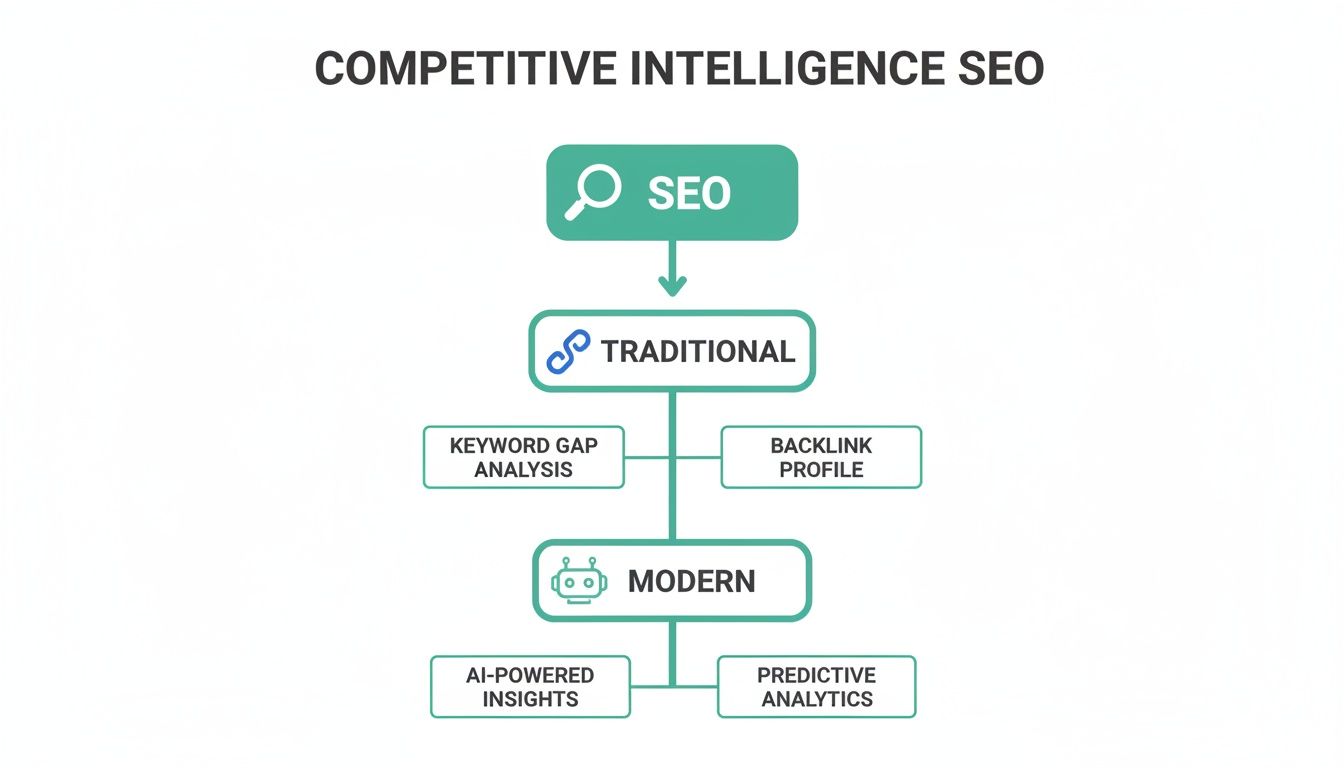
As you can see, the game has shifted from just chasing blue link rankings to understanding and influencing the sources that power AI driven answers.
Establishing Your Monitoring and Reporting Workflow
With your targets and metrics defined, you need a consistent workflow. This is what turns raw data into actionable insights that inform your strategy. It involves setting up automated tracking, scheduling regular analysis sessions, and creating clear reports for stakeholders. The goal is to spot trends and counter competitive threats before they gain momentum. The AI SEO software market is projected to grow from USD 1.99 billion to USD 4.97 billion by 2033, highlighting the increasing investment in sophisticated monitoring. A clear workflow helps organize findings and present them effectively. Comparing metrics over time is key to showing progress and spotting strategic shifts. You can learn more about this in our guide on how to do competitive analysis in SEO.
| Workflow Component | Traditional Approach | Modern CI Approach |
|---|---|---|
| Data Collection | Manual keyword and backlink exports. | Automated tracking of SERPs, AI answers, and citation sources. |
| Analysis Focus | Ranking changes and new backlinks. | Content gap analysis and AI answer share trends. |
| Reporting Cadence | Monthly or quarterly static reports. | Real-time dashboard with alerts for significant changes. |
| Action Items | Build more links, write more content. | Create authoritative source content, optimize for AI citations. |
Decoding the Metrics of AI-Powered SEO Analysis
The old SEO scorecards are becoming outdated. To win in 2025 and beyond, you must track a new set of metrics that reflect how AI is reshaping search. Foundational pillars like keyword gap analysis still have their place, but the real competitive edge now comes from understanding your visibility inside AI driven answer engines. This means we need to shift our focus from just chasing rankings to building genuine influence.
Success is no longer just about landing in the top ten blue links. It’s about being the trusted source an AI model cites in its direct answers. This new reality demands a modern approach to competitive intelligence for SEO, one that measures your presence in these emerging, high impact formats.
Understanding Next Generation Competitive SEO Metrics
The heart of a modern competitive intelligence SEO strategy is measuring what truly matters in an AI first world. It means looking beyond traditional metrics to new indicators that signal authority and trust to Large Language Models (LLMs). These metrics reveal who is winning the authority battle inside AI Overviews and conversational search, even if they don't have the highest organic ranking.
Here are the key metrics for this new landscape:
AI Answer Share: Think of this as the new impression share. It’s the percentage of times your brand is mentioned or cited in AI generated responses for a target set of queries.
Citation Source Dominance: This metric pinpoints which domains and specific URLs AI engines consistently use as their source of truth. The goal is simple: become the primary citation for your core topics.
LLM Tracking: This involves actively keeping an eye on mentions of your brand, products, and key people across different LLMs like Gemini and ChatGPT to gauge sentiment and contextual relevance.
These numbers paint a much clearer picture of your actual influence. A competitor might have fewer top ranking keywords but a higher AI Answer Share, making them a much bigger threat than a traditional analysis would suggest.
Comparing Traditional vs Modern AI Search Metrics
To get a handle on this shift, it helps to see the old and new metrics side by side. Traditional metrics tell you how you're doing in classic SERPs, while modern metrics reveal your influence in the world of generative answers. This distinction is critical. We're finding that these modern metrics often predict future market shifts long before they show up in your traffic data.
| Metric Category | Traditional Metric (Google SERPs) | Modern Metric (AI Search & Answers) | What It Tells You |
|---|---|---|---|
| Visibility | Keyword Rankings | AI Answer Share | How often your brand appears in AI-generated responses. |
| Authority | Domain Authority / Backlinks | Citation Source Dominance | Which domains AI engines trust as authoritative sources. |
| Traffic | Organic Clicks | Mention Velocity & Context | The frequency and nature of brand mentions within LLMs. |
| Content | Top Performing Pages | Most Cited Content | Which of your assets are being used to form AI answers. |
Ultimately, keeping tabs on these modern metrics allows you to build a more resilient and forward looking SEO strategy. This data is a huge piece of the puzzle, and you can learn more about how it fits into the bigger picture in our article on how to calculate share of voice.
Using AI to Supercharge Your Competitive Intelligence
It's time to use AI as your own strategic weapon. The same technology powering generative answers is also reinventing competitive intelligence, automating the heavy lifting of data analysis to deliver insights at incredible speed. This lets you get ahead of the market instead of just reacting to it. Forget spending weeks digging through competitor content. Modern AI algorithms can deconstruct an entire strategy in minutes, spotting thematic gaps, identifying effective content formats, and flagging emerging trends. This is the heart of predictive SEO, using data to find tomorrow's ranking opportunities.

Leveraging AI for a Deeper Competitive Analysis
Today's competitive intelligence SEO tools are much more than keyword trackers. They dig deep into the mechanics of AI search, giving you an almost unfair level of clarity on your rivals' game. To get the most out of this, you need to understand the shift toward Generative Engine Optimisation (GEO): from search engines to answer engines. AI platforms can now monitor brand mentions across LLMs, turning unstructured chatter into a goldmine of actionable data. You're not just tracking if a competitor gets mentioned, but how and why. This is where you find the hidden angles that manual research will always miss.
Automating Insight Discovery with AI Platforms
AI isn't just a nice to have anymore; it's a massive performance driver. With Google AI Overviews now in front of 2 billion users and AI search traffic exploding by 527%, the shift is undeniable. Around 60% of searches now result in zero clicks because people get their answers directly. If you're not visible in the AI's answer, you're invisible.
This automation comes to life when you see what AI actually does for you:
Content Gap Identification: AI tools scan thousands of competitor pages to surface valuable topics you've completely missed.
Predictive Keyword Forecasting: They analyze trend data to suggest keywords that are about to take off, not ones that have already peaked.
Sentiment Analysis: Instantly gauge how people feel about a competitor's brand across social, forums, and reviews.
This is how you move from guessing to knowing, making strategic bets with precision.
Actionable Plays to Outmaneuver Your Competition
All this data is useless until it fuels action. Let's turn our intelligence into practical, step by step plays you can run right now to carve out a measurable advantage. These are proven tactics designed to exploit competitor weaknesses and cement your authority in an era of AI driven search.
Each play moves beyond simple analysis into clear instructions with expected outcomes. The goal is to outmaneuver rivals by being smarter and faster. This is how competitive intelligence for SEO graduates from a report into a real world market advantage.
The Content Gap Counterattack Play
This classic tactic gets a modern upgrade for generative SEO. Forget just finding keywords a competitor ranks for that you don't. Instead, you're hunting for entire user questions they fail to answer completely. Your mission is to create the definitive resource that fills that void.
Identify Weak Content: Use your competitive intelligence tools to find competitor pages that rank well but have low engagement, thin content, or miss the full scope of a user's problem.
Deepen the Research: Go beyond keywords. Dive into "People Also Ask" boxes, Reddit threads, and niche forums related to the topic. What follow up questions are people really asking?
Build a Superior Asset: Create a more thorough piece that directly answers those overlooked questions. Weave in unique data, custom visuals, and structure it cleanly for both human readers and AI crawlers.
The payoff? You don't just steal their organic rankings; you also position yourself as the preferred citation source for AI engines on that topic.
The Authority Backlink Replication Strategy
Think of authoritative backlinks as trust signals, endorsements that tell search engines you’re credible. This play involves systematically earning links from the same high authority domains already pointing to your competition. It's the most direct way to borrow their credibility. First, analyze a competitor’s backlink profile and filter for high authority domains. Next, categorize their links by type, whether they are guest posts, resource page links, or directory listings. Finally, launch a targeted outreach campaign to those same domains, offering a better, more relevant resource for them to link to.
The AI Citation Snatch Play for SEO
This is a distinctly modern play built for the age of generative answers. It’s all about identifying the exact sources AI models use to answer key questions in your niche and then building a more authoritative resource to replace them. This is the heart of any serious competitive intelligence SEO program for 2026 and beyond. Imagine a B2B SaaS company sees a competitor dominating AI answers for "best project management workflows." The AI Citation Snatch play is a surgical strike to unseat them. The company would start by dissecting the competitor's cited article, noting its structure, data points, and any logical gaps. The next move is building something undeniably better. This new asset would include more workflow examples, updated statistics from 2025, and a free downloadable template. The final step is promoting this superior piece to authoritative industry sites to build the signals AI engines need to recognize it as the new definitive source.
Choosing Your Competitive Intelligence SEO Toolkit
Executing a modern SEO strategy means having the right gear. Your competitive intelligence toolkit is the arsenal you'll use to gather data, analyze rivals, and spot opportunities. Making the right call here directly shapes the quality and speed of your insights for 2025 and beyond. The demand for these platforms is exploding. The global SEO software market, currently valued at USD 85.97 billion, is projected to rocket to USD 271.9 billion by 2034. That growth signals a massive shift toward tools that deliver a real competitive edge. You can learn how enterprises are leading this charge on Fortunebusinessinsights.com.
Core Features of a Modern SEO Intelligence Toolkit
When evaluating platforms, think beyond basic keyword and backlink analysis. A truly modern toolkit needs features built for the new era of search, giving you a clear view into AI driven discovery. The goal is to invest in a tech stack that gives you an actual advantage.
Your ideal toolkit should have:
AI Answer Share Tracking: The ability to measure how often your brand and your competitors are cited in AI Overviews.
LLM Tracking: Features that monitor brand mentions and sentiment across major Large Language Models like Gemini and ChatGPT.
Citation Source Analysis: Tools that pinpoint the exact domains and URLs that AI engines rely on as primary sources.
Predictive Analytics: AI powered forecasting that can spot emerging keywords and content trends before they become mainstream.
Selecting Your Tools for Competitive SEO Intelligence
Picking the right software means understanding the difference between tools built for the past and platforms designed for the future. Traditional tools are great at analyzing SERPs, but they often can't see into the complex world of generative SEO. For a deeper dive, check out our guide on the best competitive analysis tools. Prioritize platforms that offer modern features like LLM tracking, AI search visibility monitoring, and citation source analysis. A future proof tech stack is one that gives you clear insights into the AI powered answer economy. That's how you secure an advantage that lasts.
Summary and Final Recommendations
In the evolving landscape of 2026, competitive intelligence is the bedrock of a successful SEO strategy. It’s about shifting from a reactive stance to a proactive one. By blending traditional SEO analysis with modern metrics like AI Answer Share and Citation Source Dominance, you can anticipate market shifts and outmaneuver your rivals. The key is to build a continuous process of gathering data, analyzing it with AI powered tools, and translating those insights into actionable plays. This approach ensures you not only compete in today’s search environment but also dominate the AI driven answer engines of tomorrow.
Frequently Asked Questions
What is competitive intelligence in SEO?
Competitive intelligence in SEO is the ongoing process of researching and analyzing your competitors' digital marketing strategies to identify their strengths and weaknesses. This data is then used to inform and improve your own SEO efforts, from content creation to backlink building, with a focus on gaining an advantage in both traditional and AI-powered search results.
How does competitive intelligence improve SEO performance?
It improves performance by providing a clear roadmap of what works in your industry. By understanding which keywords your competitors rank for, what content resonates with their audience, and where they get their authoritative backlinks, you can identify gaps in your own strategy, discover new opportunities, and make more data-driven decisions that lead to higher rankings and more traffic.
What are the best tools for competitive SEO intelligence in 2025?
The best tools integrate traditional SEO metrics with modern, AI-focused analytics. Look for platforms that offer features like keyword gap analysis, backlink profiling, and content monitoring, but also include next-generation capabilities such as AI Answer Share tracking, LLM brand mention monitoring, and citation source analysis to give you a complete picture of the competitive landscape.
How often should I conduct a competitive SEO analysis?
A basic analysis should be performed monthly to track key changes in rankings and backlink profiles. However, a deeper, more comprehensive competitive intelligence review should be conducted quarterly. This allows you to identify broader strategic shifts in your competitors' content and AI visibility, giving you enough time to adapt your own strategy accordingly.