DeepSeek SEO: A Practical Guide to AI Search Visibility in 2025
Updated February 3, 2026
What is DeepSeek SEO? In simple terms, it's the process of optimizing your website and content to be found, understood, and cited by the DeepSeek AI answer engine. This isn't about climbing a traditional search results page. The goal is to become a trusted, citable source for the direct answers DeepSeek constructs for its users. As AI-driven search becomes the norm in 2025 and 2026, mastering this new form of optimization, known as generative SEO, is no longer optional; it is essential for digital visibility.
The Unstoppable Rise of DeepSeek and its Impact on SEO
DeepSeek represents a fundamental shift in how people access information online, forcing marketers and content creators to rethink their visibility strategies. Its rapid growth has created a significant opportunity for businesses ready to adapt to this new era of AI search. The platform operates differently from traditional search engines. Instead of focusing solely on keywords, DeepSeek's models prioritize content with specific attributes.
Core Principles for DeepSeek Search Optimization
To achieve visibility on DeepSeek, content must demonstrate logical depth, verifiable data, and clear sourcing. DeepSeek's models are actively looking for content that is well structured, comprehensive, and easy for a machine to parse. This means clear headings, tables, and lists are highly valuable. Content packed with specific numbers, statistics, and factual claims that can be cross referenced is also favored. Finally, the AI rewards content that is transparent about its sources, thereby proving its authority. Keyword stuffing is an outdated tactic; winning in this environment requires a deliberate strategy to become a definitive source of truth.
Understanding the Generative SEO Opportunity with DeepSeek
Optimizing for DeepSeek means getting featured as a source within its generative answers. Unlike Google, which provides a list of links, DeepSeek synthesizes information from multiple sources to create a single, cohesive response. Your goal is to ensure your content is a primary ingredient in that synthesis. This is the core of what we call generative SEO or AI search visibility. The urgency is underscored by DeepSeek’s incredible market penetration. According to a recent analysis, the platform's user base surged to 96.88 million monthly active users by April, making it the fourth largest AI app globally. That figure represents a 25.81% increase from March alone. For a deeper dive, you can explore more of these DeepSeek statistics and see the full picture.
Key Differences in SEO Focus for DeepSeek
To achieve results, you must adapt your tactics. The old playbook is insufficient. The following table highlights the crucial differences between traditional SEO for Google and the specialized approach needed for DeepSeek.
| Tactic | Traditional SEO (for Google) | DeepSeek SEO (for Answer Engines) |
|---|---|---|
| Primary Goal | Rank on the first page of search results. | Become a cited source in a generated answer. |
| Content Focus | Narrative flow and keyword density. | Factual accuracy and structured data points. |
| Key Metric | Organic traffic and keyword rankings. | Answer share and citation frequency. |
| Technical Focus | Core Web Vitals and mobile friendliness. | Advanced schema markup and semantic clarity. |
According to Riff Analytics, a leader in AI visibility tracking, "LLM tracking is becoming essential for brands that want to maintain a competitive advantage in an AI first world." This means it is time to move beyond standard analytics and adopt specialized tools that can monitor your brand's presence inside AI responses.
How DeepSeek Finds and Cites Your Content
Getting an AI like DeepSeek to cite your content is different from traditional SEO. You are not trying to climb a list of links. Instead, you are trying to become an indispensable source of truth for a machine building an answer from scratch. This is the heart of generative SEO: moving beyond keywords to focus on what makes a page a reliable, citable authority. DeepSeek's models do not just "read" your content; they dissect it, looking for discrete, verifiable facts to extract and weave into a new narrative. An organized article with clear definitions, hard numbers, and data tables will almost always outperform a purely narrative post because it provides the raw, machine readable information DeepSeek needs.
Making Your Content Citable for AI Engines Like DeepSeek
How do you get selected as a source? You make your content incredibly easy for a machine to parse, verify, and cite. The AI constantly scans for signals of authority and clarity. Imagine a page that clearly defines a technical term, supports it with a statistic, and links to an authoritative source. That is a perfect citation candidate. Vague, opinion heavy, or data deficient content gets ignored. DeepSeek is trained to avoid ambiguity. It always asks: Can I trust this? Is it presented as a fact? Is the source credible? Your job is to structure your content so the answer to all three questions is a firm "yes."
Why Structured Data Is Crucial for DeepSeek Visibility
Structured data, or schema markup, is non negotiable for any serious DeepSeek strategy. Think of schema as a translator that tells the AI exactly what your content is about in its native language. It removes guesswork by explicitly labeling elements like FAQs, how to steps, or an article's author. While much of the web still neglects schema, sites that use it often achieve disproportionately high visibility in rich results and AI answers. Implementing the right schema can provide a massive edge. FAQPage schema breaks down topics into clean question and answer pairs, perfect for direct inclusion. HowTo schema organizes instructions into a logical sequence. Article schema clearly identifies authorship and publication dates, establishing credibility.
Auditing Your Website for DeepSeek Readiness
Is your website built to be a source of truth for an AI? Answering that question is the first step toward winning in this new era of generative SEO. Auditing your site for DeepSeek readiness is a systematic check to see if your content is structured like a reliable, machine readable dataset. By 2025 and 2026, websites that fail this audit will become invisible to the growing number of people getting answers directly from AI. This audit is a practical playbook covering everything from on page elements to off page signals, while also adhering to general best practices that help improve SEO rankings overall.
Evaluating On-Page DeepSeek SEO Factors
The core of your audit begins with your on page structure. DeepSeek rewards precision and clarity. First, examine your schema markup. Are you correctly using FAQPage, HowTo, and Article schema? Next, analyze your heading structure. A page with a clear, logical hierarchy is an open book to an AI crawler. Here is a quick checklist:
Precise Schema Markup: Is
FAQPageschema on Q&A pages? IsHowToused for step by step guides?Logical Heading Hierarchy: Do headings follow a natural sequence and accurately describe their content?
Factual Density: Is your content packed with specific, verifiable data points, statistics, and definitions?
Analyzing Off-Page Authority for DeepSeek SEO
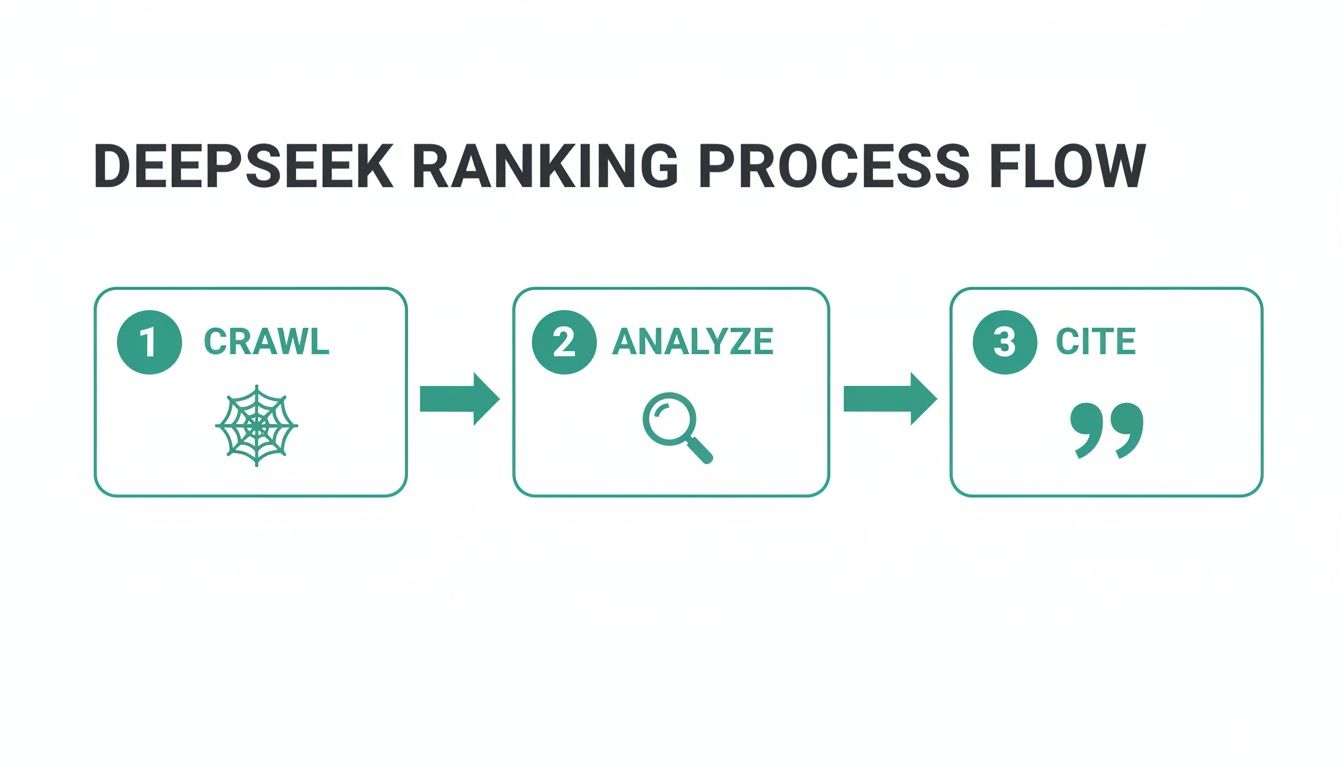
Beyond your own site, DeepSeek weighs citations from established authorities heavily. A crucial part of your audit is understanding this off page landscape. You need to identify which external sources DeepSeek already trusts in your niche and find gaps where competitors are winning the citation game. This process reveals how DeepSeek discovers, analyzes, and cites information. As you can see, becoming a cited source is the final, crucial step. DeepSeek's own viral adoption demonstrates this principle; its organic search traffic increased by an incredible 584.21% in just six months, driven by benchmark wins and competitive pricing. This is the kind of authority that earns citations.
Using Analytics to Improve DeepSeek Performance
To audit effectively, you need tools that see what AI engines see. A platform like Riff Analytics is essential for spotting underperforming pages. It helps you track which pages are getting cited and which are being ignored in favor of a competitor. This data is necessary to prioritize your optimization efforts. For a detailed walkthrough, our comprehensive site audit checklist is a great resource.
Crafting Content for DeepSeek's Answer Engine
Once your audit reveals the gaps, it is time to build content that DeepSeek wants to cite. The goal for 2025 and beyond is to stop writing standard blog posts and start creating authoritative "source documents" an AI can parse and trust. This is a fundamental shift. Generative SEO is less about storytelling and more about information architecture. DeepSeek’s models are not reading your content for flair; they are scanning it for discrete, verifiable facts, clear definitions, and unambiguous data points. Content that provides these elements with precision becomes an invaluable asset for the AI.
Transforming Content for Better DeepSeek SEO
The main idea is to make your content simple for a machine to understand and verify. This means embedding factual statements directly into your text. For instance, instead of writing, "Our product helps improve efficiency," be specific. A much better, citable version is, "Our product was shown to improve operational efficiency by 22% in a 2024 case study." The second statement is a fact an AI can use. This level of precision is everything. Treat every key assertion as a potential source for a generated response and ensure it is backed by data or a clear definition.
Advanced Schema for a Stronger DeepSeek Presence
Basic schema is just the starting point. To truly stand out, use advanced tactics to build a powerful knowledge graph. This means going beyond standard Article or FAQPage schema to connect the dots between entities on your site. Using about and mentions properties, you can explicitly tell AI models how different concepts, people, or products relate to one another. An article about a software feature could use schema to link to the author's profile, the product's main feature page, and relevant case studies. This creates a dense web of interconnected, machine readable information that establishes deep contextual authority, a massive signal for AI search visibility.
How to Measure Your DeepSeek SEO Performance
If you cannot measure it, you cannot improve it. Traditional metrics like keyword rankings and organic traffic are becoming obsolete because they fail to capture what matters for visibility inside an AI search engine. Success in 2025 and 2026 demands a new set of KPIs. These AI native metrics are not about your spot on a list of links; they are about your brand's presence inside the answers DeepSeek generates. This requires a shift in both mindset and toolset, moving beyond standard website analytics to track your direct influence.
Key Metrics for Your DeepSeek SEO Reporting
To get an accurate read on your performance, you must track KPIs that reflect citation and answer dominance. Standard analytics platforms are blind to this activity, making specialized LLM tracking tools essential. The core metrics for your dashboard include:
Answer Share: This measures the percentage of relevant, AI generated answers where your brand is mentioned or your content is cited.
Citation Frequency: This counts how often DeepSeek names your domain as a source. High frequency indicates trust.
Contextual Sentiment: This analyzes how your brand is mentioned. Are you positioned as a leader or an alternative?
A tool like the DeepSeek brand mention tracker is perfect for this, offering continuous monitoring of these crucial data points.
Setting Up a Monitoring Process for DeepSeek
Once you define your KPIs, you need a workflow to monitor them constantly. DeepSeek's models are always evolving, and competitors are always adapting. Use a platform like Riff Analytics to automate the tracking of your answer share and citation frequency. Set up alerts and reports to spot trends, find new opportunities, and see how your optimizations are paying off. This moves your strategy from reactive to proactive.
Comparing Traditional and AI SEO Metrics
It is critical to understand how different this new measurement model is. The following table contrasts old metrics with the new KPIs for AI search.
| Metric Type | Traditional SEO (Google) | DeepSeek SEO (AI Engines) |
|---|---|---|
| Primary Goal | Achieve a high ranking on a SERP. | Become the primary cited source in an answer. |
| Visibility KPI | Keyword Rank and Organic Impressions. | Answer Share and Citation Frequency. |
| Engagement KPI | Click Through Rate (CTR) and Time on Page. | Contextual Sentiment and Share of Voice. |
| Tools Used | Google Search Console, Ahrefs, SEMrush. | Riff Analytics, specialized LLM tracking platforms. |
DeepSeek's rapid growth in enterprise AI search underscores this transition. The platform has risen to number three in market share for developer SDK usage, processing 5.7 billion calls per month. Its appeal is amplified by a 28% cost savings per million tokens compared to OpenAI's models, cementing it as a major player you cannot ignore. You can find more stats on DeepSeek's AI market position on sqmagazine.co.uk. Learn more in our guide on how to rank in AI overviews.
Summary and Final Takeaways
DeepSeek's rise signals a new chapter for digital marketing, shifting user expectations toward direct, synthesized answers. To succeed, you must build content that is not only informative for humans but also perfectly structured as a reliable dataset for an AI. This requires a focus on factual density, clear sourcing, and technical precision through schema markup. Brands that adapt to this new reality will dominate in 2025, 2026, and beyond. Measuring performance with AI native KPIs like answer share and citation frequency using specialized tools is no longer optional; it is essential for a data driven strategy that ensures your content becomes a trusted source.
Frequently Asked Questions about DeepSeek SEO
What is DeepSeek SEO and why is it important for 2025?
DeepSeek SEO is the practice of optimizing your content to be used as a citable source by the DeepSeek AI answer engine. It is important for 2025 and beyond because AI is becoming a primary way people find information, and visibility within these answers is crucial for brand authority and reach.
How can I make my content more visible to DeepSeek?
Focus on creating factually dense, highly structured content. Use clear headings, bullet points, and data tables. Implement precise schema markup like FAQPage and HowTo to make your content easily machine readable. Back up all claims with specific data and statistics.
What tools are needed to track my DeepSeek SEO results?
Traditional SEO tools cannot measure performance inside AI answers. You need a dedicated AI visibility or LLM tracking platform like Riff Analytics. These tools monitor metrics like answer share, citation frequency, and contextual sentiment, providing a clear picture of your actual influence.
How is optimizing for DeepSeek different from Google's AI Overviews?
While both involve optimizing for AI generated answers, DeepSeek often pulls from a more globally diverse set of sources and has a strong preference for technical and data rich content. Optimizing for it requires a specific focus on becoming a citable authority in its knowledge base through structured data and factual precision.