How Do You Calculate Share of Voice in 2025 and Beyond?
Updated January 21, 2026

In today's crowded digital landscape, understanding your brand's visibility is non negotiable. But how do you actually measure it? The answer is Share of Voice (SOV), a powerful metric that tells you how much of the conversation in your market you truly own. In simple terms, SOV is your brand's visibility compared to your competitors. By 2025 and 2026, as AI search and generative SEO reshape how we find information, knowing how to calculate share of voice won't just be a marketing task; it will be a core business strategy for survival and growth.
The basic formula is straightforward: divide your brand’s key metric, like mentions or impressions, by the total for your market, then multiply by 100. This percentage reveals your command over the digital dialogue, from social media chatter to citations in AI-generated answers.
Why Calculating Share of Voice Is Critical Now
Share of Voice used to be a tidy little advertising metric, but today it’s the ultimate measure of your brand’s visibility across the entire digital ecosystem. The battlefield has expanded far beyond social media feeds and search results, right into AI generated answers from models like ChatGPT and Google's AI Overviews. It's no longer just about who ranks highest on Google; it’s about who gets cited as the definitive answer.
Mastering this calculation gives you a clear, honest benchmark of your brand's presence and authority. It helps you finally answer questions like:
Brand Awareness: How visible are we really to our target audience?
Competitive Standing: Are we leading the conversation, or are we falling behind?
Market Penetration: Have we established a real presence in the channels that matter most?
How to Determine Your Share of Voice with a Formula
While the basic formula stays the same, the specific numbers you plug in will change depending on the channel you’re measuring.
A classic social media example makes this crystal clear. Let’s say your brand gets 500 mentions in a month, and your three main competitors get 300, 450, and 250 mentions, respectively. The total conversation size is 1,500 mentions.
Your calculation is simply (500 / 1,500) × 100, which gives you a 33.33% SOV. This isn’t just some abstract number; it's a direct indicator of your command over the online buzz in your niche.
This same logic now applies to modern channels, including the fast emerging field of generative SEO and LLM tracking. To see how this fits into the bigger picture, it's worth reading up on how to measure marketing effectiveness in the AI era.
And for a more foundational overview, check out our guide on what Share of Voice is and why it's so vital for modern brands.
How to Calculate Your Share of Voice Across Channels
Calculating your brand's Share of Voice isn't a one size fits all process. The beauty of this metric is its flexibility; it works for everything from traditional PR to the wild west of AI driven search. At its core, the logic is always the same: (Your Brand Mentions ÷ Total Category Mentions) × 100.
The real trick is knowing which specific numbers to plug into that formula for each channel.
For example, a major tech firm like Salesforce once calculated its earned media SOV by dividing its 2,500 articles by the total 10,000 pieces published across all its cloud computing competitors. That simple math revealed a 25% SOV, a clear benchmark that drove a massive content push to boost their visibility. You can find more practical examples of PR metrics on prowly.com.
This same thinking now applies to AI search, where the formula helps you track citations in Google AI Overviews or responses from models like Claude.
At a high level, the process is pretty straightforward.
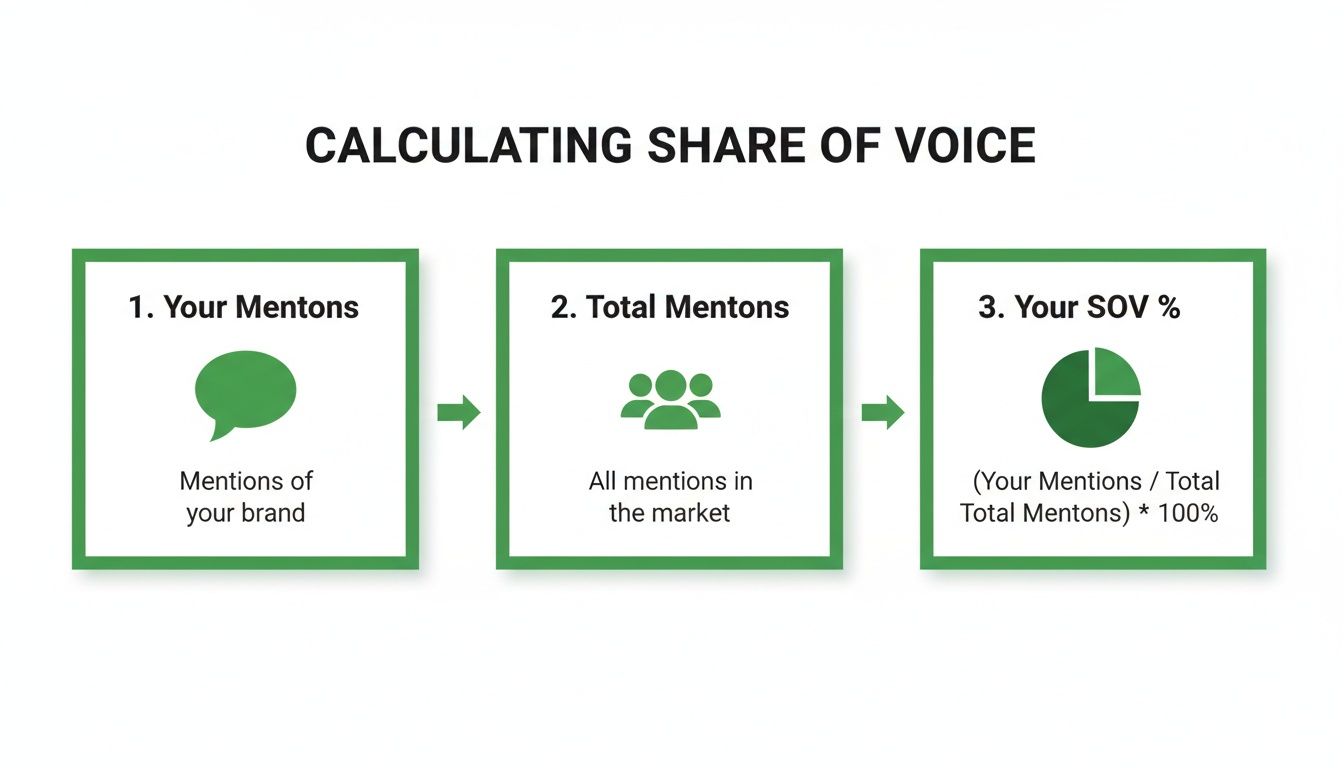
You start by isolating your brand's mentions, stack them up against the total market conversation, and then turn that ratio into a simple percentage. But the devil, as always, is in the details.
Comparing Share of Voice Calculation Methods
This table breaks down how to calculate Share of Voice across key digital marketing channels, helping you choose the right approach and tools for your specific goals.
| Channel | Primary Metric | Calculation Formula | Key Data Sources | Best Suited For |
|---|---|---|---|---|
| Organic Search | Click Share | (Your Estimated Clicks ÷ Total Clicks for Keywords) x 100 | SEO tools (SEMrush, Ahrefs), Google Search Console | Measuring true SERP dominance and traffic potential. |
| Social Media | Mention Volume | (Your Brand Mentions ÷ Total Competitor Mentions) x 100 | Social listening tools (Brandwatch, Talkwalker), native analytics | Gauging brand popularity and conversational dominance. |
| Paid Advertising | Impression Share | (Your Impressions ÷ Total Available Impressions) x 100 | Google Ads, Microsoft Ads (Auction Insights reports) | Assessing paid visibility and ad budget effectiveness. |
| PR & Media | Article Count | (Your Media Placements ÷ Total Industry Placements) x 100 | Media monitoring tools (Meltwater, Cision) | Tracking earned media impact and press coverage. |
| AI Search | Inclusion Rate | (Your Mentions in AI Answers ÷ Total Monitored Prompts) x 100 | AI visibility tools (Riff Analytics, TryProfound) | Monitoring brand presence in generative AI responses. |
Choosing the right method is all about aligning the calculation with your strategic goals. Are you trying to win the conversation on social, own the search results page, or get cited by AI? Each goal demands a different flavor of SOV.
Figuring Out Your Organic Search SOV Calculation
For organic search, just counting mentions won't cut it. You're really measuring your visibility on search engine results pages (SERPs) and, increasingly, within AI generated answers. The goal is to figure out what percentage of relevant organic traffic your brand actually captures.
First, define a tight list of high value keywords your audience uses to find solutions like yours. Then, use an SEO tool to track your rankings for these terms alongside your top competitors.
The formula looks like this:
(Your Brand's Total Clicks ÷ Total Clicks for All Tracked Keywords) x 100
You get your "total clicks" by estimating it: multiply the monthly search volume of each keyword by the average click through rate (CTR) for your ranking position. This is way more insightful than just counting rankings because it weights keywords by their actual traffic potential.
A Practical Approach for Calculating Social Media SOV
On social media, calculating Share of Voice is much more direct. It’s all about the volume of conversation your brand generates compared to your rivals. Here, you’re tracking direct brand mentions, hashtags, and even untagged chatter about your products.
Your first move is to use a social listening tool to pull all relevant mentions for your brand and a defined list of competitors over a set timeframe, like 30 days.
Make sure you're tracking these key metrics:
Direct Mentions: Every time a user tags your brand's official handle.
Hashtag Usage: The frequency of your branded hashtags versus competitor hashtags.
Untagged Mentions: Conversations where people talk about your brand without using an "@" tag.
Once you have the data, the formula is simple. Add up all your mentions and divide by the total mentions for everyone in your competitive set. This gives you a clean snapshot of who's winning the social conversation in your space.
How to Calculate SOV in Paid Advertising
In paid advertising, the MVP metric for Share of Voice is Impression Share. Luckily, this data is sitting right inside platforms like Google Ads. It tells you the percentage of time your ads were shown out of the total number of times they could have been shown.
According to Google, a high impression share is a direct indicator of brand visibility. It proves your budget, bids, and ad quality are strong enough to show up consistently for your target searches.
For the full picture, dive into the platform’s auction insights report. This lets you compare your impression share directly against your key competitors. You can see exactly how often your ads appear versus theirs, giving you a perfect measure of your paid SOV. The goal isn't just to boost your own number, but to understand who's capturing the impressions you're missing out on.
Calculating Share of Voice in AI Search
Generative AI has completely upended how people find information, making the old Share of Voice metrics feel dated. As we push through 2025 and into 2026, AI search visibility isn't just about ranking on a results page anymore. It’s about being the brand AI engines cite as the answer. Welcome to the new frontier of SOV.
This battle is measured by a metric called AI Answer Share. It tracks your brand's presence inside the outputs of Large Language Models (LLMs) like ChatGPT, Perplexity, and Google's AI Overviews. Put simply, it’s the percentage of times your brand is mentioned or your content is cited when a user asks a relevant question.
This shift demands a new playbook called generative SEO, focused on making your content a preferred source for AI models. It’s no longer enough to be visible. Your brand must be seen as an authority that LLMs trust enough to recommend.
How to Determine Your AI Answer Share Calculation
Figuring out your AI Answer Share requires a workflow built for the world of generative AI. Unlike a static SERP, AI answers are dynamic and pull from multiple sources, making measurement a bit more complex but a lot more insightful.
The core formula is still classic SOV, just adapted for this new channel. You're tracking your brand’s citations against your competitors' across a specific set of prompts.
Here's the math:
(Your Brand Citations in AI Responses ÷ Total Competitor Citations) x 100 = AI Answer Share %
This calculation tells you exactly how much of the "answer real estate" you actually own.
Let's say you track 100 relevant industry prompts. Your brand gets cited 20 times, while your competitors are cited a total of 80 times. Your AI Answer Share is 20%. It’s a simple number, but it’s a powerful benchmark for your generative SEO efforts.
The Workflow for Calculating AI Share of Voice
A structured approach is everything if you want accurate, repeatable measurements. The process boils down to defining what to track, gathering the data, and then running the numbers.
Here’s a practical breakdown:
Define Your Arena: First, nail down a focused list of your top three to five direct competitors. At the same time, build a list of high intent, non branded questions your ideal customer would ask an AI assistant.
Monitor the AIs: This is where you need specialized tools for LLM tracking. You'll use them to query models like ChatGPT, Gemini, and Perplexity with your target prompts. This step is non negotiable for systematically collecting data on who gets cited. You can get a feel for how this works by checking out an AI Overview tracker.
Tally the Citations: For every prompt you run, log each time your brand or a competitor is mentioned by name or has their content cited as a source. This creates the raw dataset you need.
Calculate and Analyze: Plug your numbers into the AI Answer Share formula. This gives you a clear performance metric you can benchmark and track over time to see if your content and SEO strategies are actually moving the needle.
As models like ChatGPT increasingly shape buying decisions, knowing how to get seen in their answers is a massive advantage. It’s worth digging into strategies to be the brand ChatGPT recommends to get ahead.
The Right Tools for Measuring Your Brand's SOV
Let’s be honest: you can calculate Share of Voice manually. But it's slow, tedious, and riddled with potential errors, especially as your market heats up. To get this right, you need a solid stack of tools built to automate the heavy lifting and deliver clean, actionable data. The right platform turns SOV from a rough guess into a sharp metric you can build a strategy around.
But there's no single magic tool. The best approach involves layering different platforms, each designed to monitor a specific corner of the digital conversation from social media chatter all the way to AI generated answers.
Tools for Social and Media SOV Calculation
When you need to track conversations happening on social media and in the news, social listening and media monitoring tools are your best friends. Platforms like Brandwatch or Meltwater are fantastic at this, scanning millions of sources in real time.
They’re built to track:
Direct brand mentions on social media, blogs, and forums.
Sentiment analysis, figuring out if the buzz is positive or negative.
Branded hashtag usage and the broader trends driving conversations.
These tools give you a powerful read on public perception and brand heat. But they weren't designed to measure visibility in search results or AI, which requires a completely different toolkit.
Platforms for Measuring Organic and Paid SOV
For anything related to search engine performance, you'll turn to the giants of SEO and advertising. Tools like Ahrefs and Semrush are the industry standard for a reason. They give you a clear picture of your organic keyword visibility and help you estimate traffic share, showing you exactly where you stack up against competitors for business critical keywords.
If you're running paid campaigns, the Impression Share data inside Google Ads is the purest, most direct measure of your SOV on that channel.
According to Semrush, their proprietary SOV metric, "Visibility Score," directly correlates with higher organic traffic. It’s a clear signal that owning the top rankings for high volume keywords is still a primary driver of market presence.
While these platforms are essential for understanding search engine dominance, they have a blind spot: they can’t track your brand’s presence inside the new wave of LLM tracking and AI answer engines.
How to Calculate SOV in AI with Specialized Platforms
The rise of generative SEO created a gap in the market, and a new breed of tool has emerged to fill it. Specialized AI visibility platforms like Riff Analytics are built from the ground up to measure brand presence inside AI generated responses. They deliver unique value by tracking metrics that old school tools completely miss, like AI answer share and citation sources.
If you're curious about this new landscape, our guide on the best SERP tracking tools digs into some of these modern solutions. These platforms automate the otherwise impossible task of querying different AI models and parsing their outputs, giving you a clear, quantifiable picture of your AI SOV.
Common Share of Voice Mistakes to Avoid
Even the sharpest metrics are useless if the math is wrong. A botched Share of Voice calculation can send your entire marketing strategy veering off course, pushing you to chase irrelevant competitors or pour money into channels that just don’t deliver. Getting the calculation right is step one in building a competitive intelligence program you can actually trust.
Mistake 1: Defining Your Competitor List Incorrectly
Many brands fall into the trap of defining their competitive set too broadly. Tossing every company in your general industry into the mix just dilutes the data. Your SOV will look artificially tiny, and the insights you get will be too generic to do anything with. But going too narrow is just as dangerous. If you only focus on one or two direct rivals, you create a distorted, myopic view of the market. You'll completely miss the emerging threats quietly stealing audience attention.
Mistake 2: Ignoring the Quality and Sentiment of Mentions
Another classic error is treating every single mention as equal. This is a massive oversight if you want to determine your Share of Voice accurately. Ten furious customer complaints are not the same as ten glowing reviews from industry influencers. Simply counting the volume without digging into the underlying sentiment gives you a flat, misleading picture of where your brand truly stands. A brand could boast a high SOV based on mention volume, but if 70% of that chatter is negative, their market position is actually incredibly weak.
Mistake 3: Using Inconsistent Data and Timeframes
Consistency is everything for meaningful analysis. Too many teams sabotage their own efforts by comparing data from different time periods or using inconsistent keyword sets. Calculating your SOV over a single week and stacking it up against a competitor’s month long data is like comparing apples to oranges. The numbers will be meaningless. To fix this, lock in a standardized reporting cadence—weekly, monthly, or quarterly. Use the exact same set of keywords and competitors for every single report. This discipline ensures that any shifts you see in your SOV are from actual market dynamics, not just sloppy measurement.
Getting Started with Share of Voice Calculation
You've got the formulas and the workflow down. But a few common questions always pop up when teams start calculating Share of Voice for the first time. Let's tackle them head on.
How Often Should I Calculate Share of Voice?
For most brands, running the numbers monthly hits the sweet spot. It’s frequent enough to catch important trends and see the impact of your campaigns, but not so often that you get lost in meaningless daily noise. That said, during a big product launch or a brand crisis, you'll want to ramp that up to weekly or even daily monitoring. The real key is consistency. Pick a cadence that lines up with your regular strategic reporting, and stick to it.
Can Small Businesses Calculate SOV Without a Huge Budget?
Absolutely. You just need to be smart about your scope. Don't try to boil the ocean by tracking every single player in your industry. Instead, narrow your focus to your one to three most direct competitors. From there, you can use free tools like Google Alerts for media mentions and Google Trends for a pulse on search interest. For social, a bit of manual tracking on mentions and branded hashtags can go a long way. This lean approach gives you sharp, actionable insights without the hefty price tag.
Is Share of Voice Just a Vanity Metric?
This is the big one. And yes, SOV is deeply connected to market share. Think of SOV as a leading indicator. Market research has shown a clear correlation: when a brand's Share of Voice goes up, a rise in market share often follows. It makes intuitive sense. SOV measures your brand's presence in the public conversation, while market share measures your presence in customer wallets. By winning the conversation, you build the awareness and preference that directly influence buying decisions.
Summary and Key Takeaways
Calculating Share of Voice in the age of AI means adapting to a new reality. The core principle remains the same: measure your brand's visibility against the total market conversation. However, the channels have evolved. Focusing on AI Answer Share by tracking mentions and citations in generative AI responses is no longer optional, it's essential. By systematically monitoring your brand's visibility in engines like ChatGPT and Google's AI Overviews, you gain a critical advantage. This approach, the heart of generative SEO, lets you measure what truly matters and sharpen your strategy to win the new search landscape.
Frequently Asked Questions
1. How does generative SEO affect Share of Voice calculation?
Generative SEO shifts the focus from simple keyword rankings to brand citations inside AI generated answers. It forces you to calculate SOV by tracking how often AI models reference your brand or content as a trusted source compared to competitors. This metric, known as AI Answer Share, is the new benchmark for AI search visibility.
2. What is the best way to track brand mentions in LLMs for a SOV calculation?
The most effective method is using specialized LLM tracking platforms. These tools automate the work of querying multiple AI engines with your target prompts, collecting data on brand mentions and citations, and providing analytics to benchmark your performance and calculate your AI Share of Voice over time.
3. Why are citation sources important for calculating AI Share of Voice?
Citation sources are the websites and documents AI models use to build their answers. When your content is cited, it directly boosts your AI SOV and establishes your brand as a credible leader in your field. Tracking these sources reveals what content the AI considers authoritative, giving you a roadmap for your own content strategy.
4. How can I calculate my company's share of voice on a budget?
Start by focusing on 1-3 direct competitors and use free tools. Set up Google Alerts for your brand and competitor names. Use Google Trends to compare search interest. Manually track branded hashtags and mentions on your primary social media channel. This lean approach provides directional data without the cost of enterprise software.