How Many Keywords Per Page SEO: A Modern Guide for 2025
Updated January 12, 2026
The old SEO question, "How many keywords should I use per page?" is officially obsolete. In 2025 and beyond, this number game has been replaced by a smarter, more effective strategy: building topical authority. Instead of chasing a magic number, the goal is to center your content around one primary keyword and support it with a comprehensive network of related terms. This approach signals expertise to modern search engines like Google and AI engines like Perplexity, proving your content is the most authoritative answer available.
Understanding the Optimal Number of Keywords Per Page
So, what is the ideal number of keywords per page for SEO today? The most accurate answer is not a number, but a strategy. Focus on creating one page that is the most helpful and complete resource for a user's query. This is the only way to achieve sustainable rankings in an era of sophisticated algorithms and AI Overviews.
This shift from counting keywords to covering topics is critical. It demonstrates genuine relevance to search engines far more effectively than any outdated metric. For years, keyword density was a key performance indicator. However, this led to keyword stuffing, where pages were filled with repetitive terms, making the content unreadable. Today, that practice will earn you a penalty, not a top spot.
Why Prioritizing Topics Beats Counting Keywords for SEO
Thinking about the ideal number of keywords per page is really about focusing on depth, not repetition. A modern SEO strategy is far more nuanced. It involves creating a web of related terms and concepts around a central theme, which sends a powerful signal to Google that your content is comprehensive. A study by SearchAtlas revealed that pages ranking in the top 10 results now have 50% lower keyword density than they did just a few years ago. This data underscores the shift toward semantic richness.
Here is how to structure your content for maximum impact:
One Primary Keyword: This is the core search query the page is built to answer. It should appear in your title tag, H1 heading, and introduction.
Secondary Keywords: These are close variations or synonyms of your primary keyword.
Semantic Keywords: These are conceptually related terms and questions that add context, making your content thorough and boosting your AI search visibility.
When you structure a page this way, you are not just targeting keywords; you are satisfying user intent completely.
The Negative Impact of Counting Keywords on Your Rankings

Fixating on a specific number of keywords per page is an outdated SEO habit that will actively sabotage your performance in 2025. This approach is unnatural and ignores what modern search engines value. Today’s algorithms use advanced Natural Language Processing to understand the context and relationships between ideas, not just count keyword occurrences.
This means over optimizing your content, a practice known as keyword stuffing, is a major red flag. Search engines interpret it as a lazy attempt to manipulate rankings instead of providing real value. The result is often a penalty that tanks your visibility. A page that naturally covers a topic with a rich variety of related terms will always outperform one that is just trying to hit an arbitrary keyword quota.
How Many Keywords Is Too Many Per Page
The data shows a clear trend away from keyword repetition. The most successful pages focus on quality and comprehensive coverage. According to a recent analysis, top 10 search results have significantly lower keyword density than in previous years, reflecting Google's focus on content quality and "information gain." You can explore the SEO statistics in the full research for more details.
This shift is crucial for your AI search visibility. Generative AI engines and LLM tracking systems require deep contextual understanding to formulate answers. Pages stuffed with keywords are semantically shallow and lack the richness these systems need to identify them as an authoritative source worth citing. A page with too many keyword repetitions will fail to perform in generative SEO.
Developing a Keyword Strategy for Each Page
Let's move from theory to practical application. A smart keyword strategy for 2025 is not about hitting a certain number of keywords. It is about building a page so comprehensive that it becomes the definitive answer for a search query. The framework we use is the "one primary, many related" model.
Every page needs a single primary keyword that captures the core user question. This first step is vital because it sets the direction for the entire piece. You must understand your audience and analyze what your competitors are ranking for. If you need help with this, our guide on how to do competitive analysis in SEO is an excellent resource.
Mapping Your Primary and Secondary Keywords Per Page
Once you have your primary keyword, it is time to add its supporting cast: secondary and semantic keywords. Secondary keywords are close synonyms, while semantic keywords are related ideas and questions that provide depth. A good rule of thumb is to aim for one primary keyword and two to four closely related secondary keywords per page. This keeps your content focused.
If you are planning content on a larger scale, a solid framework for scaling your content marketing efforts will help you connect your strategy across your entire site.
Here is where to place your keywords:
Primary Keyword: Place it in your title tag, H1 heading, the first paragraph, and the URL slug.
Secondary Keywords: Weave these into your H2 and H3 subheadings to structure the article.
Semantic Keywords: Sprinkle these naturally throughout the body content, in bulleted lists, image alt text, and FAQ sections.
This structure sends clear signals about your page's expertise, optimizing it for both traditional and generative AI search.
Optimizing Content for Semantic Search and AI Visibility
Your keyword strategy now extends beyond classic search results into the world of AI powered search. The groundwork you lay with semantic keywords directly fuels your success with generative AI engines like Google’s AI Overviews and Perplexity. These models rely on a deep contextual grasp of a topic to build their answers. Pages that cover a subject comprehensively are more likely to be cited as an authoritative source.
This diagram breaks down the ideal keyword hierarchy for a single page, built for both traditional search engines and AI.
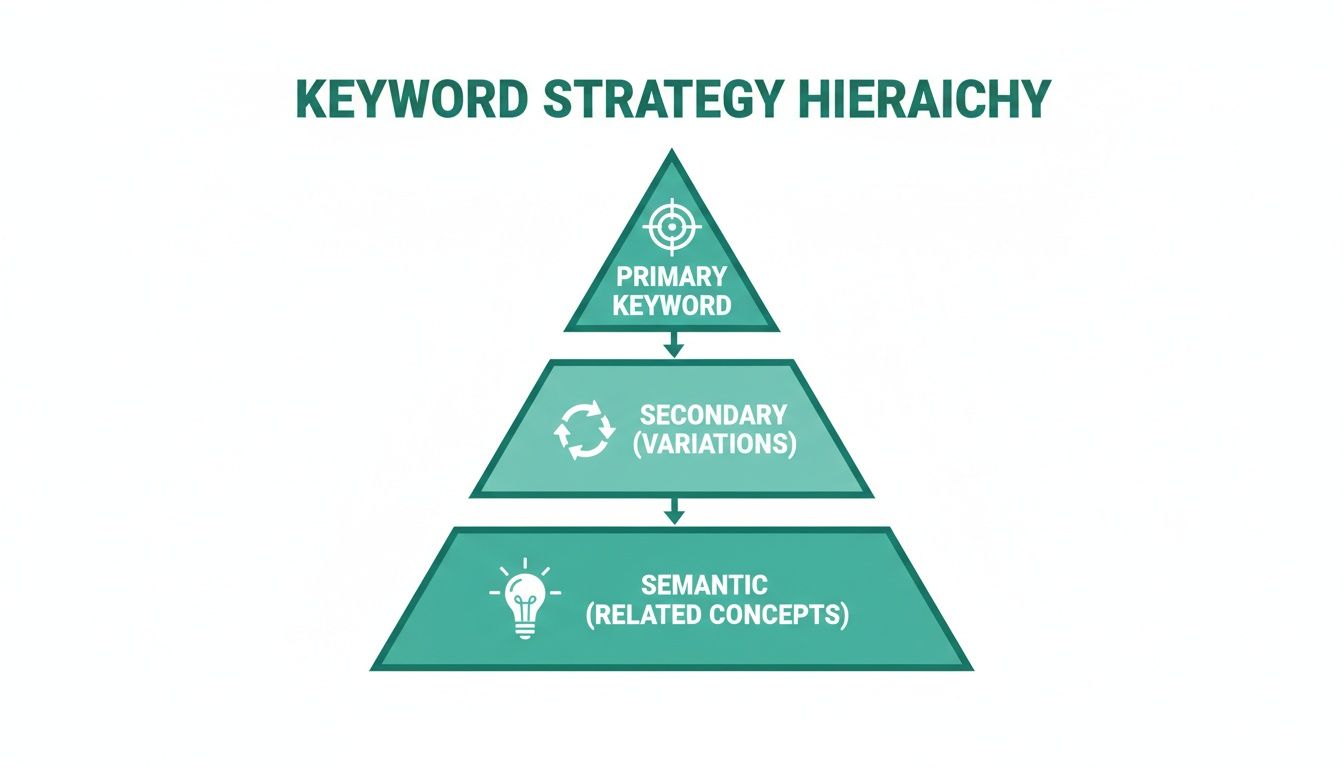
This structure shows how one primary keyword is supported by secondary variations and a wide base of semantic terms. Together, they create deep topical relevance. A semantically rich page provides the clear signals AI needs, turning your content into a valuable resource for both humans and machines.
How Semantic Keywords Boost Your AI Search Visibility
Thinking about "how many keywords per page" now means preparing your content for AI. This field, known as Generative SEO, is about making your content easy for Large Language Models (LLMs) to understand and reference. When a user asks a question, these AI systems scan for the most complete and trustworthy information.
According to Writesonic, a well optimized page should focus on one primary keyword but back it up with two to four secondary keywords and other related terms to build contextual depth.
This is where your semantic keyword strategy is most effective. By naturally weaving in related concepts, you are providing the AI with the material it needs. This makes your content a prime candidate for citations in AI generated summaries. To learn more, our guide on how to optimize content for AI search offers practical steps. This approach future proofs your SEO, positioning your content as a foundational source of knowledge.
Comparing Keyword Optimization Strategies
The difference between old and new SEO is stark. An outdated strategy built on keyword density cannot compete with a modern approach rooted in semantic relevance and topical authority. Making this shift is essential for visibility in 2025 and beyond.
The old method treated search engines as simple machines that could be tricked with repetition. The modern approach treats them as sophisticated systems that reward the most helpful answer. This fundamental difference changes everything, from keyword selection to success measurement. This comparison highlights why we have moved past asking "how many keywords?" and now focus on creating the single best resource on a topic.
Keyword Stuffing vs. Semantic SEO: A Strategic Comparison
The table below breaks down why building semantic relevance is a far superior strategy to chasing an arbitrary keyword count, especially for AI search visibility.
| Aspect | Outdated Approach (Keyword Density) | Modern Approach (Semantic Relevance) |
|---|---|---|
| Core Philosophy | Manipulate rankings through repetition. | Earn rankings by being the best answer. |
| Keyword Focus | A rigid list of exact match terms. | One primary keyword supported by a web of related concepts. |
| Key Metrics | Keyword count and density percentage. | Topical coverage, user engagement, and AI citations. |
| AI Visibility | Poor. Lacks the context needed for LLMs. | Excellent. Provides rich, structured data for AI Overviews. |
One approach is about gaming a system, while the other is about creating genuine value. In today's AI driven search environment, only the latter has a future.
Your Modern Keyword Optimization Checklist
It is time to put everything together. This is a repeatable process for auditing existing content and guiding new creations. It is a gut check to ensure you are building strategic assets, not just filling pages.
Here is how to approach it every time:
Start with your North Star. Every page gets one primary keyword. This focus prevents keyword cannibalization and ensures each piece of content has a clear purpose.
Build out the context. Find two to four strong secondary keywords and a handful of semantic terms that add depth. These details show search engines you are covering the topic comprehensively. A keyword rankings and visibility report is perfect for tracking these related terms.
Place keywords thoughtfully. Your primary keyword should be in your title tag, H1, first paragraph, and URL. Weave secondary and semantic terms naturally into subheadings, body copy, and image alt text. The goal is natural flow, not forced repetition.
Do a final human check. Read the page aloud. Does it sound natural? Does it answer the user's question without sounding robotic? This final pass separates content that exists from content that performs, securing better rankings with both traditional and generative AI search.
Summary and Key Takeaways
The question of "how many keywords per page" has evolved. Instead of focusing on a specific number, modern SEO prioritizes creating the single best resource for a user's query. This means focusing on one primary keyword and supporting it with a rich ecosystem of secondary and semantic terms. This approach builds topical authority, satisfies user intent, and optimizes your content for both traditional search engines and emerging AI platforms. By moving away from outdated tactics like keyword stuffing and embracing semantic relevance, you create content that is valuable, authoritative, and built to perform in 2025 and beyond.
Frequently Asked Questions
What is the best number of keywords per page for SEO in 2025?
There is no magic number. The best practice is to focus on one primary keyword per page. Support this with 2 to 4 secondary keywords (close variations) and a variety of semantic keywords (related concepts and questions) to build topical authority and cover the subject comprehensively for both users and search engines.
How can I determine the right secondary and long tail keywords for my page?
Start by analyzing the search engine results page (SERP) for your primary keyword. Look at Google's "People Also Ask" and "Related Searches" sections. These are direct insights into what users are searching for. SEO tools like Ahrefs or Semrush also provide extensive keyword suggestion features that can help you find relevant long tail and semantic terms.
Can I target the same primary keyword on multiple pages?
No, you should avoid targeting the same primary keyword across multiple pages. Doing so causes "keyword cannibalization," where your own pages compete against each other in search results. This confuses search engines about which page is the true authority, often resulting in lower rankings for all of them. Assign a unique primary keyword to each page.
Does Google penalize for using a keyword too many times?
Yes, this is called "keyword stuffing," and it can lead to a penalty. Modern algorithms can easily detect when keywords are used unnaturally to manipulate rankings. This practice creates a poor user experience and signals low quality content. Instead of repetition, focus on using a diverse range of related terms to demonstrate expertise.
How does generative SEO affect how many keywords I should use?
Generative SEO and AI search engines prioritize content that is contextually rich and comprehensive. For optimal performance, your page should not just repeat keywords but explore a topic in depth using many related entities and synonyms. This provides Large Language Models (LLMs) with the structured, authoritative information they need to generate answers, increasing your chances of being cited.