How to Calculate Share of Voice: A 2025 Guide
Updated December 15, 2025

In a digital landscape crowded with brands, how do you know if anyone is actually listening to you? That’s where Share of Voice (SOV) comes in. In plain language, SOV is your brand’s slice of the conversation compared to your competitors. For 2025 and 2026, this metric is more critical than ever. It's no longer just about social media mentions; it’s about your visibility in AI search results, podcast appearances, and every other channel where your customers spend their time. Calculating your SOV is the first step toward understanding your true market presence and making smarter strategic decisions.
For example, if your brand receives 500 mentions online in a month and the total mentions for you and your top three competitors combined is 2,000, your share of voice is 25%. This simple percentage cuts through the noise to reveal how much of the market’s attention you truly command.
Understanding What Share of Voice Really Means for Your Brand
At its core, Share of Voice (SOV) is your brand's visibility relative to the competition. It’s a direct measure of your presence within a specific market or channel. Think of it as answering the question, "In a crowded room, how many people are actually talking about us versus everyone else?"
In a world saturated with digital noise, this metric has grown far beyond its advertising roots. Today, it’s a vital sign for your brand's overall health and a strong predictor of future market share. According to a landmark Nielsen analysis of market share growth, brands that achieve a share of voice higher than their share of market tend to grow.
This measurement is even more critical as AI-driven search and new media platforms reshape how people find brands. The fundamental idea of SOV hasn't changed, but the battlegrounds have expanded to include concepts like AI search visibility and LLM tracking.
How Calculating SOV Connects to Your Business Growth
Think of SOV as a leading indicator, a preview of your future performance. A higher SOV often precedes an increase in sales and revenue. Why? Because it directly fuels:
- Brand Awareness: The more people see or hear about you, the more likely you are to be top of mind when they're ready to buy.
- Market Authority: Dominating the conversation positions your brand as a leader and a go to resource in your industry.
- Competitive Intelligence: When you track SOV, you're also tracking your competitors. You see their strategies in action, revealing where they’re winning and where you have an opportunity to gain ground.
The game is changing again with the rise of AI assistants and generative search. Visibility isn't just about ranking on a Google results page anymore. Now, it's about being mentioned inside AI generated answers. Understanding AI brand visibility explained is quickly becoming a key differentiator for companies that want to stay ahead.
The Foundational Share of Voice Formula Explained
At its heart, the share of voice calculation is straightforward. It’s a clean, powerful way to measure your brand’s presence against the entire conversation happening in your market. The math isn't complicated, but what it reveals about your strategy for 2025 and beyond is massive, especially as we track visibility across traditional search and new AI engines.
The universal formula is your brand’s performance divided by the total market’s performance, then multiplied by 100 to get a percentage.
SOV (%) = (Your Brand Metrics / Total Market Metrics) × 100
This formula is your starting point. The real work is in defining which metrics you'll count and who makes up the "total market" you're measuring against.
Defining Your Metrics for an Accurate SOV Calculation
To get a number you can trust, you must set clear ground rules. Before you start pulling data, lock in two things: your metric and your market.
- Your Metric: The specific data point you'll track. It could be anything from social media mentions and keyword impressions to ad spend.
- Your Market: The defined set of competitors you’ll measure yourself against. Be realistic and specific.
Consistency is everything. Use the same competitors and the same timeframe, whether weekly, monthly, or quarterly, every single time. This is the only way to get a true trend line and avoid skewed results. You can dig deeper into how PR metrics apply to this kind of analysis with resources from industry leaders.
A Practical Walkthrough of the Calculation Process
Let's ground this with a real world scenario. Imagine you run a local coffee roastery and want to figure out your share of voice on Instagram for the last quarter. First, you define your market as three other local roasteries. Next, you pick your metric: the number of times your branded hashtag was used.
Here’s the data you collect:
| Brand Name | Branded Hashtag Uses (Q3) |
|---|---|
| Your Roastery | 250 |
| Competitor A | 400 |
| Competitor B | 150 |
| Competitor C | 200 |
| Total Market | 1,000 |
Now, let's run the numbers: (250 / 1,000) x 100 = 25%. Your share of voice for branded hashtags is 25%. That single number gives you a clear benchmark, showing you own a full quarter of the tagged conversation.
Calculating Your Share of Voice Across Marketing Channels
A single, blended share of voice number provides a great top line view, but it doesn't tell the whole story. Your brand's visibility shifts dramatically across different battlegrounds, from paid search results to the fast paced conversations on social media. To get data you can actually use, you have to get specific. That means learning how to calculate share of voice for each channel that matters to your business.
A channel specific approach shows you where you’re truly winning and where competitors have a strategic edge. This flow illustrates the basic process.
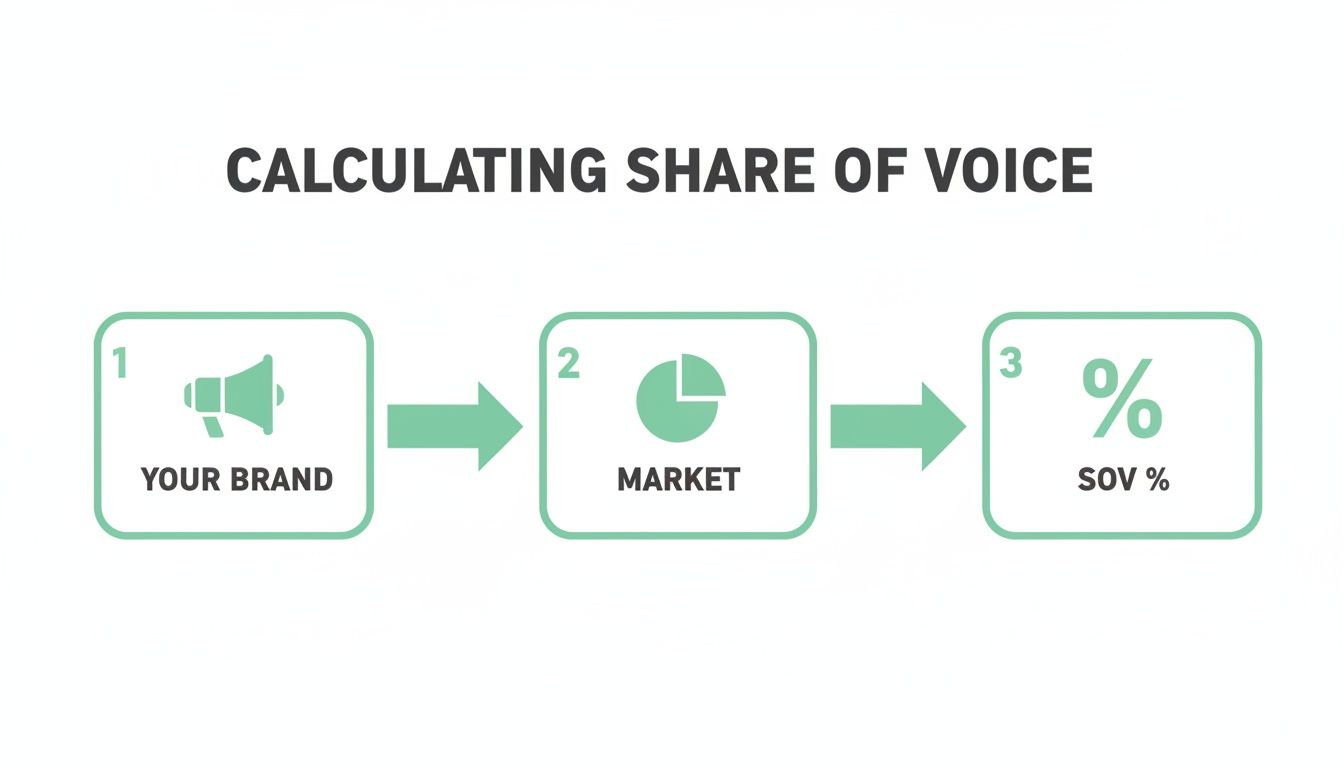
Whether you’re looking at PPC ads or organic rankings, the core logic is the same. You’re just measuring your slice of the pie to understand your true visibility.
How to Find Your SOV for Organic Search
For organic search, SOV is all about visibility. The goal is to measure how often your website shows up in search results for a curated list of high value keywords. This goes beyond simple rankings to give you a real sense of how much potential traffic you're capturing. The go to metric here is organic visibility. SEO tools calculate this by analyzing your ranking positions for a tracked keyword set and factoring in the estimated search volume for each term. A higher visibility score means a larger share of potential clicks. To see what’s really happening, you need to dive into your keyword rankings and visibility report.
Measuring Your Voice in Paid and Earned Media
When you turn to paid and earned media, the metrics become more direct. For paid search, the industry standard is Impression Share (IS). This metric, available right inside Google Ads, shows you the percentage of time your ads appeared out of all the times they were eligible to. An Impression Share of 40% means your ads were shown for four out of every ten relevant searches.
For earned media like PR, the focus shifts to mentions. If your brand landed 2,450 media placements while your competitors collectively earned 17,550, your PR share of voice would be 12.25%.
Steps to Calculate Social Media Share of Voice
On social media, share of voice is a direct measure of the conversation. The goal is to track how many people are talking about your brand compared to your competitors. This means you’ll need to track a few key data points. Common choices include:
- Direct Mentions: How often your brand’s handle (@YourBrand) is used.
- Hashtag Usage: The volume of posts using your branded or campaign specific hashtags.
- Engagement Volume: The total likes, comments, and shares on your posts versus your competitors'.
By summing up these metrics for your brand and dividing by the total market volume (your brand plus competitors), you get a clear picture of who is dominating the social conversation.
Choosing the Right Tools to Measure Share of Voice
You can't calculate an accurate share of voice manually. Trying to scrape every social mention, track every keyword shift, and log every competitor ad is a recipe for burnout, not insight. This is where your tech stack becomes your greatest advantage. The right tools do the heavy lifting, turning an overwhelming amount of raw data into something you can actually use. They pull the inputs you need from social media chatter, organic search rankings, news mentions, and even how you're showing up in new AI generated answers.
Think of these platforms as an investment in competitive intelligence. Without them, you're just guessing. With them, you get a clear, evidence based picture of your brand's true visibility.
Key Tools for an Accurate Share of Voice Calculation
No single tool does it all. A holistic view of your share of voice requires a mix of platforms. Social listening tools are fantastic for tapping into public conversation, while SEO software is non negotiable for understanding search visibility. As you look at your options, make sure to explore the full market, including alternatives to well known social listening and market intelligence platforms like Brandwatch. The best tool is the one that fits your specific channels, team workflow, and budget.
Comparing Tools for Share of Voice Measurement
To help you build your toolkit, it helps to see how the main categories stack up. Each type of tool gives you a different piece of the SOV puzzle. Knowing what each one does best will help you prioritize your investment and make sure you have your most important channels covered.
| Tool Category | Primary Use Case | Key Metrics Tracked | Example Tools |
|---|---|---|---|
| Social Listening Platforms | Tracking brand mentions, sentiment, and conversation volume on social media. | Mentions, Hashtags, Reach, Sentiment | Brandwatch, Talkwalker |
| SEO & Content Platforms | Measuring organic search visibility and competitor keyword performance. | Organic Visibility, Keyword Rankings, Impression Share | Ahrefs, Semrush |
| AI Visibility & LLM Tracking | Monitoring brand citations and source usage within AI-generated answers. | Share of Answer, Citation Volume, Source Mentions | Riff Analytics, SEOClarity |
| Media Monitoring Suites | Monitoring brand mentions in online news, blogs, forums, and press releases. | Article Mentions, Media Reach, Source Authority | Cision, Muck Rack |
A smart combination of these tools is what gives you a complete, multi channel view, turning SOV from a simple number into a powerful lever for growth.
How to Measure Visibility in the New Era of AI Search
How do you begin to measure share of voice when the classic search results page is replaced by a conversation with an AI? For years, we focused on ranking reports. Now, in a world dominated by Google AI Overviews, Perplexity, and ChatGPT, those reports are becoming less relevant. As we move deeper into 2025, visibility is being completely redefined. The real win is becoming a trusted source that an AI cites directly in its answer. This demands a new metric: we're moving from share of voice to share of answer.
This metric tracks how often your brand gets mentioned or sourced in the answers generated by large language models (LLMs).

This shift forces us to adapt our strategies for what’s now called generative SEO. The goal is to create content so clear and authoritative that AI models choose to use it as a primary source. You can dive deeper into this topic in our guide to AI search optimization.
How to Calculate Your Share of Answer
To figure out your share of answer, you must systematically track your brand’s citations inside generative AI responses. The formula is similar to traditional SOV, but the data you plug in is different. You’re measuring your brand's citations against the total citations for your competitors across a curated list of queries.
To start, define the key questions your audience is asking, then systematically track how different AI engines respond. This isn't something you can do by hand. It requires specialized tools built for LLM tracking, as standard SEO platforms aren't equipped for these conversational interfaces. It is critical to understand how to be the brand ChatGPT recommends to stay visible.
Turning Your SOV Insights into Strategic Action
Getting your share of voice number is just the starting line. Think of that percentage as a diagnostic report. It tells you where your brand stands, but the real value comes from what you do with that information. A low score isn’t a failure; it’s an opportunity. A high score is a clear signal of what’s working, giving you the green light to double down on a winning strategy.
You’ll often find an imbalance. Maybe you're crushing it on social media but you're a ghost in organic search. That’s your cue to shift focus, borrowing resources from a strong channel to fortify a weaker one.
Benchmarking and Tracking Your SOV Calculation Over Time
An isolated SOV number is just a snapshot. To make it meaningful, you have to benchmark your performance against key competitors and track it over time. A trend line tells a story. It gives you the historical context needed to prove your marketing efforts are working, letting you draw a straight line from a campaign launch to a measurable lift in visibility.
This isn't just a marketing metric; it connects directly to business outcomes. A 10 point difference in share of voice relative to share of market can drive a 0.5% increase in market share. This concept, known as 'extra share of voice' (eSOV), shows a direct link between maintaining a higher SOV than your market share and achieving real business growth.
Summary: Mastering Your Share of Voice Calculation
Calculating your share of voice is more than a simple measurement; it's a strategic imperative for any brand looking to grow in 2025 and beyond. It starts with a clear formula: divide your brand's metrics by the total market's metrics. However, true insight comes from applying this calculation consistently across all relevant channels, from organic search and social media to the emerging frontier of AI generated answers, or "Share of Answer."
By using the right tools, benchmarking against competitors, and tracking your performance over time, you can transform SOV from a passive number into an active driver of strategy. A low SOV points to opportunities for growth, while a high SOV validates your current efforts. Ultimately, understanding and acting on your share of voice is crucial for securing and expanding your position in an increasingly competitive digital landscape.
Frequently Asked Questions
How often should I calculate share of voice? For most businesses, a quarterly check in is ideal. It’s frequent enough to catch important trends without getting lost in daily noise. However, during a major campaign or in a fast paced industry, monthly or even weekly tracking might be necessary to stay agile. Consistency in your timing and competitor set is key.
What is a good share of voice percentage? There is no universal "good" number. The goal is to achieve an ‘extra share of voice’ (eSOV), where your SOV percentage is higher than your market share percentage. According to Nielsen, a 10 point eSOV can lead to a 0.5% increase in market share. For challenger brands, the focus should be on steady growth, while market leaders should aim to defend their dominant position.
What tools are best for tracking share of voice in AI search? This is a new frontier that requires specialized tools. Platforms like Riff Analytics are designed specifically for LLM tracking. They monitor how often your brand is cited in responses from engines like ChatGPT and Google AI Overviews, a blind spot for traditional SEO tools.
How do I calculate share of voice if my budget is limited? You can get a solid estimate without expensive tools. Use free resources like Google Alerts for media mentions, the native search functions on social media platforms to count conversations, and free keyword rank checkers for a baseline of your SEO visibility. This manual approach is more time consuming but provides a valuable starting point.
What is the biggest mistake when calculating share of voice? The most common mistake is ignoring sentiment. A high SOV driven by negative customer complaints is a crisis, not a victory. You must segment your mentions into positive, negative, and neutral categories to understand the true story behind the numbers.