How to Do Competitor Analysis in SEO: A Practical 2025 Guide
Updated January 30, 2026

At its core, SEO competitor analysis is the process of identifying who ranks for the keywords you want, dissecting their strategies, and using that intelligence to build a better approach. Think of it as your roadmap for winning organic search. In 2025 and 2026, as AI search engines like Perplexity and Google’s AI Overviews reshape how people find information, this process is no longer just about outranking others on a list of blue links. It’s about becoming the definitive, trusted source in your niche across all search formats.
A modern analysis framework shows you what content resonates with users, where competitors are building authority, and which brands are being cited by AI. This guide will walk you through how to do competitor analysis in SEO, step by step, to build a resilient, future-proof strategy.
Why a Modern SEO Competitor Analysis is Crucial
Heading into 2025, just tracking keyword rankings isn't enough. With platforms like Perplexity synthesizing answers for users, your brand’s survival depends on being cited as a primary source. This is where a modern approach to competitor analysis becomes a non-negotiable part of your SEO strategy. We’re moving past basic rank reports and into a deeper look at the entire digital battlefield, including traditional search results and the new world of generative SEO.
Understanding Your True Competitive Landscape
Here's a hard truth: your direct business rivals often aren't your biggest search competitors. A proper analysis almost always uncovers niche blogs, hungry affiliate sites, or massive informational hubs that dominate the SERPs for your most valuable queries. Ignoring these players means leaving traffic and market share on the table. The explosion of AI search visibility brings another class of competitors: the brands consistently cited in AI generated answers. Identifying them is your first step to understanding what signals AI engines value, a critical piece of the generative SEO puzzle.
An effective analysis framework will show you:
Content Strengths: What topics and formats are succeeding in both traditional search and AI responses?
Authority Gaps: Where are competitors landing high value backlinks that you are not?
AI Citation Patterns: Which sources are large language models (LLMs) referencing for key industry topics?
A Framework for Actionable Competitor Insights
A structured analysis is about gaining the intelligence needed to make smarter, faster decisions. Instead of guessing which content to create or which keywords to chase, you can act on insights pulled straight from the battlefield. This process is all about finding specific, actionable opportunities to outmaneuver everyone else. For instance, you might find a competitor’s top performing guide is ranking with outdated stats or completely misses a few crucial subtopics. That’s your opening. You can create a more comprehensive, up to date resource that serves users better and earns higher rankings.
How to Pinpoint Your Real Search Competitors
Before you begin your analysis, you must answer one critical question: who are you actually competing against? Spoiler: it’s rarely your biggest brand rival. Your true search competitors are the domains that consistently show up for the keywords that matter most to your business. This could be a niche blog, an affiliate site you've never heard of, or a huge informational hub. Getting this right is the foundation of everything that follows. Forget brand names and focus completely on who's winning on the search engine results page (SERP).
Identifying SEO Competitors with Keyword Data
The most reliable way to find your search rivals is to analyze keyword overlap at scale. This data driven method cuts through guesswork and shows you exactly who is capturing your target audience’s attention. For instance, we once found that a B2B client's main search competitor wasn't another company in their space, but a review site that dominated high intent keywords. That single insight changed everything. By focusing on these "true search competitors" and closing content gaps, they saw a 933% increase in organic search share of voice. You can see how this works in a detailed case study on Rankmax.com.au. This process will help you build a realistic list of 3 to 5 primary search competitors to dissect.
Looking Beyond SERPs for Your AI Visibility Competitors
As we head into 2025 and 2026, the definition of a "competitor" is expanding to include whoever dominates AI search visibility. These are the brands and sites consistently cited in answers from ChatGPT, Perplexity, and Google’s AI Overviews. Your AI visibility competitors might be a completely different group from your traditional organic rivals. AI models often favor sources that show deep expertise, clarity, and factual accuracy. To find these new competitors, you need tools built to monitor AI responses. A platform like Riff Analytics lets you track which domains are being cited for your target queries, a crucial part of the modern search ecosystem.
A Quick Comparison of Competitor Types
Understanding the different kinds of competitors you're up against is key to a smart analysis. Each type requires a different focus.
| Competitor Type | Key Characteristic | Main Goal of Analysis |
|---|---|---|
| Organic Search Competitor | High keyword overlap in traditional SERPs | Identify content gaps, backlink opportunities, and on page tactics. |
| AI Visibility Competitor | Frequently cited in AI engine responses | Uncover what content structure and authority signals AI values. |
| Direct Business Rival | Offers a similar product or service | Benchmark brand messaging, pricing, and feature positioning. |
By segmenting your competitors this way, you can create a more targeted and actionable plan. You'll not only know how to improve your Google rankings but also how to become a trusted source for the AI assistants reshaping how people find information. To get a head start, check out our guide on how to find SERP feature opportunities.
How an SEO Competitor Analysis Finds Content Gaps
Once you know who you’re really up against, it's time to find their weaknesses. We're moving past simple identification and diving deep into the keyword and content gaps that represent your biggest growth opportunities. The goal is to uncover valuable search terms your competitors are ranking for that you've completely missed. A solid keyword gap analysis is one of the most powerful moves in SEO because it shows you exactly where your rivals are capturing traffic. Get this right, and the results can be massive. One brand used this exact tactic to grow its organic share of voice by a staggering 933%. You can read more about this powerful SEO tactic on EcommercePro.com.
Performing a Competitor Keyword Gap Analysis
First, you need data. Using your favorite SEO tool, compare your domain against your top three to five search competitors. The tool will generate lists of keywords, showing which are unique to them, which you share, and where you're lagging. A huge list of keywords is useless without prioritization. You need to zero in on terms that show clear commercial intent, have decent monthly search volume, and fall within a keyword difficulty range you can realistically compete for. This turns a massive data dump into an actionable hit list. As you build out new content, check our guide on how many keywords per page for SEO for effective optimization.
Uncovering Qualitative Gaps in Competitor Content
Keywords tell you what people are searching for. A qualitative content audit tells you why a competitor's page is winning. This goes beyond keyword density and word count. You need to dissect the structure, substance, and user experience of top ranking pages to understand what resonates with both users and search engines. Look for patterns. How do competitors organize their information? Do they use images, videos, or interactive elements? Are their articles long form guides, listicles, or Q&As? Analyzing these elements reveals the content formats that are already working in your niche, giving you a blueprint to create something even better.
Your Guide to Finding AI Citation Gaps
In 2025 and beyond, your analysis must include AI search visibility. The new critical task is spotting "citation gaps," places where AI engines cite your competitors as authoritative sources but ignore you. This is a massive red flag that your content is missing the trust signals these models find. Monitoring LLM tracking data from a platform like Riff Analytics shows you which topics and pages are earning your competitors citations. These insights are pure gold. They tell you exactly where you need to build more comprehensive, fact dense content to position your brand as a primary source and secure your place in the new era of generative SEO.
Analyzing Backlinks and Authority Signals
Fantastic content gets you in the game, but authority is what powers rankings. In SEO, that authority is built with backlinks. A strong link profile tells search engines that other reputable sites are vouching for you, making it a massive factor for both traditional search and AI engine citations. When you dive into your competitors' off page strategies, you’re essentially looking at the blueprint they used to build credibility. Understanding where their best links come from lets you build a smarter, more efficient link building plan.
Performing a Competitor Backlink Analysis for SEO
The first move here is a proper backlink audit. Using a tool like Ahrefs or Semrush, you can pull a complete list of every single domain linking to your top rivals. The initial goal is to look past the raw numbers and zero in on quality and relevance. A competitor might have thousands of garbage links from spammy directories, which are practically worthless. Your job is to sift through the noise and pinpoint the high authority, contextually relevant links that are genuinely moving the needle for them. These are the links that build the topical authority needed to rank for competitive terms and earn those coveted AI citations.
A Guide to Deconstructing Competitor Link Building
Once you’ve got a clean list of your competitors’ best backlinks, it's time to play detective. How did they get them? This part of the process is about reverse engineering their strategy to see what’s actually working in your niche. By categorizing their top links, you can spot patterns and identify tactics you can replicate. Common link building strategies you might uncover include digital PR, guest posting on reputable blogs, or creating useful resource pages that other sites link to. Figuring out their primary methods gives you a clear roadmap.
Comparing Key Competitor Authority Metrics
Not all link profiles are created equal. When you stack your domain up against the competition, it’s incredibly helpful to benchmark a few key metrics. This table gives you a simple framework for seeing where you stand and where you need to muscle up.
| Metric | What It Tells You | How to Analyze It |
|---|---|---|
| Total Referring Domains | The number of unique websites linking to a domain. | Look for a significant gap. If competitors have far more, you'll need a more aggressive campaign. |
| Domain Authority (DA/DR) | A score predicting a website's ranking potential. | Compare your score directly to competitors to gauge the general authority gap you need to close. |
| Link Velocity | The rate at which a domain is acquiring new backlinks. | If competitors are acquiring links much faster, it’s a sign their efforts are more active. |
A thorough backlink audit is a non negotiable part of any serious SEO competitor analysis. With 5.9 million Google searches happening every minute, having a strong authority signal is make or break, especially since only 0.63% of searchers ever click to page two. You can find more SEO statistics and what they mean for your strategy on seranking.com.
Choosing Your SEO and AI Analysis Tools
Your competitor analysis is only as strong as the data you're pulling. Choosing the right software isn't just a box ticking exercise; it's the step that separates vague guesses from a sharp, actionable strategy. The best tools don't just gather data, they show you opportunities you’d otherwise never see. Heading into 2025, your tech stack needs to nail traditional SEO metrics like keyword rankings and backlink profiles. More importantly, it needs to track how you and your competitors show up in AI generated answers.
Selecting Your Core SEO Competitor Analysis Software
Every solid analysis starts with a foundational, all in one SEO platform. Think of tools like Semrush, Ahrefs, or Moz as your workhorses. They are the industry standard for a reason. With these platforms, you can knock out the essential tasks that form the backbone of any competitor review, including keyword gap analysis, backlink audits, and content exploration. These tools provide the hard numbers you need to benchmark your performance. For a deeper look at how they compare, check out our guide on the best competitive analysis tools.
The New Frontier in Competitor Analysis: LLM Tracking
While the big SEO suites are non negotiable, they no longer show you the whole picture. A huge piece of the modern competitive puzzle is tracking AI search visibility, and that requires a new breed of software built for LLM tracking. Your toolkit needs to account for AI SEO content strategies that focus on winning mentions inside models like ChatGPT. This is where tools like Riff Analytics come in. They are built to answer the questions traditional platforms can't touch, such as which competitors are cited most often in AI Overviews and chat responses.
A truly effective tech stack gives you this 360 degree view. It covers everything from keyword rankings and backlink profiles to AI citations and sentiment. By pairing the power of a traditional SEO suite with a specialized AI visibility platform, you’ll have the intelligence needed to build a dominant, future proof digital strategy.
Building Your Action Plan and Measuring Results
All that data you just collected is completely useless without a clear plan to act on it. This is the moment your research project transforms into a strategic roadmap for growth. The whole point is to turn those insights into specific, prioritized actions that will actually move the needle. A simple scoring framework is the most effective way to cut through the noise. Just rank each opportunity, like creating a new blog post or chasing a specific backlink, on two scales: potential impact (high, medium, low) and required effort (high, medium, low). Your quick wins will jump right off the page.
Creating a Prioritized SEO Action Plan
Your analysis probably generated dozens of things you could do. Don't let yourself get overwhelmed. Group them into a few key buckets to bring structure to the chaos. Your plan should have concrete next steps for new content creation to target keyword gaps, existing content optimization to refresh old data or add new subtopics, and targeted link building to acquire links from high authority domains. A mature SEO strategy connects these actions back to your overall revenue attribution model, so you can prove exactly how your efforts are impacting the business.
How to Monitor Performance and AI Visibility
Once you start executing, you need a system to see if it’s working. Continuous monitoring is what keeps you agile. You'll want to track your traditional organic rankings, but in today's world, you also have to track your visibility in AI powered search.
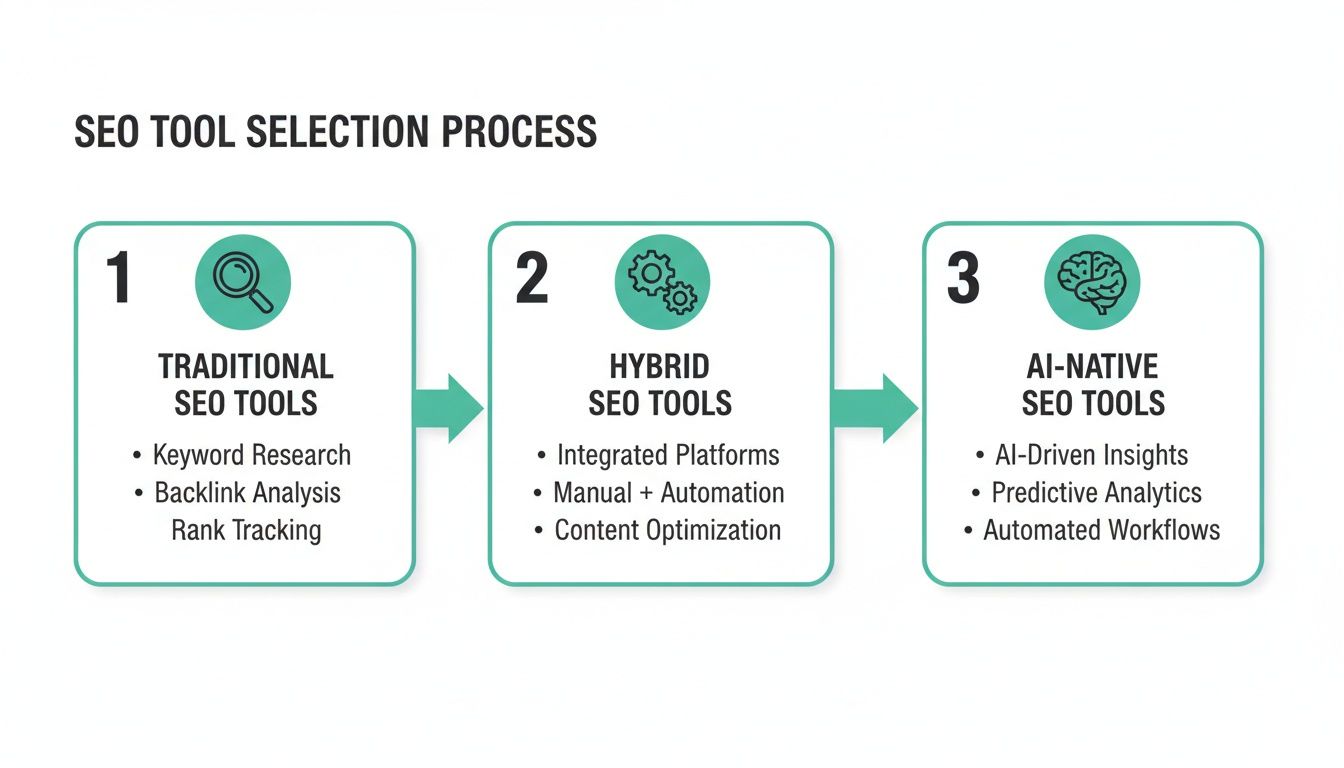
As you can see, a complete strategy now demands a hybrid approach. You need your classic SEO tools, but you also need AI native platforms to get the full picture. According to Semrush, about 73% of companies actively invest in content marketing. A competitor analysis ensures that investment is strategic, not speculative. This creates a constant feedback loop: act, measure, refine. It's the only way to make sure your strategy stays effective as the search landscape keeps changing.
Summary: A Winning SEO Competitor Analysis Process
Conducting a thorough SEO competitor analysis is no longer optional in 2025; it's the foundation of a modern digital strategy. By correctly identifying your true search and AI visibility competitors, you can uncover actionable keyword, content, and backlink gaps. This process transforms guesswork into a data driven roadmap. Remember to use a combination of traditional SEO platforms and specialized AI tracking tools to get a complete 360 degree view of the competitive landscape. The final step is to translate these insights into a prioritized action plan and continuously measure your performance, ensuring your brand not only competes but thrives in the evolving world of search.
Frequently Asked Questions
How do I find keywords my competitors rank for but I don’t?
You can use SEO tools like Semrush, Ahrefs, or Moz. Their keyword gap features let you enter your domain and up to five competitor domains to generate a report showing keywords unique to them. It’s a great way to spot immediate content opportunities.
What is the difference between a content gap and a keyword gap?
A keyword gap identifies specific search terms you aren't targeting. A content gap is more qualitative; it refers to entire topics, subtopics, or content formats that your competitors cover but you have overlooked, even if the exact keywords aren't high volume.
How can I track my competitors' AI citations?
Specialized platforms like Riff Analytics are built for this. They monitor responses from major AI engines and Google's AI Overviews, letting you track which domains get cited for specific queries. This reveals your "AI visibility competitors" and helps you pinpoint citation gaps.
How often should you do an SEO competitor analysis?
A comprehensive analysis should be done at least once a year, with lighter quarterly reviews to track progress and spot new trends. In highly competitive industries, a monthly check on key metrics is advisable to stay ahead.