How to Find SERP Feature Opportunities
Updated January 19, 2026
Search engine results pages are no longer a simple list of ten blue links. Google now mixes classic organic results with featured snippets, People Also Ask boxes, video carousels, local packs, product modules, and AI-generated answer layers. Those elements are SERP features, and they change where attention goes before a searcher ever reaches the standard results. Knowing how to find serp feature opportunities is really about spotting where the page can win visibility with the right format, not just a slightly better rank.
In practice, SERP features are as much a distribution problem as a ranking problem. A page can sit in a respectable organic position and still lose the click if the result above it answers the question faster, shows a video, or pulls in a local pack. Research compiled by Passionfruit notes that a large share of target keywords trigger at least one SERP feature, while only a minority of ranking pages capture them. That gap is where the opportunity sits.
Why Finding SERP Feature Opportunities is Critical for SEO
Winning in search today means understanding which result types are on the page and how each one changes click behavior. A SERP feature is any non-standard organic element that gets special treatment in the results: featured snippets, PAA boxes, video carousels, local packs, review stars, image packs, shopping modules, and more. Some still send strong traffic. Others reduce the value of a normal rank 1 because the user gets an answer, a map, or a product comparison before they ever scroll.
That difference matters when you set priorities. A featured snippet can outrank the top organic listing in practical visibility. PAA boxes can expand topical coverage and put your brand in follow-up questions you were not directly targeting. Video carousels reward a different asset type than an article. Local packs can make a traditional organic result far less important for near-me or service-intent queries. To even begin, you need a clear understanding of the top Google ranking factors that still form the foundation of visibility.
Many teams still treat every keyword like a blue-link ranking contest, while format eligibility is often the decisive factor. Semrush has also published a useful SERP feature workflow because it frames the gap as an optimization issue, not just a ranking issue.
Discovering SERP Feature Chances in an AI World
As generative search and AI Overviews continue to reshape the SERP, occupying these feature spots becomes even more important. Earning a placement in a People Also Ask box or a featured snippet does more than drive clicks. It also gives search engines structured, extractable language that can feed newer answer formats.
Modern tools now track this new layer of AI search visibility. They do not just show rankings; they help monitor citation sources and competitive gaps. This kind of data supports a practical workflow for identifying and winning SERP features in the age of AI-driven search. If you are also investing in video assets, this overview from Whisper AI is a useful companion because video SEO quality often determines whether you can compete for carousel visibility at all.
How We Evaluate SERP Feature Opportunities
The easiest way to waste time is to chase every feature that appears in a rank tracker. A workable method is narrower.
Data sources used
- Google Search Console for impressions, CTR, page/query pairing, and baseline trend lines
- A rank tracker such as Semrush, Ahrefs, or STAT to confirm which features are live on the SERP and who owns them
- Manual SERP checks in incognito to verify format, above-the-fold prominence, and whether the feature is stable enough to target
A keyword becomes a viable target when all three are true
- You already have some visibility, usually page 1 or page 2.
- A live feature is present on the results page.
- Your current page does not match the format the feature is rewarding.
A keyword is usually a poor target when any of these apply
- The feature rewards a format you realistically do not have, such as video-only results with no video production capacity.
- The feature is dominated by local, news, or merchant-style results that your business type cannot credibly enter.
- The query intent does not match the page you would optimize.
- The current winner is satisfying the query with a radically different asset, not a better version of your existing article.
How to judge opportunity score Use a simple effort-versus-upside lens: current visibility, feature prominence, content-fit gap, and expected business value. If a page already gets impressions, the SERP feature sits above the fold, and a modest reformat could make the page eligible, that is a high-priority target.
Pinpointing Your Most Valuable SERP Feature Targets
The hunt for attainable SERP features starts with a shortlist, not a brainstorm. Pull your existing query data first, because the fastest wins usually come from pages that already have impressions and partial rankings.
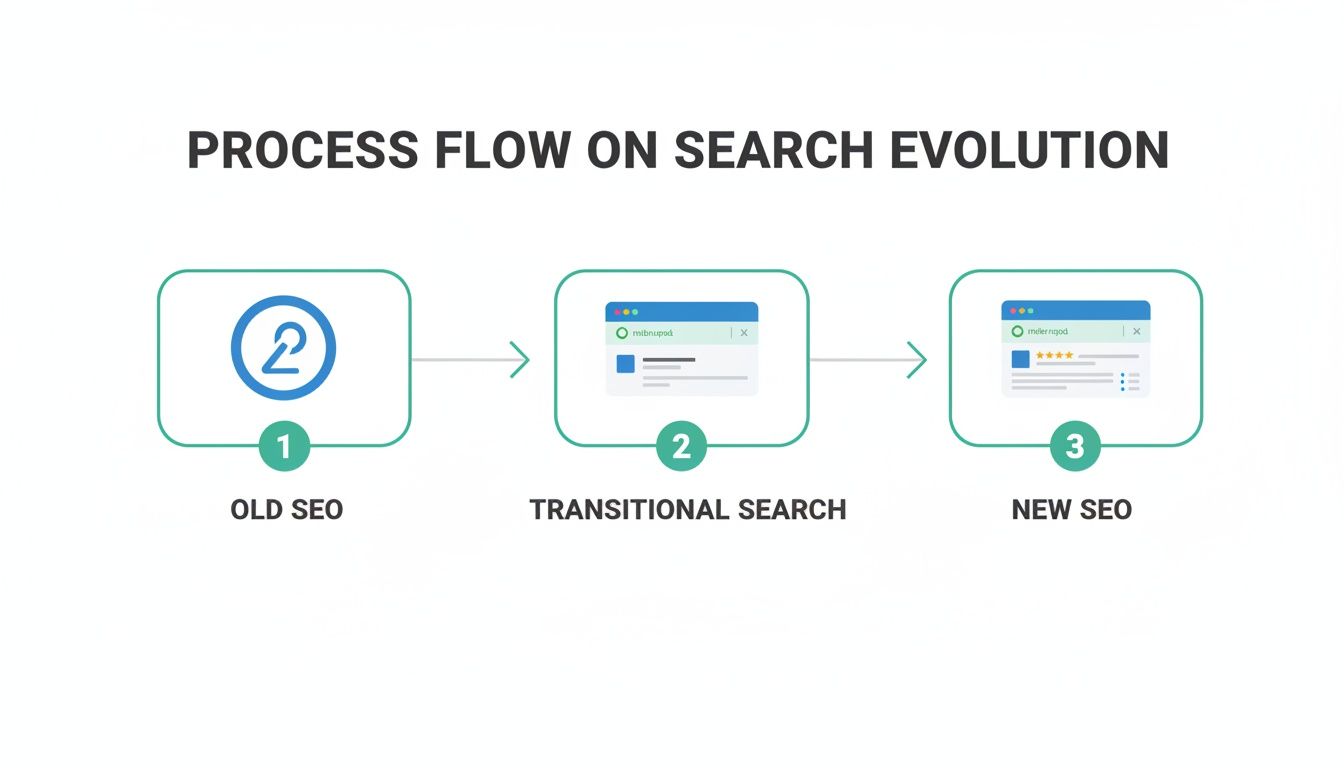
This evolution makes one thing clear: modern SEO success is measured by visibility within these rich results, not just traditional rankings.
Step 1: Export the queries that already matter
Start in Google Search Console and export queries for the last 28 to 90 days. Keep clicks, impressions, CTR, and average position. Then narrow the list to terms where the page is already visible but underperforming:
- average position roughly 3-20
- meaningful impressions
- weak CTR relative to position
That combination usually signals either a click-suppressing SERP layout or a result format mismatch.
Step 2: Confirm a live feature is actually present
Next, verify the live SERP in a rank tracker and then manually inspect the results page. Do not rely on exported labels alone. Note:
- which feature appears
- whether it is above the fold
- what type of page or asset is winning it
- whether the feature is stable across a few close variants
This is also where competitor comparison becomes useful. Building a workflow to systematically uncover these chances is a core part of effective SEO competitive intelligence.
Step 3: Compare the winning format against your page
Now identify the mismatch. That is the key opportunity.
Examples:
- A snippet winner opens with a direct 45-word definition, while your article buries the answer after three paragraphs.
- A PAA answer comes from pages with clean question-led subheads, while your page uses vague benefit-focused headings.
- A video carousel is present, but your page has no embedded video and your YouTube result is thinly optimized.
- A local pack dominates the query, but your target page is a general service page without location specificity or strong business signals.
If there is no realistic format fit, discard the target.
Step 4: Sort by effort versus upside
Once you have a candidate list, prioritize the targets that combine existing visibility with low formatting effort and clear business relevance.
| Opportunity Signal | What it usually means | Priority |
|---|---|---|
| Page ranks 3-10, low CTR, snippet/PAA live | Strong reformatting opportunity | High |
| Page ranks 8-20, video carousel live, no video asset | Opportunity exists but needs new production | Medium |
| Query triggers local/news-heavy results you do not fit | Low eligibility | Low |
| Feature appears on a high-intent query tied to revenue | Higher upside even if effort is moderate | High |
Choosing Your Toolkit for Feature Opportunity Analysis
Winning SERP features is a game of intelligence. To find the right opportunities, you need the right tools, and modern workflows go beyond basic rank tracking. For teams seeking a serious edge, consider unlock AI for SEO to speed up analysis.
Finding Feature Gaps with Leading SEO Suites
The fastest way to get started is with an all-in-one SEO platform. Tools like Semrush and Ahrefs are useful for auditing your current keyword footprint and seeing where you stand on SERP features. Their keyword gap analysis features help surface keywords where competitors own a SERP feature and you do not.
Comparing Tools for SERP and AI Visibility Analysis
Choosing the right platform comes down to what you need to track. If you want a broader view of traditional rich results and newer AI visibility, a good AI SEO tools comparison can show which platforms are built for that mix.
| Tool | Primary Use Case | SERP Feature Tracking | AI/Generative Tracking |
|---|---|---|---|
| Semrush | All purpose SEO, keyword research | Extensive, tracks most feature types | Beta features for AI visibility |
| Ahrefs | SEO suite with strong backlink data | Comprehensive feature tracking | Limited, focused on classic SERP |
| Riff Analytics | AI visibility & brand monitoring | Tracks features as citation sources | Core feature, AI mention based |
| STAT | Enterprise rank tracking | Highly accurate, great for local | No dedicated AI tracking |
The table makes the difference clear: while the big suites are strong for broad SERP feature tracking, specialized platforms like Riff Analytics are emerging to handle the specific challenge of AI search visibility.
Decoding Search Intent to Win High Value Features
Winning a high-value SERP feature is not about a secret algorithm hack. It is about matching the underlying search intent. Snagging a featured snippet or a product-style result depends on how well your page aligns with what the searcher needs.
Think about a query like "best running shoes for beginners." The user is not just looking for one product page. Their intent is commercial, but also investigational. Content that delivers this in a well-structured, easy-to-scan format, like a comparison table or a clean numbered list, is more likely to win a feature.
Using Search Intent to Identify SERP Feature Chances
Start mapping specific query types to the features they most commonly trigger. If a keyword consistently triggers a video carousel, a blog post alone will not cut it. You need a video asset.
According to Jeremiah Greco of Eight Oh Two Marketing, “If you can effectively rank your content in featured snippets, you likely understand what Google is looking to serve up in its other SERP Features.”
That insight holds because the logic is similar across formats: match the format to the user’s need.
Analyzing Related Searches for Deeper Content Insights
Do not ignore the related searches section at the bottom of the SERP. It is more than a source of long-tail keywords; it shows what users are likely to ask next. When you analyze these queries, you can build more complete content that anticipates the full journey.
How to Get Into SERP Features
Getting into SERP features usually comes down to four requirements: the right query, the right page type, the right structure, and clean technical eligibility. You do not earn them by adding a few keywords. You earn them by making your page the easiest asset for Google to extract, summarize, or display.
Use this checklist before you optimize:
- Confirm the feature already appears for the target query.
- Make sure your page matches the dominant intent.
- Reformat the page so the answer or asset appears early and clearly.
- Add supporting elements such as lists, tables, FAQs, embedded video, business details, or relevant schema where appropriate.
- Re-crawl and measure the result rather than assuming a markup change created the win.
The biggest blocker is often not authority but format mismatch. Teams may have the right topic and a ranking page, yet the page is written like a generic blog post when the SERP is rewarding a concise answer block, a visual asset, or a local entity profile.
Crafting Content That Captures Specific SERP Features
Knowing which SERP features you want to win is only useful if you reshape the page for the exact feature on the results page. The most reliable approach is to build around the extraction pattern Google is already rewarding. That means the page format, the answer placement, and the supporting elements should line up with the feature you want.
That methodical approach shifts you from hoping you will get featured to creating content that is clearly eligible. It is also useful when thinking about how to rank in AI Overviews, since both AI-driven and traditional search systems reward clarity and authority.
Featured Snippets
What the SERP usually rewards: a direct answer, definition, process, list, or comparison that can be extracted quickly.
What page format tends to win: articles with question-led subheads, short answer blocks, numbered steps, comparison tables, and clean formatting.
What supporting elements help:
- 40-60 word direct answers
- ordered or unordered lists
- concise tables for comparisons
- clear terminology and plain-language definitions
What commonly blocks eligibility:
- long intros before the answer
- fluffy subheads that do not state the question
- mixing multiple concepts into one paragraph
- burying the answer below images or tangents
People Also Ask
What the SERP usually rewards: pages that answer adjacent questions clearly, not just the main keyword.
What page format tends to win: articles with a tightly scoped FAQ or question-led subsections that mirror the follow-up questions shown in the live SERP.
What supporting elements help:
- question-based subheads
- short answers followed by elaboration
- FAQ schema where appropriate
- internal links to deeper sections for context
What commonly blocks eligibility:
- generic FAQs unrelated to the target SERP
- one-sentence answers with no supporting explanation
- repeating the same answer across multiple questions
Video Carousel
What the SERP usually rewards: videos that solve the query directly, especially for tutorials, demonstrations, product explainers, and task-based searches.
What page format tends to win: a well-optimized video on YouTube or another indexable platform, ideally embedded on a supporting page that reinforces the same topic.
What supporting elements help:
- a title that matches the task or question
- detailed video description
- timestamps or chapters
- transcript or summary on the page
What commonly blocks eligibility:
- uploading a video with a vague title
- no transcript or surrounding page context
- producing a promotional asset for a query that demands instruction
Local Pack and Merchant-Style Results
What the SERP usually rewards: businesses with strong location relevance, complete profiles, trustworthy details, and pages aligned to local or transactional intent.
What page format tends to win: optimized location pages, service pages with clear geographic targeting, merchant listings with reviews, pricing or inventory signals, and accurate business information.
What supporting elements help:
- consistent NAP details
- embedded map or directions context
- product, review, or local business schema where appropriate
- location-specific proof points
What commonly blocks eligibility:
- generic national pages trying to rank for local intent
- inconsistent business data across listings
- thin location pages spun from one template
Measuring Success and Proving the ROI of Feature Optimization
How do you prove SERP feature work had an effect? Use a before-and-after workflow inside Google Search Console instead of relying on rank snapshots. The goal is to separate true feature wins from normal ranking movement.
Baseline the target queries before you edit
Before changing the page, record:
- clicks
- impressions
- CTR
- average position
- target page URL
- whether a feature is visibly present on the live SERP
Export this for the prior 28 days at minimum. If volume is low, use a longer baseline.
Check Search Appearance where Google exposes it
In Google Search Console, open the Performance report and review Search Appearance filters where available. Depending on the feature and site type, you may see labels for rich results or product-style appearances. This does not cover every feature, but when it appears, it is one of the cleanest ways to validate that the result type changed.
Compare 14-day and 28-day windows after edits
Once the page is re-crawled and indexed, compare two windows:
- first 14 days after the edit for early directional signals
- first 28 days after the edit for a more stable read
Look for changes in the target queries, not just page totals. A true feature gain often shows up as improved CTR at a similar average position, broader query coverage, or stronger impressions on question variants before click volume fully catches up.
Separate feature wins from normal ranking movement
If average position improved from 9 to 3, higher clicks may just be a ranking gain. A better sign of feature impact is:
- CTR lifts while average position stays roughly flat
- new impressions on question-led variants after answer-block edits
- increased visibility on related questions after FAQ additions
- video query impressions rising after embedding and optimizing a matching video asset
KPI guide by feature type
| Feature Type | Primary KPI | Secondary KPI | Early signal before clicks rise |
|---|---|---|---|
| Featured Snippet | CTR on target query | Stable position with higher clicks | Impressions rise on exact-question variants |
| People Also Ask | Query coverage growth | Impressions from follow-up questions | New long-tail question impressions |
| Video Carousel | Video-led clicks / page assists | Impressions for video-intent terms | Search visibility for tutorial variants |
| Local Pack | Calls, directions, local clicks | Branded + non-branded local impressions | More visibility on city/service combinations |
Search Console is still the core reporting layer here, but use it alongside your rank tracker and live SERP reviews.
Summary and Key Takeaways
Successfully winning SERP features requires a strategic, format-first mindset. Instead of writing general content, build pages specifically designed to fit the structure Google prefers for snippets, PAA boxes, video carousels, and local or merchant results. The practical workflow is straightforward: identify pages with impressions and weak CTR, confirm a live feature, compare the winning format against your page, prioritize by effort versus upside, and then measure the change in Google Search Console against a clear baseline.
For tool support, platforms like Semrush and Ahrefs help surface feature gaps, while newer platforms like Riff Analytics help teams monitor AI visibility alongside classic SERP opportunities.
Frequently Asked Questions
1. What is the best way to find low hanging SERP feature opportunities?
The most efficient method is to use an SEO tool's keyword gap analysis feature. Compare your domain to your top competitors and filter for keywords where they own a SERP feature like a featured snippet or People Also Ask box, but you do not.
2. How does generative SEO affect SERP feature strategy?
Generative SEO broadens the strategy. While you still target specific features like snippets to signal authority, the larger goal is to become a trusted citation source for AI Overviews. This means building deep topical authority across your site with well-structured, factual content that AI models can easily parse and reference.
3. Does structured data guarantee a SERP feature?
No. It does not guarantee a feature, but it is often a prerequisite for eligibility on some result types. Proper schema helps Google understand the page, but it does not force a rich result.
4. How can I measure the ROI of winning SERP features?
Use Google Search Console to track click-through rate, impressions, and query-level changes before and after optimization. A CTR lift at a similar average position is one of the clearest signs that feature work paid off.
| Feature Type | Primary Intent | Business Impact | Optimization Effort |
|---|---|---|---|
| Featured Snippet | Informational | High (Position 0) | Medium |
| People Also Ask | Informational | Medium (Authority) | Low |
| Video Carousel | Informational | High (Engagement) | High |
| Local Pack | Transactional | High (Local Clicks) | Medium |
| Feature Type | Primary Goal | Content Structure | Key Optimization Tactic |
|---|---|---|---|
| Featured Snippet | Own "Position 0" with a direct answer. | Create a concise 40–50 word paragraph that directly answers the user's question. | Place the answer block immediately after the introductory paragraph. Use a question as an H2 or H3. |
| People Also Ask | Build topical authority and visibility. | Develop an FAQ section on the page with clear question and answer pairings. | Use schema markup for FAQs and ensure answers are thorough yet easy to scan. |
| Video Carousel | Dominate visual search queries. | Produce a high quality video that addresses the query and embed it in a relevant blog post. | Optimize the YouTube title, description, and tags with the target keyword. |