How to Rank in AI Overviews: A Practical Guide for 2025
Updated December 24, 2025
AI Overviews are the AI generated summaries that appear at the top of search results, designed to give users direct answers without needing to click on a link. To rank in AI Overviews, your content must be clear, factually accurate, and well structured so that language models can easily understand and trust your information. As we head into 2025 and 2026, getting cited in these summaries is no longer a niche tactic but a core requirement for digital visibility, demanding a new approach to SEO focused on brand authority, original data, and machine readable content.
The New Search Landscape of AI Overviews
Welcome to the new reality of search. The rise of AI Overviews marks a fundamental shift from a list of links to a direct conversation. For businesses and creators, the goal is no longer just to rank number one. The real prize is becoming a cited, authoritative source inside those AI generated summaries. This new world demands a different kind of SEO playbook, one that blends classic principles with a modern focus on generative SEO to earn the trust of AI models and stay visible in a world with fewer clicks to go around.
Why Optimizing for AI Overviews Matters
Getting your AI search visibility right is non negotiable. When Google rolled out AI Overviews in May 2024, it immediately scrambled search traffic patterns. Early data from search analysts showed that pages cited in AI Overviews could see significantly more impressions than even the traditional number one organic result, demonstrating a massive shift in where user attention is focused.
This new format rewards content that is:
Direct and Concise: It gives a clear answer without the fluff.
Factually Accurate: It’s backed by data, research, and credible sources.
Well Structured: It uses headings, lists, and tables that are easy to scan.
Authoritative: It shows real expertise and is trustworthy.
How to Get Your Content Featured in AI Overviews
To get your content featured in AI Overviews, you have to think like a large language model. Success comes from combining timeless SEO principles with new generative SEO tactics. This means focusing on factual accuracy, structured authority, and semantic richness to ensure your content is the most reliable and citable source for an AI model's answer. Leaning into advanced AI SEO automation strategies is becoming essential for staying visible. You have to be proactive to stay ahead. The game has changed. Quality and authority now trump many of the old ranking factors.
Auditing Your Content for AI Readiness
Before you can earn citations in AI Overviews, you need an honest look at where your content stands. An AI readiness audit is a systematic review of your articles, blog posts, and landing pages to see how they stack up against what AI models value. Heading into 2025, this audit is the foundational step for any brand serious about showing up in AI generated answers. You are no longer just looking at keywords and backlinks; you are evaluating clarity, factual accuracy, and structure through the lens of a machine. This internal review is where the path to ranking in AI Overviews truly begins.
The way search is evolving is clear. It is a shift from just collecting links to becoming a trusted, direct source of answers for AI.
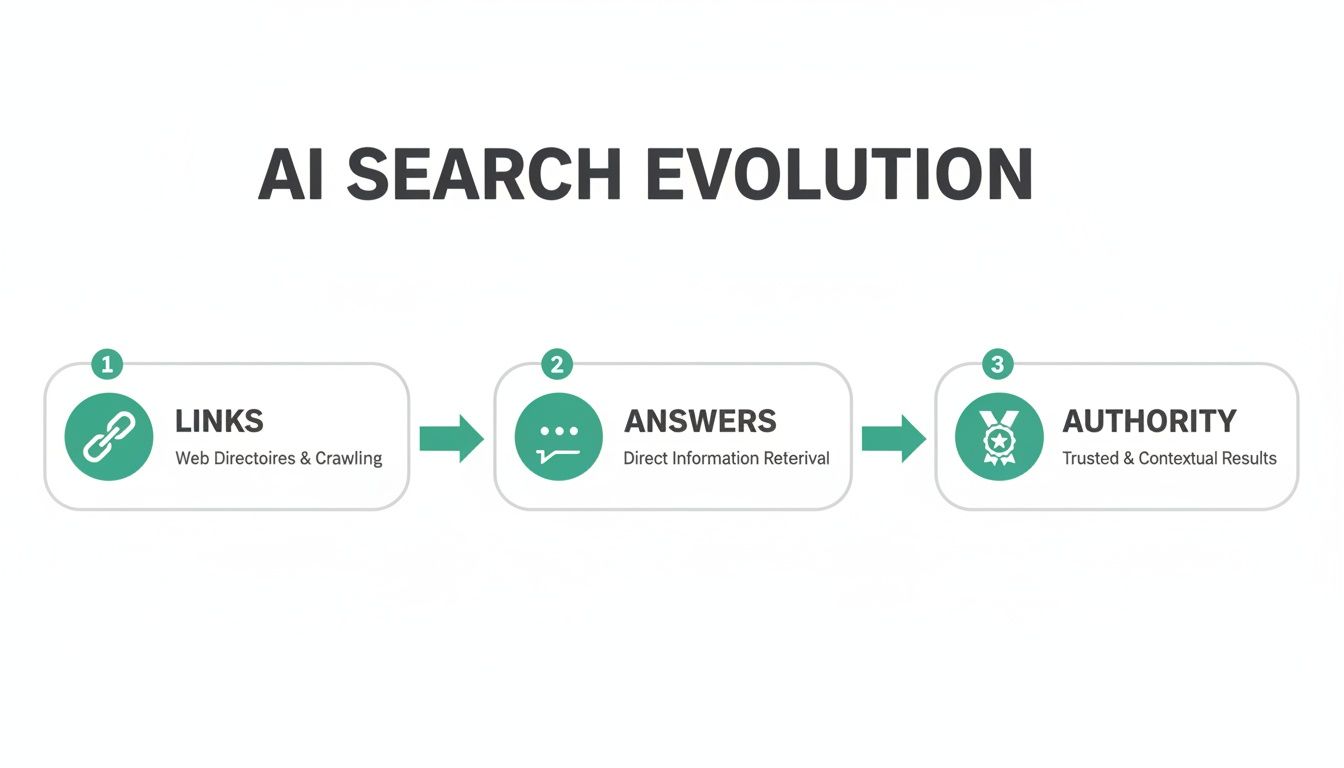
This journey shows that while old school SEO signals are not dead, the new endgame is to become so authoritative that AI models cite you directly.
Analyzing Your Content's AI Optimization Score
First up in your audit: does your content provide clear, direct answers? Large language models are built for speed and synthesis. If your content is long winded, stuffed with jargon, or buries the lede, it will be skipped. Pull up your top performing articles and ask yourself if the intro immediately tackles the user's main question and if sentences and paragraphs are short and simple. An analysis from SE Ranking found that AI Overviews favor content with clear definition sections, such as an H2 tag like "What is [Topic]?" followed by a tight explanation. For a more structured approach, this site audit checklist offers a great framework.
Evaluating Factual Accuracy to Improve Your AI Overview Ranking
In the world of generative SEO, trust is everything. An AI model is highly unlikely to cite a source that’s full of outdated stats, unverified claims, or fuzzy information. This means your audit needs a rigorous fact checking phase. Go through your content and hunt down every data point, statistic, and factual claim. Verify that each one is still current and properly attributed to a credible source. An article published in 2024 that is still referencing a 2018 study is a major red flag. Regularly updating your content with the latest data is a powerful signal that your information is fresh and reliable.
Comparing Key Content Audit Focus Areas
Your audit needs to cover a few different dimensions. The table below breaks down the key areas to focus on, highlighting how the priorities have shifted from traditional to generative SEO.
| Audit Area | Traditional SEO Focus | Generative SEO Focus |
|---|---|---|
| Structure | Keyword density, H1 placement | Scannability, logical flow, use of lists and tables |
| Factual Accuracy | Generally important for credibility | Critical for trust, requires recent data and citations |
| Clarity | Readability scores | Direct answers, concise language, simple sentences |
| Semantic Richness | Synonyms and LSI keywords | Comprehensive coverage of related topics and entities |
This underscores the shift. While the old rules have not disappeared, getting cited in AI Overviews demands a much sharper focus on unmistakable clarity and verifiable facts.
Mastering Structured Data for AI Visibility
If you want AI models to cite you, you need to speak their language. That language is structured data, often called schema markup. It’s a layer of code you add to your website that explicitly tells search engines what your content is about, removing all the guesswork for machines. Instead of forcing an AI to figure out that a block of text is a recipe, you use Recipe schema to label it directly. This simple act of translation makes your content far more digestible and trustworthy for AI systems. As we head deeper into 2025 and 2026, this is a core part of any serious AI visibility strategy.
Where to Focus Your Schema Efforts for AI Overview Rankings
There are thousands of schema types, but only a handful truly move the needle for AI Overviews. The goal is to focus on the types that directly answer questions, provide instructions, or establish authority. Research from 2024 indicated that using relevant structured data correlates with a significantly higher chance of being featured in an AI Overview. Pages with FAQPage and HowTo schema were among the most frequently cited sources, making them your top priorities for implementation.
The Most Impactful Schema Types for AI Visibility
Choosing the right schema is everything. The table below breaks down the most effective schema types for gaining traction in AI Overviews, outlining their primary use cases and the essential properties you need to include. While Article schema is foundational for building authority, FAQPage and HowTo schema are your power tools for directly feeding answers and instructions into AI models. For a deeper dive, check out our guide on answer engine optimization.
| Schema Type | Best Use Case | Key Properties to Include |
|---|---|---|
| FAQPage | Answering multiple related questions on a single page. | mainEntity, name (the question), acceptedAnswer (the answer). |
| HowTo | Providing step-by-step instructions for a specific task. | step, tool, supply, totalTime. |
| Article | Standard blog posts, news articles, and in-depth guides. | author, datePublished, headline, publisher. |
Implementing and Validating Your Structured Data for AI Search
Just putting schema on your site isn’t enough; you have to make sure it’s implemented correctly. Errors in your code can make it completely useless, so validation is a non negotiable step. The best tool for the job is Google's own Rich Results Test. Just paste in a URL or a code snippet, and the tool will immediately tell you if your structured data is valid. This simple check can save you from a tiny technical error that's holding back your otherwise perfectly optimized content.
Crafting Content That AI Models Trust
To show up in AI Overviews, you have to stop writing just for humans and start creating content that machines can actually understand. In 2025 and 2026, this means ditching the fluff and building your articles with clear, scannable information that an AI can parse and trust without a second guess. You are no longer just an author; you are an architect of information. Your job is to structure your expertise in a way that makes it the most reliable, efficient, and logical source for an AI generated answer.
Building Your Content for AI Search Visibility
The first rule is to write with ruthless clarity. AI models are trained to find the shortest path to a credible answer. If your article buries the lede three paragraphs deep, the AI has already moved on to a more direct source. Get straight to the point. Start every article by directly answering the user's question in your opening sentences. Use a natural, conversational tone and break down complex ideas with simple, descriptive headings. This gives the AI clear signposts to follow, making your content a prime candidate for summarization.
How to Structure Content for Better AI Overview Rankings
Writing for AI also means adopting a specific structure. Forget about long, dense blocks of text. Your new best friends are white space and scannable formats. Keep paragraphs short, ideally one to three sentences max. Use lists and bullet points, as they are incredibly easy for an AI to pull into a summary. Most importantly, lean on data. Citing specific numbers and original research adds a layer of credibility that models are explicitly trained to look for. If you want your content to be easily digestible for AI, it’s worth looking into different techniques and tools for paragraph summarization.
Establishing E-E-A-T and Brand Authority for AI Search
Beyond structure, your content has to scream trustworthiness. Google's E-E-A-T (Experience, Expertise, Authoritativeness, Trustworthiness) guidelines are more critical than ever, because AI models are being programmed to favor sources that nail these qualities.
According to a 2024 analysis by Backlinko, "AI systems favor stats, benchmarks, and transparent pricing. Think less about ‘ranking for one keyword.’ Instead, seed your expertise wherever Google looks for answers."
This means you need to actively build these signals into every piece of content. Detailed author bios showing real credentials, citations linking out to other credible sources, and publishing original research are all powerful ways to prove your authority to an AI.
Monitoring Your AI Overview Performance
How do you actually know if all this optimization work is paying off? You can't improve what you don't measure. Monitoring your AI Overview performance becomes an essential, ongoing part of your strategy. Heading into 2025 and 2026, this tracking phase is what separates the brands that are guessing from those making data driven decisions to win citations. It’s a systematic process of tracking your visibility, understanding the context of your citations, and measuring the real world impact on your brand.
Key Metrics for Measuring Your AI Search Visibility
Your traditional SEO metrics like keyword rankings and organic traffic are still vital, but they do not paint the full picture anymore. For AI search visibility, you need to add a new set of KPIs designed for the generative era. The primary metrics we track are AI Overview mentions, citation share against competitors, contextual relevance of how your content is used, and the impact on referral traffic from AI Overview links. These give you direct insight into how AI models perceive and use your content.
Tools and Workflows for LLM Tracking
Manually checking thousands of search queries for AI Overviews is a non starter. Effective LLM tracking requires specialized tools built to monitor these new formats at scale. Platforms like our own at Riff Analytics are designed specifically to automate this grind, giving you the data needed to make smart decisions. A typical workflow starts by setting up a project with your target keywords and competitor domains. The tool then scans AI search results on a regular basis, identifying where you and your rivals are cited. This allows you to spot trends and find content gaps.
Comparing AI Overview Monitoring Tools
Choosing the right tool depends on your team's needs, from basic mention tracking to deep competitive analysis. Here’s a quick look at how different tools stack up.
| Feature | Basic AI Tracker | Advanced Platform (like Riff Analytics) |
|---|---|---|
| Mention Tracking | Tracks when your domain is cited in AI Overviews. | Tracks domain citations, unlinked brand mentions, and contextual usage. |
| Competitor Analysis | Limited to a handful of pre-selected competitors. | Provides comprehensive citation share analysis and uncovers emerging competitors. |
| Content Gap Insights | Identifies keywords where you are not cited. | Highlights the specific sources competitors are using and provides actionable guidance. |
| Trend Reporting | Shows a simple count of mentions over time. | Offers detailed dashboards for tracking mention trends, sentiment, and traffic impact. |
Summary and Key Takeaways
Ranking in AI Overviews requires a deliberate and strategic approach that blends classic SEO with a new focus on machine readability and trust. The core principles are to create clear, factually accurate content that directly answers user questions. This content must be supported by strong E-E-A-T signals, implemented with proper structured data, and organized for scannability. By auditing your existing content, mastering schema markup, crafting trustworthy articles, and consistently monitoring your performance, you can position your brand as an authoritative source that AI models prefer to cite. This ongoing cycle of optimization and analysis is the key to winning in the new era of generative search.
Frequently Asked Questions
What are the most common content gaps that prevent AI Overview citations?
The biggest issues are failing to provide a direct answer at the beginning of an article, using outdated statistics or no data at all, and writing long, dense paragraphs. Poor structure, such as a lack of clear headings and lists, also makes it difficult for an AI to parse and extract information effectively.
Can I get into an AI Overview without backlinks?
While possible for very niche queries, it is difficult. Backlinks remain a powerful signal of authority and trustworthiness, which are critical for AI models. However, high quality, well structured content that perfectly matches user intent can sometimes be cited even with a weaker backlink profile, especially if it provides a unique answer not found elsewhere.
How does semantic richness affect ranking in AI Overviews?
Semantic richness is crucial because it demonstrates comprehensive topical authority to an AI model. When your content includes related concepts, synonyms, and answers to follow up questions, it signals that your page is a one stop resource. This makes it a much more appealing and reliable source for an AI generated summary.
How often should I conduct an AI readiness audit on my content?
For your most important "money" pages, a quarterly review is a smart practice to stay ahead of algorithm changes and competitor updates. For your entire content library, aim for an annual or biannual audit. The AI search landscape is evolving rapidly, so regular check ins will keep your strategy sharp and effective.