Meta Description Maker Guide: How AI Snippet Tools Work
Updated November 10, 2026
A meta description is the short summary inside the HTML of a page. Search engines may show it under the title, or they may ignore it. In 2026 that choice matters more, because many results now include an AI answer beside the blue links. A meta description maker only drafts the candidate. It does not decide what appears, and it does not decide whether an assistant cites you.
What a Meta Description Maker Does Today
- What it produces: A short, page specific summary for the meta description tag, written so a person can tell what the URL covers.
- Why it matters in 2026: The same summary now sits next to AI answers, not only classic blue links.
- Manual versus a generator: Hand writing fits a few flagship URLs. A generator fits volume, if a person still checks every claim.
- Length is a display habit: Phone and desktop snippets cut off at different points. A fixed character target is not a ranking rule.
- AI search visibility: Clear entities and consistent terms help retrieval systems understand the page. They do not force a citation.
- How you measure it: Compare the live snippet and, separately, whether assistants mention or cite the page after you publish.
A meta description maker is software that drafts the summary placed in the meta description tag. Search engines may use that text under the title. They may also build the snippet from the visible page, or write a different snippet for a different query. The draft is one candidate. Publishing it is not a guarantee.
How a meta description maker fits AI search
Pew Research Center analyzed browsing from March 2025 and found that 58% of people in its study encountered at least one Google search with an AI generated summary. Across all searches in the study, 18% generated such a summary, and 88% of those summaries cited at least three sources. The description now has to make sense beside those answers, as part of generative SEO, not only as a blue link blurb. A description maker cannot control whether an AI system cites the page.
Think of the description as the sign in the shop window. The generator is a sign writer who drafts several options quickly. The owner still checks each sign against what is on the shelf. For a plain language walk through of what that sign is for, understanding search result descriptions is a useful starting point before you automate anything.
If you have only a handful of money pages, write them by hand. If you have dozens of new URLs, a generator can draft faster, as long as you reject any line the page does not support.
Manual Writing or a Generator Compared
| Criteria | Manual writing | Template generator | AI generator |
|---|---|---|---|
| Speed per page | Slow, several minutes per page | Fast, fills fields in bulk | Fast, drafts several variants |
| Page specificity | High when the writer reads the page | Low, fills one pattern | High when fed the page copy |
| Consistency across a site | Low when several writers share the work | High | High, if the brand voice is set |
| Accuracy risk | Low, the writer checks each fact | Low to medium, set by the quality of the data fields | Medium, drafts need a fact check |
| Cost | Staff time | Low | Low to moderate subscription |
| Best use | Flagship and money pages | Large catalogs with shared data fields | Mid volume blogs and new pages |
Manual writing wins on flagship pages, where a wrong price or a fake guarantee costs more than the time you save. Template generators suit large catalogs. Price, location, size, and model already live in fields, so the sentence can be assembled without inventing a claim. AI generators suit mid volume blogs and new pages when you paste the copy, not a keyword alone.
Where each meta description maker workflow fails
According to Google's SEO documentation, a strong description is typically a succinct one or two sentence summary, unique to one page, and snippets can still come from the page content instead of the tag. Duplicate descriptions give both systems and readers less page specific information. A repeated template fails that test even when every field is filled in.
Say a product page has a verified spec sheet. A template that pulls weight, waterproof rating, and price stays honest. A blog post with no data does not. An AI draft of that post will often invent a stat or a promise. The fact check against the page is mandatory before you publish. For title patterns that should stay aligned with those descriptions, see what a meta title is. Teams that want starter lines for hand editing can also look at SEO meta description templates and then rewrite anything the page does not prove.
Draft with the tool, rewrite the first sentence by hand, and check every number against the page.
Keeping Descriptions Accurate When Google Rewrites Them
| Device | Peak displayed length | Decline begins | Source |
|---|---|---|---|
| Desktop without dates | About 156 characters | After about 165 characters | Portent, 30,000 keywords, 2020 |
| Mobile | About 118 characters | After about 121 characters | Portent, 30,000 keywords, 2020 |
Those peaks are display observations, not a rule Google published as a ranking requirement. Search Engine Journal's report on Portent and Ahrefs is the place to read them in context. Portent analyzed 30,000 keywords in 2020 and found that Google rewrote supplied descriptions in 71% of mobile results and 68% of desktop results. Desktop snippets without dates tended to peak at about 156 displayed characters and drop sharply after 165. Mobile snippets commonly peaked around 118 characters and declined after roughly 121.
Why character count does not control the snippet
Ahrefs, in a separate study of 20,000 keywords, reported rewrites in 62.78% of cases. Google replaced descriptions for 59.65% of high volume fat head queries and 65.62% of long tail queries. Descriptions past the commonly recommended length were rewritten 61.46% of the time, compared with 63.69% for descriptions inside the suggested limit. Length alone did not decide whether Google used the text.
Google's snippet documentation says the HTML element has no defined maximum length. Google truncates what it displays to fit the device, and it may build a different snippet for a different search. A generator cannot promise the sentence you saved. max-snippet can limit how much is shown. It does not force Google to use your tag.
Google's 2007 snippet guidance, updated when DMOZ listings dropped out in 2017, also makes a quieter point. A high quality meta description matters most when a page has little text for snippet generation. Thin pages need the most careful draft and the closest fact check.
Practical rules still help the candidate you do control.
- One URL, one description. Do not paste one sentence across a category.
- Lead with the offer. Put the central value in the opening words, before a phone truncates the line.
- Write for the shorter screen. A readable line near the mobile peak survives more often than a desktop paragraph.
- Do not chase 156. That figure is a peak in one study of desktop snippets without dates, not a target to hit.
Say a store repeats one template on 500 product pages. Google has little reason to prefer that text over the product copy, because every URL says the same thing. Five hundred descriptions built from each product's real specs at least give a distinct candidate. Then look at the live result. Counting characters in the CMS is not the same as seeing the snippet. The same habit of matching on page proof to the query helps when you optimize for featured snippets.
Measure the sentence Google actually shows. Do not stop at the character counter.
How a Meta Description Maker Builds a Snippet
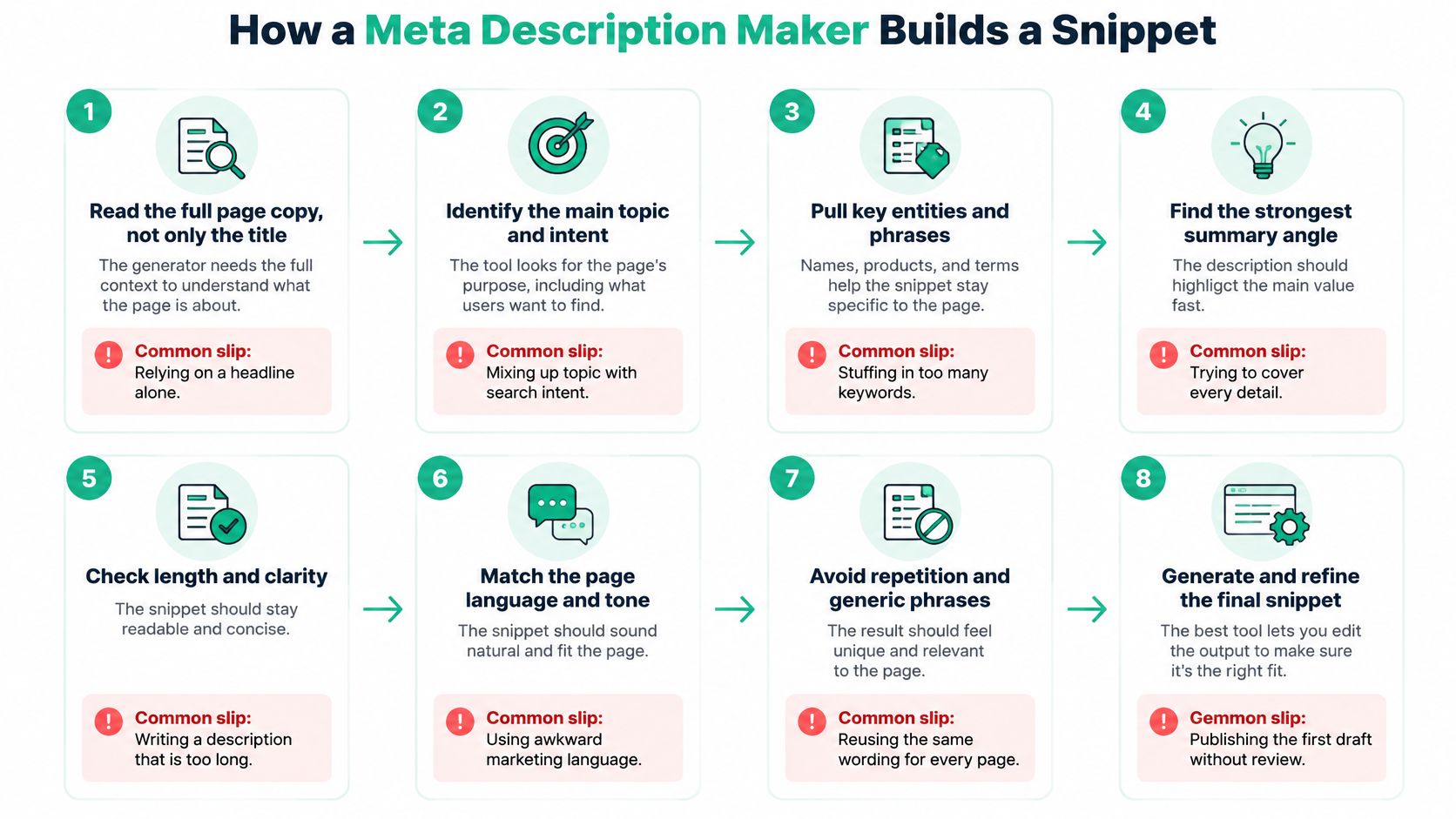
- Read the full page, not only the title. The draft has to match what the page says. The usual slip is writing from the keyword alone.
- Pull out the subject, the audience, the outcome, and one piece of evidence that a rival page does not share. Listing generic benefits any competitor could claim is the slip.
- Put the primary topic in the opening words and keep a single lead proposition. A slogan in the first words wastes the only part a short snippet is sure to show.
- Draft two or three variants in the brand voice, then pick one. Accepting the first draft is how generic lines ship.
- Check every draft for prices, guarantees, stock, and awards the page does not show. Numbers the model invented are the costly slip.
- Read the line out loud and cut it until it still makes sense if the tail is chopped. Treating a desktop peak as a quota produces padded sentences.
- Confirm the description belongs to this URL. Reusing one sentence across a category throws away the only advantage of writing it.
- Publish, and log the date and the exact text. Without that record you cannot tell later whether the live snippet changed.
If you maintain descriptions by pulling live copy from many URLs, it helps to know understanding web scraping basics so the source text is the page, not a stale export.
A before and after from a hiking boot page
Before: "Shop the best hiking boots online. Great prices, fast shipping, and top brands for every adventure."
After: "Men's waterproof hiking boots, 3 pounds a pair, with the lug depth and price from this season's spec sheet."
The second line can be checked against the page. The first line could sit on any outdoor store.
Writing Descriptions for AI Search and Generative Answers
Pew Research Center found that users clicked a traditional search result in 8% of visits involving an AI summary, compared with 15% of visits without one. They ended the browsing session on 26% of pages with an AI summary, versus 16% of pages with only traditional results. When the answer is already on the results page, a vague teaser has less time to earn the click.
Generative SEO is the work of making a page easy for assistants such as ChatGPT, Perplexity, Gemini, and Google AI Overviews to summarize without distorting it. Those systems favor pages with clear entities and terms that stay the same from the title to the body to the description.
Three writing habits follow from that.
- Repeat the names. Use one name for the product, one for the feature, and one for the audience, on the page and in the description.
- State the evidence early. The spec, the comparison, or the audience has to appear before the line can be cut.
- Drop the teaser. If the page does not contain the promise, the description should not make it.
LLM tracking belongs in the same workflow. A brand can be named in an answer with no click at all. Mentions and citations are part of discovery, not a consolation prize for lost visits.
Before the next draft, tick four entity checks. The product name matches the page. The audience matches the page. The one proof point is on the page. No synonym swaps the meaning halfway through the sentence.
Checklist for Choosing a Meta Description Maker
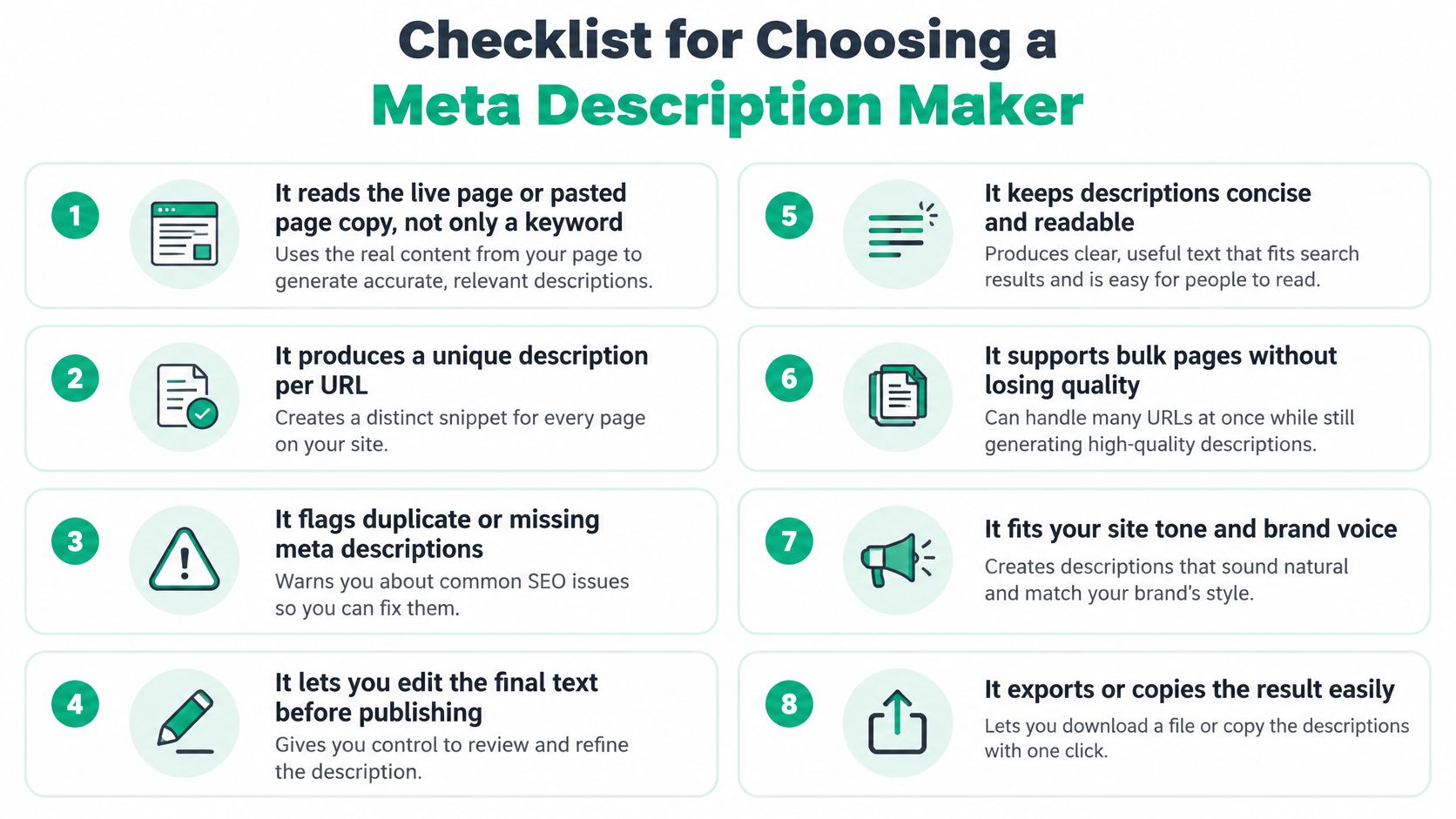
- It reads the page. Live URL or pasted copy, not a keyword field alone, so the draft can stay faithful.
- It writes one description per URL. And it flags duplicates already on the site.
- It shows length for phone and desktop. So you can see truncation risk without treating either number as a rank factor.
- It generates in bulk with a review step. Nothing publishes until a person accepts it.
- It exports clean HTML. The CMS write does not break the tag.
- It stores a brand voice and a banned claim list. Prices, guarantees, and superlatives you refuse to invent.
- It logs drafts and dates. Audits need to know what was live.
- It offers a free trial. Five real pages are enough to judge it.
- It states how drafts are stored. Including whether your copy is used to train models.
The five page test for a meta description maker
Pick five URLs of different types, such as a product, a guide, a comparison, a category, and a thin landing page. Generate a description for each. Score accuracy, uniqueness, and whether every claim is on the page. The pass rule is simple. No unsupported claim on any of the five, or the tool does not roll out across the site.
Measuring Results With AI Visibility Tracking
| Metric | What it shows | Action it triggers |
|---|---|---|
| Mention inclusion | Whether AI engines name the brand for target prompts | Publish or update the page that should be cited |
| Position and context | Where and how the brand appears in an answer | Rewrite the page lead to match the answer |
| Sentiment and accuracy | Tone and factual correctness of the description | Fix copy and profiles that carry a wrong claim |
| Citation sources | Which pages the engine uses as evidence | Strengthen those pages first |
| Mention trend over time | Change in visibility after optimization | Confirm the update worked or revert it |
After you change descriptions and page leads, ask the same prompts in ChatGPT, Perplexity, Gemini, Claude, and Google AI Overviews. You are checking whether the brand is named, not whether a character count moved.
What to log in the meta description maker workflow
Riff Analytics is one platform built for that check. It detects brand and competitor mentions, tracks inclusion and position, and measures sentiment and accuracy for every response. Analyze Response Context shows how engines position the brand and what triggers positive or negative mentions. Track Citation Sources shows where engines find the content, which sources they cite most, and where a citation gap remains. Mention trends show whether an optimization changed visibility over time.
A workable timeline is a baseline week, an update to five pages, and a recheck at 30 days. Keep a change log of the description text, the page lead, and the date. No tracker proves cause by itself. Rank tracking and AI visibility tracking also answer different questions, which is why teams keep both, including a separate look at AI rank tracking.
Summary and Answers to Common Questions
- A meta description maker drafts a candidate summary. It does not own the snippet.
- Hand writing fits flagship pages, templates fit shared catalog fields, and AI drafts fit volume only with a fact check.
- Unique copy and a clear lead matter more than hitting a character peak, because rewrites happen on both short and long text.
- In AI search, name the evidence early and keep entity names consistent.
- Choose a tool only after five real pages pass with no unsupported claims.
Does a meta description maker guarantee the text appears in Google
No. Google can build the snippet from the page, use your description, or write a different line for a different query. Treat the tool as a way to submit a strong candidate, then look at the live result.
How long should a meta description be in 2026
There is no fixed maximum on the HTML element. Phone snippets in the 2020 observations peaked nearer 118 characters and desktop snippets without dates nearer 156. Write a clear lead, and do not treat either figure as a ranking quota.
Do AI generated meta description drafts need a fact check before publishing
Yes. Drafts can invent prices, guarantees, and specs. Compare every claim with the page, and do not publish a number the page does not show.
How do you measure whether AI engines cite pages you updated
Run a baseline, change a small set of pages, and recheck the same prompts about 30 days later. Log mention inclusion, citation sources, and the trend. Our AI-SEO plans include AI visibility tracking, citation gap analysis, and competitor benchmarking, and the same 30 day test works with any tracker that reports those metrics.
Pick five URLs this week, run them through the checklist, and reject any draft the page does not support. Then watch mentions and citations for 30 days in Riff Analytics, or in another tracker that reports the same metrics, so you can tell whether the new descriptions changed anything a searcher or an assistant sees.