A Practical Guide to Optimize for AI Overviews
Updated February 12, 2026
Optimizing for AI Overviews means creating clear, factual, and highly structured content that AI systems can easily understand, trust, and cite. In the search landscape of 2025 and 2026, this is no longer optional. It’s about shifting your strategy from simply ranking for keywords to becoming an authoritative source for direct, AI-generated answers. Getting featured in these summaries is the new benchmark for search visibility.
The New Search Landscape of AI Overviews
Welcome to the new era of search. AI Overviews are changing how people find information on Google. Think of an AI Overview as a smart summary at the top of the results page, directly answering a question by pulling the best information from multiple sources. User behavior is already shifting from clicking a list of links to reading the summarized answer.
Mastering how to optimize for AI Overviews is critical. The game is no longer just about ranking first; it’s about becoming a trusted, citable source that AI models rely on. Your new goal is to be featured in that summary box, a practice often called generative SEO.
Embracing Generative SEO and Answer Share
A key metric emerging from this shift is "answer share," which measures how often your brand gets cited as a source in AI answers. Securing a high answer share is the new benchmark for AI search visibility. Getting cited in an overview builds your authority and captures attention before a user even thinks about scrolling down to the traditional blue links.
Why Your Strategy Must Adapt for AI Search Visibility
The impact of AI Overviews is already significant. Research shows that longer search queries of four or more words trigger AI Overviews over 60% of the time. These are the detailed, informational questions where users want specific answers, which is exactly what AI summaries are built to deliver. If your content isn't tailored to this format, you risk becoming invisible to a large portion of your audience.
According to research from SE Ranking, pages already ranking in the top 10 organic spots are featured as sources in AI Overviews over 92% of the time. This tells us that solid SEO fundamentals are still the foundation. But now, a new layer of optimization is required to make the leap from being a high ranking link to becoming a citable source.
For more context on this evolving field, you might find our guide on the differences between SEO, GEO, and AEO helpful.
Auditing Your Website for AI Readiness
Before you can chase after AI Overviews, you need an honest assessment of where you stand. An AI readiness audit gives you that clear picture. It's your baseline, helping you measure progress and find the biggest, easiest wins first. Think of it as looking at your site through the eyes of a large language model, where all that counts is clarity, accuracy, and getting straight to the point.
The audit starts by finding your high potential pages. Focus on content that already ranks in the top 10 for informational queries. Research shows a staggering 92% of AI Overviews pull their sources straight from the first page of organic results. Your job is to find the content that's already close to the goal line and just needs a push to become a trusted source.
Evaluating Content for AI Search Visibility
Once you have your shortlist of pages, the real work begins. Generative AI values content that is factual, concise, and incredibly easy to digest. You need to get critical and ask tough questions about every single page. Does it answer a specific question directly? Is the core information sitting right at the top, or is it buried under fluffy introductions?
A huge piece of this is scrutinizing your E-E-A-T (Experience, Expertise, Authoritativeness, Trustworthiness). These aren't just buzzwords; they're the signals AI models are trained to find and reward.
Experience: Does the content feel like it was written by someone who has actually done the thing they're writing about?
Expertise: Is the author clearly identified? Do they have credentials that matter?
Authoritativeness: Are other credible, well respected sources linking to this content?
Trustworthiness: Is the information accurate, fact checked, and backed up with data?
This evaluation process is about spotting the subtle weaknesses that might make an AI model hesitant to trust you. If you need a good starting point, this comprehensive site audit checklist can help guide your initial assessment.
Benchmarking Your Performance to Optimize for AI Overviews
To set realistic goals, you have to know the score. This goes beyond simple rank tracking. You need to figure out who currently "owns" the answer share for your most important topics. A few new tools are emerging to provide this exact insight, a practice we often call LLM tracking.
This benchmarking process tells you where your competitors are getting cited and what content formats are winning. Is it a short, punchy definition? A clean bulleted list? Or maybe a simple data table? Seeing these patterns gives you a clear roadmap for what to build.
Content Strategies to Capture AI Citations
Earning citations in AI Overviews means changing how you think about content. It's no longer enough to write a long article that ranks well. You have to structure information so a machine can easily parse, verify, and feature it as a definitive answer. This means prioritizing clarity and factual density without losing the engagement your human audience expects.
The good news is that the tactics to optimize for AI Overviews are specific and repeatable. Think concise paragraphs packed with facts, question based headings that mirror real searches, and trust signals like original data and expert quotes. It's all about turning your content into AI friendly assets.
How to Structure Content for Better AI Search Visibility
The quickest way to improve your AI visibility is to make your content scannable. Large language models are built to find and extract information fast. Overly complex sentences and long, dense paragraphs slow them down.
Break your content into small, digestible chunks of one to three sentences. This forces you to be direct and clear, which is exactly what AI systems reward. Use headings and subheadings as direct answers to potential questions. For instance, instead of a generic heading like "Product Features," try a question: "What Are the Core Features of Riff Analytics?" This lines up perfectly with a search query.
The Power of Factual Density and Clear Sourcing in Generative SEO
AI Overviews are all about facts. To become a trusted source, your content must be dense with verifiable information like recent statistics, original data, and direct quotes from subject matter experts. When you include a statistic, make it easy for an AI to see that it’s current and credible. This is where transparent sourcing becomes non negotiable. Always link out to the original source.
This approach proves your authority and helps the AI model validate your claims, making your page a much stronger candidate for a citation.
Optimizing with AI Friendly Formatting
Beyond clear writing, the right formatting choices can make a huge difference in how easily an AI can interpret your content. The goal is to present information in a highly structured format that can be lifted directly into an AI Overview.
Bulleted and Numbered Lists: Use these to break down processes, features, or key takeaways.
Simple Data Tables: For comparisons or dense data, tables are invaluable. They organize complex information in a way that’s immediately understandable.
FAQ Sections: Add a dedicated FAQ section at the end of your articles to target long tail, question based queries directly.
To really get this right, a basic understanding of prompt engineering is surprisingly helpful. The same principles of giving clear, structured instructions to an AI apply to how you structure content for AI crawlers. If you're looking for more ways to refine your content, you can learn more about how to optimize content for AI search in our detailed guide.
Technical SEO for Generative AI Trust
Amazing content won't get you cited in AI Overviews on its own. For a generative model to trust and reference your information, that content needs a rock solid technical foundation. This is where technical SEO provides the critical behind the scenes signals that prove your site is authoritative, reliable, and easy for AI crawlers to understand.
Think of it like building a house. Your content is the furniture and interior design, but technical SEO is the foundation and the framework. Without it, the whole structure is wobbly. For AI, these technical elements are everything for verifying who you are and what your content is about.
Optimizing Your Site Structure for AI Crawlers
A clean site architecture has never been more important. AI bots must process staggering amounts of information as efficiently as possible. A logical, well organized site with clear internal linking helps them map out the relationships between your content, which is how they establish your topical authority.
This means your most important pages should be easy to find from your homepage, and related articles need to link to each other. For instance, a pillar guide on "AI search visibility" should link out to its supporting articles on "LLM tracking" and "generative SEO." This creates a powerful content hub that signals deep, trustworthy expertise on a specific topic.
Leveraging Structured Data to Optimize for AI Overviews
Structured data, or schema markup, is one of the most powerful tools for optimizing for AI Overviews. It's a vocabulary you add to your site's code to help search engines understand your content on a much deeper level. For AI, it removes guesswork by providing unambiguous context.
The right kind of schema can directly increase your chances of getting cited.
Organization Schema: This clearly tells AI who you are, establishing your brand as a recognized entity.
Article Schema: It provides crucial details like the author, publication date, and headline.
FAQPage Schema: This markup structures your content into a question and answer format, making it simple for an AI to pull directly.
This structured approach is already delivering results. Recent AI search statistics show that implementing structured data can boost AI citations by a stunning 44%, with 60% of marketing teams planning to shift their SEO budgets toward AI optimization by 2026.
| Optimization Tactic | Primary Goal for AI | Implementation Effort | Potential Impact |
|---|---|---|---|
| Schema Markup (Article, FAQ) | Provides clear context and makes content easily citable. | Medium | High |
| Clean Site Architecture | Helps AI understand topical authority and content relationships. | High | High |
| Author Bios & Profiles | Establishes E-E-A-T signals for individual content pieces. | Low | Medium |
| Site Speed & Core Web Vitals | Improves crawl efficiency for resource intensive AI bots. | Medium to High | Medium |
| Internal Linking | Shows the semantic relationship between pages on your site. | Medium | High |
A strong technical SEO foundation is non negotiable for building the trust required to appear in AI Overviews. Start by auditing your site's architecture and internal linking. From there, make implementing structured data like Article and FAQPage schema your top priority.
Measuring Your Visibility in AI Search
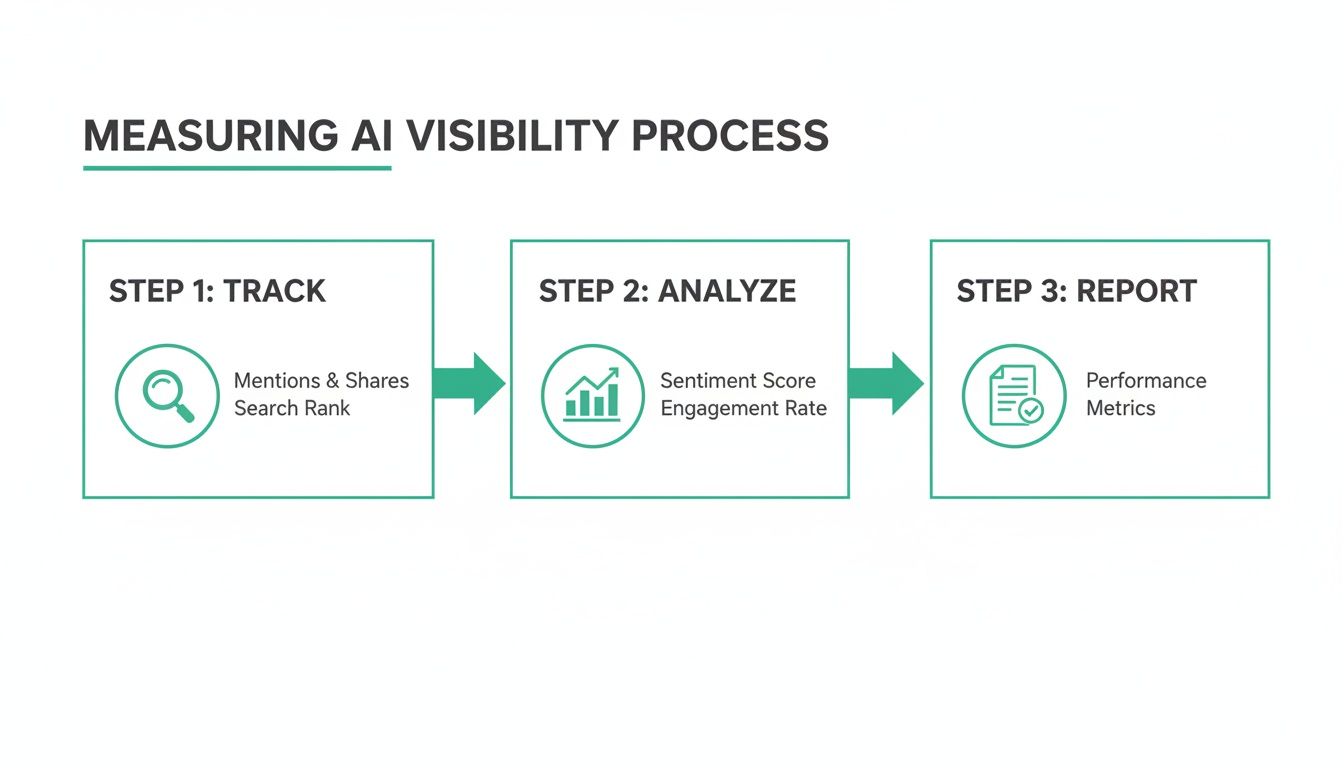
You can't improve what you don't measure. As AI Overviews redefine search results, tracking organic rankings is no longer enough. To truly optimize for AI Overviews, you need a new way of thinking about measurement. We must move past simple blue links and start looking at our actual AI search visibility. This means tracking new metrics that show how your brand performs inside generative answers.
Adopting New Metrics for Generative SEO
The single most important metric in this new world is Share of Answer. This KPI tells you the percentage of AI generated responses for your target topics that cite your brand as a source. It is the ultimate indicator of your authority.
But just showing up isn't enough. You also need to dig into the frequency and sentiment of those citations. Are you mentioned consistently across different AI engines? Is the mention positive or neutral? This is where you get deep insights into how AI models perceive your expertise. This ultimate guide to automating search visibility reports can help streamline the whole process.
How to Monitor Your AI Search Visibility with LLM Tracking
Manual spot checks won’t scale. For effective LLM tracking, you need a specialized platform. Tools like Riff Analytics are built for this purpose: monitoring your brand and your competitors across the AI engines that matter most. They provide scalable data on where you're being cited, what content is earning those citations, and where your competitors are winning.
According to Anastasia Kotsubynska, the SEO Team Lead at SE Ranking, "I recommend that you start incorporating this kind of analysis into your SEO routine. Evaluate your rankings in regular organic results, combine them with your positions in AIO snippets, and merge this with the traffic data from Google."
This integrated view is crucial. You have to connect your AI visibility data with traditional metrics like traffic and conversions to show stakeholders the complete picture of your performance.
Choosing the Right Tools to Track AI Overviews
Not all monitoring tools are built the same. A solid tool should do more than just count your mentions; it needs to provide context you can act on. Here’s a breakdown of the features you should be looking for in a generative SEO monitoring tool.
| Feature | What It Does | Why It Is Important for AI Optimization |
|---|---|---|
| Multi Engine Tracking | Monitors mentions across Google AI, ChatGPT, Perplexity, etc. | Gives you a complete view of your visibility across the entire AI ecosystem. |
| Citation Source Analysis | Identifies the exact URLs and content being cited by the AI. | Shows you which of your pages and content formats are actually working. |
| Competitive Benchmarking | Tracks your Share of Answer against key competitors. | Uncovers content gaps and opportunities to steal answer share. |
| Sentiment Analysis | Assesses the context of brand mentions (positive, neutral, negative). | Helps you understand how your brand is perceived and manage your reputation. |
Summary and Final Thoughts on AI Overview Optimization
Getting your content ready for AI Overviews isn't a one time task; it's a continuous cycle of auditing your assets, creating better content, and measuring what works. By prioritizing clarity, authority, and structured data, you can stay relevant and visible in 2025 and beyond.
Audit Your Foundation: Regularly assess your site for AI readiness, starting with pages already ranking in the top 10 for informational queries.
Create Citable Content: Structure your articles with question based headings, write short, fact dense paragraphs, and use bullet points and simple tables.
Build Technical Trust: Implement Article and FAQPage schema and ensure your site architecture and internal linking strategy signal strong topical authority.
Measure and Refine: Use LLM tracking tools to monitor your "Share of Answer" against competitors and refine your strategy based on what content earns citations.
Frequently Asked Questions about Optimizing for AI Overviews
How is optimizing for AI Overviews different from traditional SEO?
Traditional SEO focuses on ranking a URL in a list of links. Optimizing for AI Overviews is about getting your content and brand cited directly inside the AI generated answer. The key metric shifts from rank position to "Share of Answer," which measures your direct influence.
What is the best way to track visibility in Google AI Overviews?
The most effective method is using a dedicated AI visibility platform like Riff Analytics. These tools automate the tracking of thousands of queries at scale, pinpoint which pages are being cited, and benchmark your performance against competitors, providing actionable data.
Can I track my competitors' performance in AI Overviews?
Yes, and you absolutely should. Competitive benchmarking is a core feature of any modern AI visibility tool. Seeing which sources AI engines trust for your key topics reveals your content gaps and highlights strategic opportunities to gain answer share.
How important is content freshness for appearing in AI answers?
Content freshness is very important. Data suggests that pages updated within the last 60 days are significantly more likely to be featured in AI generated answers. Regularly updating your key content with new data and insights is a crucial tactic.