Mastering SEO Competitor Analysis in the AI Era
Updated February 13, 2026

An SEO competitor analysis is the process of reverse-engineering your rivals' search strategies to find opportunities to outrank them. In plain language, it’s about figuring out which keywords, content, and backlinks are working for them so you can build a smarter, more effective strategy for yourself. As we look toward 2025 and 2026, this isn't just about climbing Google's traditional results; it's about securing your visibility in an AI-driven search landscape.
Why a Detailed SEO Competitor Analysis Matters More Than Ever
In a digital world where AI Overviews are reshaping search results and user habits are constantly shifting, a thorough SEO competitor analysis is your strategic survival guide. It moves beyond simple rank tracking to become the foundation for sustainable growth. By decoding your competitors' successes and failures, you can avoid costly mistakes and prioritize actions that will deliver the biggest impact.
The stakes are incredibly high. According to research, the first organic result on Google secures an average click-through rate (CTR) of over 27%. This drops to just 2.4% for the tenth position. That massive gap underscores a winner-take-all environment where a data-driven competitive analysis is non-negotiable.
Adopting a Modern Framework for Your Competitive SEO Analysis
Forget just exporting a list of your competitor's keywords. Today’s competitive battleground is far more complex, especially with AI changing the rules. A comprehensive analysis must now account for metrics that were barely on the radar a few years ago.
A complete framework for analyzing your SEO competitors now includes:
Generative SEO Performance: Who is getting cited and sourced in AI-generated answers?
Answer Share Metrics: How much real estate is your brand taking up in AI Overviews and chatbot responses?
LLM Tracking: How do Large Language Models like Gemini or ChatGPT talk about your competitors?
SERP Feature Dominance: Who owns the featured snippets, "People Also Ask" boxes, and video carousels?
This is what it looks like in practice. You're no longer just looking at a rank tracker; you're looking at a dashboard that measures influence.
The real takeaway here is the shift from tracking simple rankings to measuring influence and citation within AI results. That requires a whole new set of tools and a new way of thinking. As you can see in our guide on how to measure your AI search visibility, this modern approach turns a reactive task into a powerful, proactive strategy for growth.
How to Find Your Real SEO Competitors
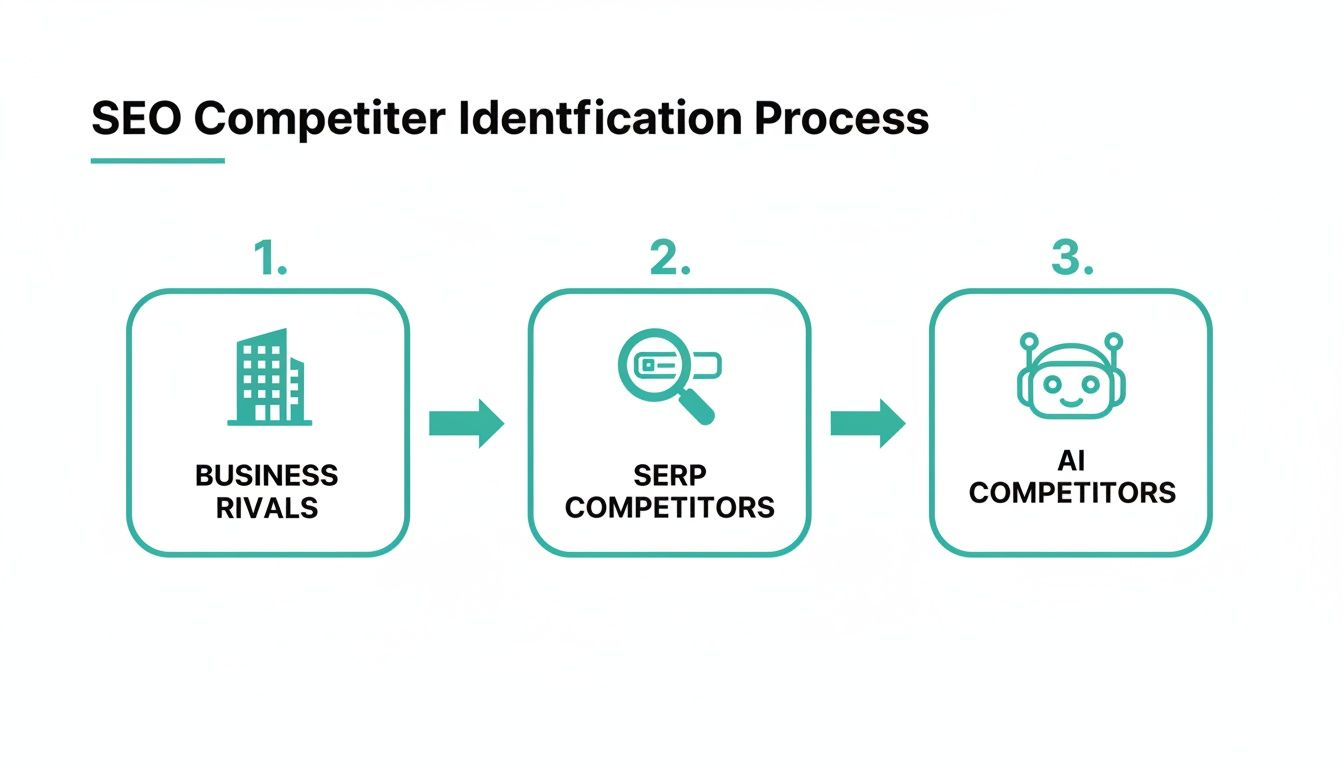
The biggest mistake marketers make is assuming their main business rivals are their top search enemies. The company across town selling the same product might have a terrible website, while a niche blog you’ve never heard of is quietly siphoning off your traffic for your most valuable keywords.
You must distinguish between your offline business rivals and your online SERP competitors. A SERP competitor is any domain that consistently appears for the keywords you want to own. They could be direct competitors, industry magazines, affiliate sites, or even a popular Reddit thread. If they occupy the digital real estate you want, they belong in your analysis.
Identifying Who to Include in Your Search Competitor Analysis
The most reliable way to perform this analysis is to let search results dictate your competitors. Start by listing your top 10 to 15 most valuable keywords with high commercial intent. For a B2B software company, that might be "project management software for small teams" or "best CRM for startups."
Next, use an incognito browser to search for these terms. Note the domains that consistently appear in the top 10 results. After just a handful of searches, a clear pattern will emerge, revealing the 5 to 10 domains that are your true SEO competitors. Those are the ones you need to dissect.
Pinpointing Competitors in AI-Powered Search
By 2026, any competitor analysis that ignores generative search is already obsolete. Your competitors in an AI world are the brands cited as sources in answers from engines like Perplexity. Finding them requires a different approach.
Start by asking these AI engines your most critical informational questions. A fintech company, for instance, might ask, "What are the best strategies for retirement savings?" Pay close attention to which sources the AI cites. These are your new AI search visibility competitors. This is where specialized LLM tracking platforms come in, automating the process to show which brands consistently earn citations and win answer share.
Analyzing Competitor Keyword and Content Gaps
Once you’ve identified your competitors, the real work begins. This is where you conduct your SEO forensics, systematically analyzing what your rivals are doing with keywords and content to find gaps they've left open.
A keyword gap analysis pinpoints valuable search terms your competitors rank for, but you don’t. A content gap analysis takes it a step further, examining the quality, depth, and format of their top pages to find strategic weaknesses. For example, a B2B SaaS company might discover a competitor is dominating an entire topic cluster around "team productivity metrics," providing a clear roadmap for creating better content to win that audience. A solid grasp of effective keyword research is the foundation for this entire process.
Uncovering Keyword Opportunities in a Competitive SEO Analysis
The first step is to map out the full range of keywords your rivals are targeting to understand their strategic priorities. It's helpful to categorize these competitor keywords:
Missing Keywords: Terms where competitors rank in the top 20, but you're nowhere to be found. This is pure, untapped potential.
Weak Keywords: You both appear, but they significantly outrank you. This signals an opportunity to improve your existing content.
Shared Keywords: The primary SERP battleground where you compete head-to-head.
Performing a Competitor Content Gap Analysis
Finding keyword gaps is only half the battle. You have to understand why their content is winning. A real content gap analysis moves past keywords and into the substance and strategy behind their top-ranking pages. Assess their content through an E-E-A-T (Experience, Expertise, Authoritativeness, Trustworthiness) lens. Are they using original data? Do they feature quotes from experts? Answering these questions gives you actionable intel to improve your own content, a process we detail in our guide to creating a better keyword rankings and visibility report.
Leveraging Tools for a Deeper SEO Competitor Analysis
Manually sifting through SERPs for this data isn't scalable. Platforms like Ahrefs, Moz, and Semrush automate the heavy lifting of tracking keyword gaps, backlinks, and emerging metrics like AI search visibility. This shift is happening fast, with recent studies showing intensified competition from AI. This new reality forces us to benchmark rivals across every search engine and device.
This table compares common workflows for this type of analysis:
| Analysis Workflow & Tools | What It Reveals | Actionable Insight |
|---|---|---|
| Keyword Gap Analysis (Ahrefs) | Keywords competitors rank for that you miss. | Create new content targeting these proven terms. |
| Top Pages Report (Semrush) | Competitors' most successful content by traffic. | Analyze their content structure and promotion strategy. |
| Content Explorer (Frase) | High-performing articles on a specific topic. | Identify winning formats and angles to improve upon. |
| LLM Tracking (Riff Analytics) | Brands cited in AI-generated answers. | Optimize content to become a citable source. |
Auditing Competitor Backlinks and Authority
A competitor's backlink profile is their content marketing playbook laid bare. It shows you exactly which websites vouch for them, what kind of content earns that trust, and how they built their authority. In 2026, looking at these links isn't just about counting them; it's about reverse-engineering their success so you can build a smarter link-building strategy. The goal is to understand the quality and relevance of their inbound links to find high-value publishers and set realistic goals for your own authority-building efforts.
Core Metrics for a Backlink Competitor Analysis
When diving into a competitor's backlink profile, focus on a few key metrics that tell a clear story:
Domain Rating (DR) or Domain Authority (DA): Scores from tools that estimate a site's overall authority on a 100-point scale, serving as a quick benchmark.
Referring Domains: The number of unique websites linking to your competitor. Ten links from ten different domains carry more weight than 100 links from a single domain.
Link Velocity: This tracks how fast a competitor is getting new backlinks. A steady growth curve usually signals a healthy, long-term strategy.
A competitor's technical foundation can also influence their link profile. For instance, a clean, fast site often attracts better links. Some architectures, like static sites, can offer performance benefits, as detailed in this guide on SEO for Static Websites.
A Deeper Dive into a Competitor Backlink Audit
Once you have baseline numbers, dig into the quality behind them. According to digital marketing expert Ann Smarty, "Analyzing where they get links from tells you which publishers to target and what content resonates." This is where you find actionable insights. Look for topical relevance, contextual link placement, natural anchor text distribution, and the types of "linkable assets" that attract the most links, such as free tools, original research, or ultimate guides.
Tracking Competitor Visibility in AI Search
Welcome to the new frontier of SEO. Traditional ranking reports are no longer enough. As search becomes a conversation, you must master generative SEO, the art of ensuring your brand appears, gets cited, and shapes the narrative inside AI-driven answers. This is about measuring your AI search visibility. By 2026, winning in search means owning the story in AI Overviews and chatbot responses from engines like Perplexity.
The New Metrics of a Competitor Analysis for AI Search
To stay ahead, you need to understand the language of AI search. Two concepts are central to any modern competitor analysis: answer share and citation analysis. Answer share measures how often your brand is mentioned or sourced in AI-generated answers for your target queries. Citation analysis identifies which specific sources AI engines trust enough to build their answers upon.
This isn't just a theoretical shift. New data shows that a significant portion of searches now end without a click due to features like AI Overviews. According to some SEO statistics, these citations are becoming a primary channel for visibility.
A Workflow for Analyzing AI Visibility
To track your generative SEO performance, start by creating a list of 20 to 30 critical, high-intent questions your customers would ask an AI. For example, a financial services company might use prompts like, “What are the best investment strategies for a volatile market?”
Next, input these questions into major AI engines. While you can track results manually, a dedicated LLM tracking platform automates this process, providing data on citation frequency, response context, and your competitors' answer share over time. This data-driven approach removes guesswork, revealing exactly who is dominating the AI visibility war.
Summary and Key Takeaways
An effective SEO competitor analysis is a continuous strategic process. By consistently monitoring your rivals' keywords, content, authority, and AI search visibility, you can turn their successes into your actionable roadmap. This loop of analysis, execution, and measurement is how you not only catch up but build a sustainable competitive advantage in a rapidly evolving search landscape.
Frequently Asked Questions
What is the difference between a direct competitor and a SERP competitor?
A direct competitor sells a similar product or service to your audience. A SERP competitor is any website that ranks for the keywords you're targeting, regardless of what they sell. For example, a local bakery's direct competitor is the bakery down the street. But its SERP competitor for "best sourdough recipe" might be a national food blog like King Arthur Baking.
How often should I conduct an SEO competitor analysis?
Perform a light monthly check-in on key rankings and new content from competitors. Conduct a deeper quarterly analysis of keyword gaps and backlink profiles. Finally, complete a comprehensive annual review to assess major market trends and adjust your overall strategy.
How do I find competitors for long-tail keywords?
Use a keyword research tool like Google Keyword Planner to see which domains consistently rank for specific, multi-word phrases in your niche. You can also search for these terms yourself and observe who appears. Often, these competitors are highly specialized niche sites with deep topical authority.
What is "generative SEO" in the context of a competitor analysis?
Generative SEO involves optimizing your content to be cited and featured in AI-generated search results, like Google's AI Overviews or chatbot responses. In a competitor analysis, this means tracking which rivals are earning these citations (measuring "answer share") and reverse-engineering their content to understand why AI engines consider them authoritative sources.
How many SEO competitors should I track for an effective analysis?
Start with 3 to 5 primary SEO competitors. This is a manageable number that allows for a deep dive into their strategies without causing data overload. For a well-rounded view, include a mix of direct business rivals, authority publications, and niche content sites that appear for your target keywords.