Mastering SEO for ChatGPT: A Guide for 2025 and Beyond
Updated December 29, 2025
SEO for ChatGPT is the practice of optimizing your website and content so that AI assistants like ChatGPT, Gemini, and Perplexity cite you as a trusted source. In 2025 and 2026, this is no longer a futuristic concept but a critical marketing channel. The goal has shifted from just ranking on a Google results page to becoming the direct, authoritative answer inside a conversational chat window. As users increasingly ask complex questions instead of typing simple keywords, getting cited by AI is the new benchmark for digital visibility.
This guide will walk you through the strategies and tactics needed to win in this new landscape of generative SEO.
The New Reality of Generative SEO and AI Search Visibility
Welcome to the next evolution of search. While traditional SEO fights for rankings on a search engine results page (SERP), optimizing for ChatGPT is about winning a totally different prize: becoming a cited, authoritative source inside an AI generated response. It's a fundamental pivot in how we need to think about digital visibility. In this new world, the aim isn't just to get a click from a list of blue links. Instead, you want your data, your insights, and your brand name woven directly into the answers users get. This approach, often called Answer Engine Optimization, demands a completely new playbook. To learn more, see our complete guide on what is Answer Engine Optimization.
Why Optimizing for ChatGPT is Non Negotiable in 2025
The rise of large language models (LLMs) as the go to source for information isn’t a future trend; it is happening now. Recent data shows ChatGPT’s user base has skyrocketed, with its activity estimated to capture 3% to 8% of Google's daily search volume. This represents a significant slice of user intent that now occurs entirely outside of traditional search engines. For SEO managers and digital marketers, this shift means that focusing only on Google is no longer sufficient. Brands must now compete for AI search visibility inside ChatGPT's answers, where its dominant market share in AI chatbots gives it a massive lead over rivals.
Understanding the Core Differences in SEO for AI Engines
It’s crucial to understand how these two approaches differ. They share common ground, like the need for quality content and authority, but their mechanics and end goals are worlds apart. One is about winning clicks; the other is about earning citations. Understanding these distinctions is the first step toward building a successful generative SEO strategy.
| Feature | Traditional SEO (for Google) | SEO for ChatGPT (for AI Engines) |
|---|---|---|
| Primary Goal | Rank high on a SERP to earn clicks. | Become a cited source in an AI answer. |
| User Interaction | Keywords and scanning a list of links. | Conversational questions and direct answers. |
| Key Signals | Backlinks, keyword density, user metrics. | Source credibility, factual accuracy, structured data. |
| Content Focus | Targeting specific keywords and user intent. | Factual, data driven, easily parsed by machines. |
Crafting Content for AI Ingestion and Citation
Writing content that an AI model will use and cite isn't about chasing old school SEO tricks. To get noticed in 2025, you need to structure your articles for machine readability. It’s about building a playbook for content that AI can easily parse, understand, and trust as a verifiable source. Think of the AI as your primary audience. It needs to see clear, logical signals that your content is factual, well organized, and authoritative. A messy, unstructured article is just noise to an AI crawler, but a clean, hierarchical post is a prime candidate for citation.
Optimizing Your Content Structure for Generative SEO
The first move toward better SEO for ChatGPT is building a clear, logical hierarchy on the page. AI models thrive on structure because it helps them map the relationships between different concepts. Your article should read like a well organized outline. Your main topic belongs in the H1 tag, with major subtopics in H2s and supporting details nested under H3s and H4s. This isn't just a nice to have for user experience; it's a non negotiable for AI crawlers.
Here’s how to put this into practice:
Use one H1 tag only. It should state the page's core topic.
Treat H2s as main sections. Each one should tackle a key pillar of your topic.
Use H3s for supporting points. These break down the ideas introduced in your H2s.
Keep headings descriptive. Instead of a vague heading like "Next Steps," be specific: "How to Measure AI Citation Impact."
This creates an unmistakable roadmap for both people and machines, making your content far easier to ingest and categorize.
The Critical Role of Factual, Data Driven Language for LLM Tracking
AI models are trained to find and prioritize factual information. Vague claims and unsubstantiated opinions are red flags that sink your content's credibility. To build trust with these systems, you have to use data driven language and cite your sources transparently. Every significant claim or statistic should be backed by a link to a credible source, creating a verifiable chain of trust that AI models can follow. For instance, instead of saying, "many people use AI," state that "ChatGPT now has over 180 million monthly active users" and link directly to the source. The more you ground your content in verifiable facts, the more valuable it becomes. For a deeper dive, our guide on Trusted LLM Optimization for AI Visibility Enhancement covers these principles in detail.
Enhancing AI Search Visibility with Semantic Richness
Semantic richness isn't about keyword stuffing. It's about using a wide range of related terms, concepts, and entities that are topically relevant to your main subject. This helps AI models understand the full context of your content, which is crucial for matching it with complex, conversational queries. Instead of just hammering the phrase "seo for chatgpt," you should naturally weave in related concepts like "AI search visibility," "generative SEO," and "LLM tracking." This approach makes your content more comprehensive and genuinely useful. If you're looking for help in the creation process, exploring some of the best AI content creation tools can help you brainstorm related topics and structure your articles more effectively.
Building Technical Authority for AI Engines
Brilliant content isn't enough anymore. By 2025, if AI engines can't easily access and trust your site's technical foundation, even the best writing will fail to get cited. Building technical authority is the other half of the SEO for ChatGPT equation. It’s all about sending strong, clear signals to AI models that your website is a credible, high performance source worthy of a mention. Think of it this way: your content is the information inside a library book, but your site's technical health is the library itself. If the building is hard to navigate, has slow service, and isn't well regarded, people and AI will simply go elsewhere.
Core Technical Signals for Better SEO for ChatGPT
Large language models, just like traditional search crawlers, have a finite budget for crawling the web. A site that’s fast, mobile friendly, and logically structured is far easier and more efficient for them to process. That efficiency directly impacts your chances of being included in an AI's knowledge base.
You absolutely have to get these core technical elements right:
Site Speed: AI crawlers will abandon a slow loading site. Aim for a Google PageSpeed Insights score of 90 or higher to make sure your content gets indexed quickly.
Mobile Experience: A huge chunk of AI interactions happen on mobile devices. A seamless mobile UX is a critical factor for both Google and AI ingestion.
Clean URL Structures: Simple, descriptive URLs help AI models understand a page’s context without having to parse the full content first.
Getting these fundamentals right ensures that AI can find, crawl, and understand your content with minimal friction.
Why Off Page Authority Is a Game Changer for Generative SEO
While on page factors get your content ready for AI ingestion, off page authority is what ultimately convinces an AI model to trust and cite it. Backlinks from reputable domains are the most powerful signal of trust you can build. For generative AI, the quality of these links matters more than ever. A link from a top tier university, a respected industry journal, or a major news outlet acts as a powerful endorsement. It tells the AI model that other authoritative entities vouch for your content's credibility. This is why a strong link building strategy, focused on quality over quantity, is central to any serious effort to optimize for AI search.
Implementing LLM Tracking to Identify Trusted Sources
A powerful advantage is LLM tracking. This means figuring out which sources AI engines already cite for topics in your niche. By understanding which domains ChatGPT or Gemini currently trust, you can reverse engineer a winning strategy. The goal is to see where they get their information and then build a plan to become one of those go to sources. Using an automated platform like Riff Analytics gives you a clear roadmap. You can identify the publications, research institutions, and industry blogs that AI engines favor and focus your outreach and digital PR on earning mentions from those specific, high value domains. This targeted approach massively accelerates your journey to becoming an authoritative library that AI is eager to reference.
How to Measure Your ChatGPT SEO Performance
You can't improve what you don't measure. For years, we've all leaned on the same familiar metrics: organic traffic, keyword rankings, domain authority. But as we push deeper into 2025 and 2026, that story is incomplete. Measuring your performance in this new arena requires a different set of KPIs. It’s no longer just about clicks. It's about citations and influence inside AI generated answers. Tracking SEO for ChatGPT is really about quantifying your brand’s presence and authority inside these conversational models. It answers the questions that matter now: Are AI models citing us as a trusted source? How often are we mentioned compared to competitors? Answering these is the only way to prove the ROI of your work.
Moving Beyond Traffic to Track AI Search Visibility
The single most important new metric is Answer Share. This isn't about website visits. It's about measuring the percentage of relevant AI generated responses that cite your brand or link to your content. Answer Share tracks your influence at the point of discovery, that critical moment before a user ever decides to click a link. A high Answer Share means AI models see your content as credible and authoritative on a given topic. For example, if ChatGPT answers 100 different prompts about "B2B content marketing" and cites your brand in 25 of those responses, your Answer Share for that topic is 25%. It's a direct measure of your thought leadership inside the AI ecosystem.
Adopting a Modern Toolkit for LLM Tracking
Manually asking ChatGPT questions to see if you show up isn't a strategy. It's an anecdote. Responses can vary wildly based on conversation history and model updates, making spot checks unreliable. To get real data, you need a dedicated LLM tracking platform. Here’s a glimpse of a dashboard that provides this kind of insight, showing how brands stack up over time.
This visual gives you a clear trend analysis of brand mentions within AI responses. It lets you benchmark your performance directly against the competition and instantly see who’s gaining or losing ground. Modern tools automate querying AI models at scale, giving you consistent, actionable data on your Answer Share. They take the guesswork out of it. To dig deeper into this, you can learn how to track brand visibility in ChatGPT with a structured, data driven approach.
Conducting an AI Readiness Audit to Improve Your SEO for ChatGPT
Before you can improve your AI search visibility, you need a baseline. An AI Readiness Audit is a deep dive into your website to find strengths, weaknesses, and optimization gaps. It assesses the core factors that determine whether an AI model will trust and cite your content.
This audit needs to hit three core areas:
Content Audit: Are your facts accurate? Do you cite sources clearly? Is your content structured with proper headings and schema?
Technical Audit: Is the site fast? Mobile friendly? Can AI crawlers easily access and digest your information?
Authority Audit: What does your backlink profile look like? Are you earning links from reputable, authoritative domains that signal trust to AI models?
According to a recent Backlinko study, "ChatGPT is not going to meet Google’s E-E-A-T guidelines (Experience, Expertise, Authority, and Trust)." This highlights why your site's underlying authority is so critical. The AI has to rely on external trust signals to validate the information it serves. Your audit gives you a clear roadmap for building that trust.
Advanced Strategies to Maximize AI Visibility
If you want to truly dominate in AI search in 2025 and beyond, you have to move beyond just participating. You need to become an indispensable source. This means adopting tactics that make your brand the go to authority for AI generated answers, focusing on creating unique value that large language models are built to cite. The core idea is simple but powerful: stop just making content and start becoming a primary source of information. This isn't about targeting keywords anymore. It's about creating proprietary data, original research, and sharp analysis that exists nowhere else. When an AI model finds unique, high value information, it's far more likely to feature it.
Pinpointing and Dominating Citation Gaps with Generative SEO
A smart SEO for ChatGPT strategy starts by hunting for "citation gaps." These are topics where AI models are currently sourcing your competitors, but your brand has deeper, more nuanced expertise. Find these openings, and you can strategically create content that fills the void and cements your authority. For anyone serious about this, exploring dedicated AI tools for SEO is a no brainer. These platforms can dramatically speed up the process. There are a lot of options out there, but a good starting point is this breakdown of the 5 Best AI Tools to Help Businesses with SEO, which can help you find a fit for your workflow.
This process of finding and filling gaps isn't a one and done task. It’s a cycle that requires constant monitoring.
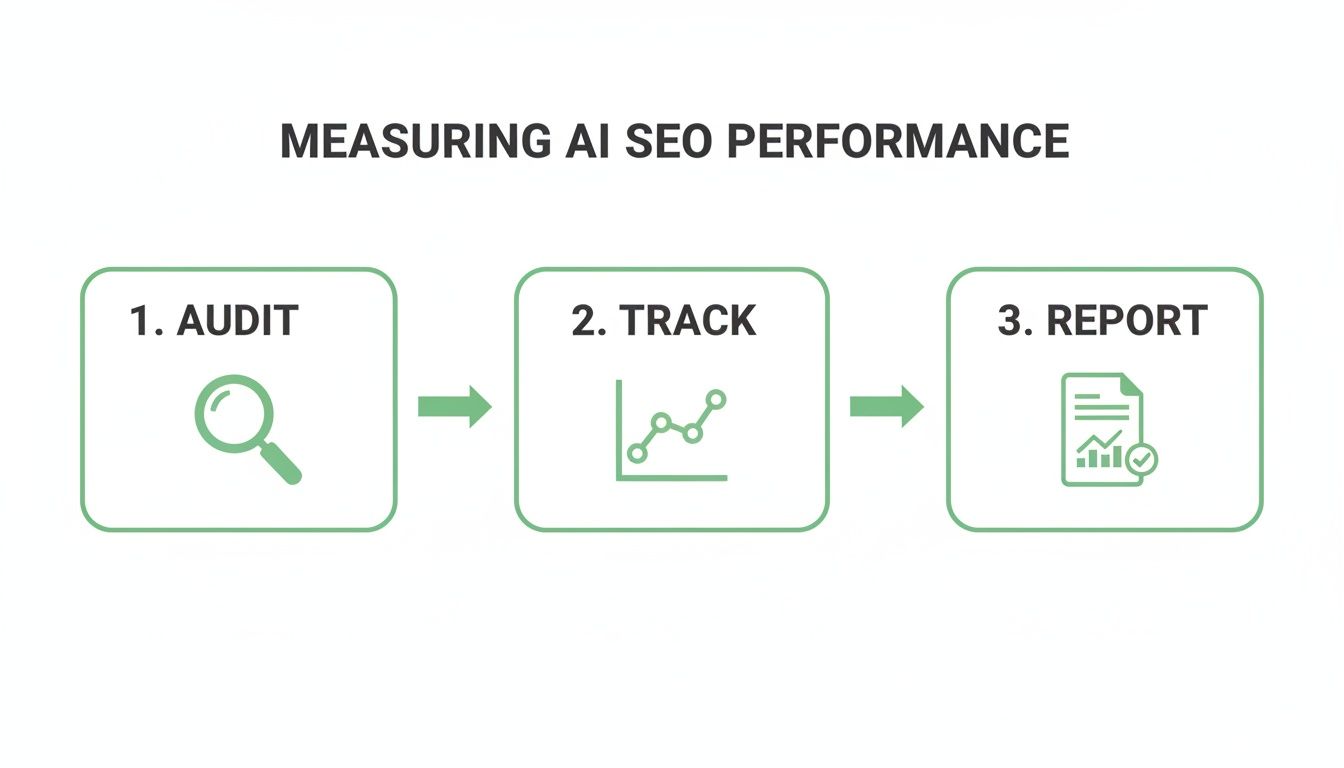
As you can see, a winning strategy is a continuous loop. You audit your current visibility, track performance over time, and use those insights to refine your approach again and again.
Leveraging Proprietary Data and Multimodal Search
Creating your own unique, proprietary data is probably the single most effective way to lock in citations. Commission original research, run industry surveys, or analyze your internal data to publish findings that only you have. When an AI needs a statistic on a topic you've researched, it has no choice but to cite you as the primary source. At the same time, you have to optimize for multimodal search. AI responses are becoming increasingly visual, pulling in images, videos, and charts. Make sure your visual assets are optimized with descriptive alt text, detailed video transcripts, and properly structured data tables. This makes your visual content discoverable and ready for inclusion in an AI answer.
Tapping into Community Platforms to Boost Your AI Search Visibility
Don't sleep on community platforms like Reddit and Quora. They've become incredibly important for generative SEO. AI models use these forums as both training data and direct citation sources because they're packed with real world questions and conversational answers. Engaging strategically on these platforms by providing expert answers and linking back to your core content creates a powerful feedback loop. Your detailed, helpful responses don't just help users; they signal your expertise directly to the AI models that are always watching.
Summary and Key Takeaways
Optimizing for AI search is no longer optional; it is a necessity for digital relevance in 2025 and 2026. At its core, SEO for ChatGPT is about building verifiable trust and authority so that AI models choose your content as a reliable source for their answers. This requires a deep focus on factual accuracy, a clear and logical content structure, and strong authority signals from reputable sources. By crafting content for machine readability, strengthening your technical foundation, and measuring your influence with tools like Riff Analytics, you can adapt your strategy from chasing rankings to earning citations and secure your brand's place in the future of search.
Frequently Asked Questions
What is the main difference between SEO for Google and SEO for ChatGPT?
The primary goal. With Google SEO, you aim to rank high on a results page to get a user's click. With SEO for ChatGPT, the goal is to have your content and data used and cited directly within the AI's answer, building brand authority and influence often without needing a click.
How does ChatGPT find information for its answers?
AI models like ChatGPT are trained on massive datasets from the public internet. For current information, many now use a built in search function, often powered by Bing, to crawl the web for relevant and timely sources to construct their answers. This makes visibility on Bing's index a key factor for generative SEO.
Why is brand authority important for LLM tracking and optimization?
Brand authority is crucial because AI models are designed to prioritize information from sources they perceive as credible and trustworthy. Signals such as high quality backlinks, frequent mentions in reputable publications, and clear expertise in a niche tell the AI that your content is a reliable source to pull answers from.
Should I use an FAQ section in my articles for better AI visibility?
Yes, absolutely. An FAQ section directly addresses specific, long tail questions that users are likely to ask an AI assistant. By providing clear, concise answers to common queries, you dramatically increase the likelihood that the AI will use your content to build its response.
How does Schema.org structured data help with SEO for ChatGPT?
Schema markup provides explicit context about your content to search engines and AI crawlers. Using schemas like Article, FAQPage, or HowTo helps an AI quickly understand the purpose and key information on your page, making it much easier to parse and cite accurately in its responses.