How to Track Brand Visibility in ChatGPT and Win in Generative SEO
Updated December 19, 2025

Tracking brand visibility in ChatGPT means systematically measuring how often, and in what context, AI models mention your brand in their answers. For marketers in 2025 and 2026, this isn't just a new metric; it's a critical channel for customer discovery and reputation management. As millions of users turn to AI for recommendations, ensuring your brand appears favorably is no longer optional. It's the new frontier of digital marketing, often called generative SEO, and mastering it requires a focused strategy built on solid data.
Why Monitoring Your Brand in ChatGPT Is Non Negotiable
Here in 2025, ignoring your brand’s presence in ChatGPT is like ignoring Google a decade ago. Generative AI is no longer a novelty; it’s a primary channel where consumers discover products and make decisions. Millions of users are asking for recommendations, solutions, and advice every single day. The brands mentioned in AI responses gain instant credibility and authority. This is the new front line for brand reputation, making LLM tracking an essential business function.
This shift changes how brand perception is formed. An AI assistant feels like a trusted, neutral third party, and its recommendations often carry more weight than a traditional ad. If your brand is consistently left out of these conversations, you are effectively invisible to a huge and growing segment of your audience. This is exactly why proactive AI search visibility monitoring has become essential.
Understanding the Scale of AI Search Visibility
The sheer volume of activity on platforms like ChatGPT underscores the urgency. According to recent industry reports, weekly active users for major AI platforms are projected to exceed one billion by early 2026. This explosive growth means that even small shifts in your AI visibility can translate to millions of impressions. To put it in perspective, some B2B tech companies saw their website sessions from AI referrals jump by over 500% in 2025 alone. Managing your presence here is a core function of modern marketing.
Preparing for the Generative SEO Future
The new discipline of optimizing for AI answers is often called generative SEO. It requires a different mindset than traditional search optimization. Instead of just chasing keywords and backlinks, the focus shifts to three key areas:
Entity Recognition: Making sure AI models clearly understand who your brand is, what you do, and what you offer.
Contextual Authority: Getting cited and mentioned on the high quality, authoritative sources that AI models are trained on and trust.
Factual Accuracy: Providing clear, structured, and accurate information that is simple for an AI to parse, understand, and repeat.
If you ignore these factors, you are ceding critical ground to competitors who are already shaping their AI narrative. By starting to track brand visibility in ChatGPT now, you’re building a foundational advantage for the future of search and discovery. For a deeper dive, our guide on AI brand monitoring is a great place to start.
Defining Metrics for Effective LLM Tracking
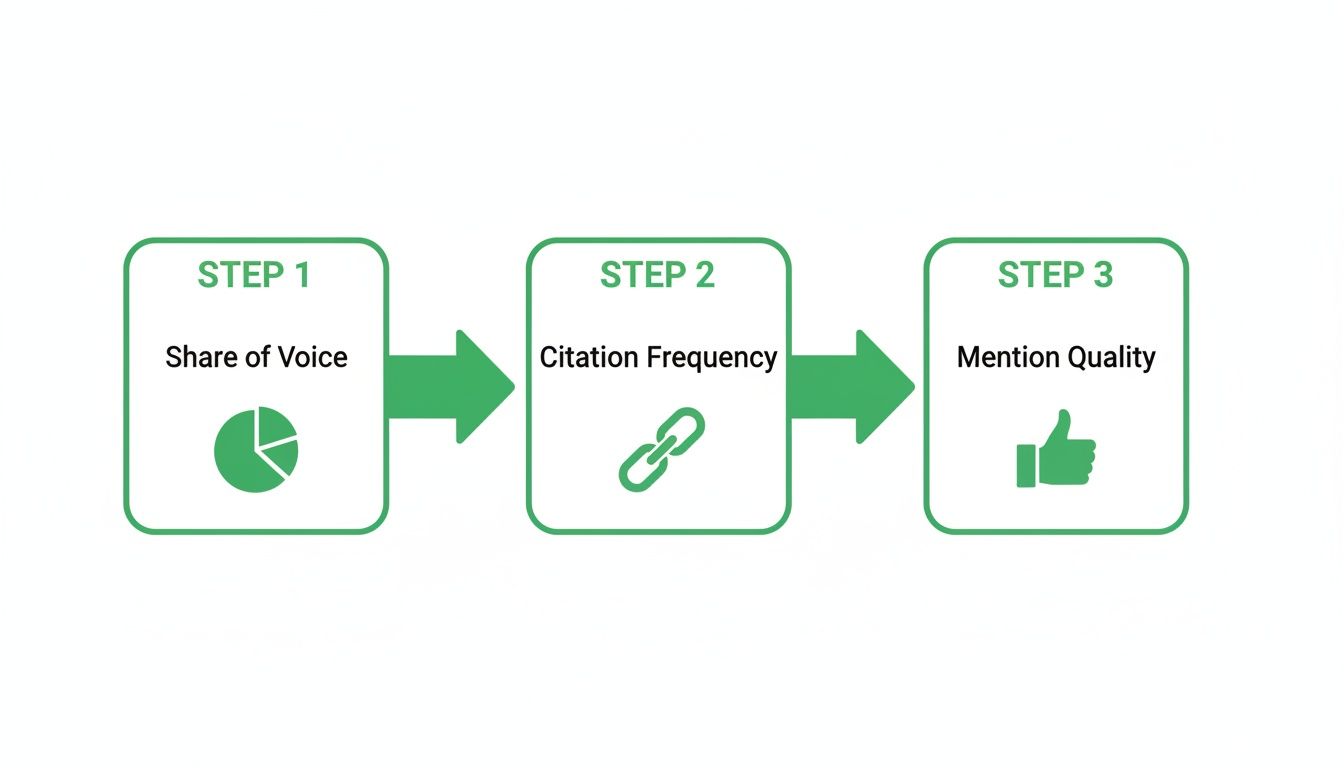
To effectively measure your brand's visibility in ChatGPT, you must move beyond simply asking "are we mentioned?" The real advantage comes from defining and measuring specific KPIs that connect your presence in AI answers to business outcomes. By 2026, the brands winning this new channel will be those measuring what truly matters, not just what is easy to count. Vague vanity metrics are misleading. Instead, you need a core set of KPIs that provide a clear, multidimensional view of your performance and turn raw mention data into a strategic playbook.
Measuring Your Share of Voice in AI Search
Your Share of Voice (SoV) is the most fundamental metric for tracking brand visibility in AI. It measures how often your brand gets mentioned for a key set of prompts compared to your competitors. A high SoV means you are the go to brand in your category’s AI driven conversations. For example, say you track 50 prompts around "best project management software." If your brand shows up in 35 of the answers while your top three competitors appear in 15, 10, and 5 respectively, you have a commanding SoV. This is a foundational marketing concept, and you can learn more about calculating Share of Voice to apply it to this new AI powered world.
Tracking Citation Frequency and Authority for Your Brand
Next is Citation Frequency. This KPI tracks how often your own content, such as blog posts, case studies, and original research, is directly cited as a source in an AI generated answer. It is a direct measure of your content’s authority and usefulness in the eyes of the model. A brand mention is good, but a direct citation is pure gold. It positions your company as a primary source of truth and an industry authority. Some data already suggests that over 50% of citations in certain LLMs point back to business websites, making your owned content a vital asset for building AI visibility.
Analyzing the Quality and Context of AI Mentions
Finally, remember that not all mentions are created equal. Mention Quality assesses the sentiment and context surrounding your brand in an AI response. Are you being framed as a market leader, a budget friendly alternative, or just another name in a long, undifferentiated list? A response that says, "For enterprise level security, Brand A is the industry standard," is infinitely more valuable than one that just says, "Other options include Brand A, Brand B, and Brand C." The first is a powerful endorsement; the second is a simple directory listing. Tracking this context is critical.
How to Build Your AI Visibility Monitoring System
To successfully track your brand’s visibility in ChatGPT, you need a structured, repeatable system. In 2025 and beyond, a dedicated monitoring workflow is the difference between reacting to changes and strategically shaping your brand’s AI narrative. Think of this system as your early warning signal, telling you when you’re gaining ground, when you’re losing it, or when a competitor makes a big move. The goal is to move from random searches to a consistent, data driven approach.
Establishing a Manual AI Brand Tracking Workflow
Starting with a manual process is a fantastic way to understand the nuances of how LLMs respond to different prompts. This hands on approach helps you build an intuition for the kinds of answers generated in your industry. It is practical and gives you immediate qualitative insights. The heart of a manual workflow is a standardized set of prompts covering different user intents:
Navigational: "What is [Your Brand]?"
Informational: "How does [Your Industry's Process] work?"
Comparative: "Compare [Your Brand] vs. [Competitor Brand]"
Best of: "What are the best tools for [Your Category]?"
Once you have a list of 20 to 30 core prompts, run them through ChatGPT on a set schedule, perhaps monthly. Log your findings in a spreadsheet, noting your brand’s presence, its position, and the context of the mention.
Scaling Your Visibility Tracking with Automated Tools
While manual tracking is insightful, it does not scale. For consistent, comprehensive monitoring, you need automation. This is where specialized tools and scripts, such as Scrappey's ChatGPT scraper, come in, letting you track hundreds of prompts across multiple AI engines like Gemini and ChatGPT. Automated solutions can run daily or weekly checks, providing a continuous stream of data. This allows you to build dashboards that visualize trends in your Share of Voice, citation frequency, and sentiment over time.
According to Averi.ai, “The companies that crack LLM visibility first will capture market share that may be nearly impossible to reclaim. It starts by tracking the right metrics... to see which content pieces the models actually trust and cite.” This highlights the importance of moving to a sophisticated, source focused monitoring system. To build a truly robust system, check out our guide on the essential components of an AI SEO analytics stack.
Comparing AI Brand Monitoring Workflows
| Aspect | Manual Monitoring | Automated Monitoring |
|---|---|---|
| Setup Cost | Low (free) | Medium to High (requires tools) |
| Time Investment | High (ongoing manual effort) | Low (after initial setup) |
| Scalability | Low (best for <50 prompts) | High (can track 1,000s of prompts) |
| Data Type | Qualitative (context, sentiment) | Quantitative (frequency, trends) |
| Best For | Initial analysis, understanding context | Ongoing tracking, trend analysis |
Reverse Engineering ChatGPT's Sources to Boost Mentions

If you want to consistently improve how you track brand visibility in ChatGPT, you must internalize one fact: its answers are pulled from a surprisingly small pool of trusted domains. For marketers looking to win in 2025 and 2026, this is a massive opportunity. Instead of guessing how to get mentioned, you can reverse engineer the AI's information diet and feed it exactly what it wants. The process involves analyzing the citations in AI answers for your industry. Once you pinpoint the key publications and forums that ChatGPT favors, you can build a laser focused content and digital PR strategy to get your brand mentioned on those specific domains.
How to Find the Sources ChatGPT Trusts
First, you need to find the "source pillars" in your niche. These are the handful of domains ChatGPT leans on repeatedly. To find them, analyze citations from a broad set of your core prompts. A simple workflow looks like this:
Run your key prompts: Start with a list of 50 to 100 informational and "best of" prompts relevant to your business.
Log every source: Meticulously track every domain and URL cited in the responses.
Find the patterns: After running hundreds of prompts, clear patterns will emerge. You will likely find a small group of domains receiving a huge share of citations.
Recent studies confirm how concentrated these sources are. One analysis found that after a model update, Reddit citations jumped 87% and Wikipedia mentions surged over 60% in some datasets. You can dive deeper into these findings on entity updates at Pemavor.
Developing a Strategy to Improve Your AI Visibility
Once you've identified the domains that matter, it is time to act. Your mission is to strategically get your brand mentioned within the content on those sites. This is about earning legitimate, contextually relevant mentions that add real value. A critical insight is that your brand's AI visibility depends on different factors than traditional SEO. Only about 50% of AI citations overlap with Google's top results, making traditional ranking data less useful for predicting AI performance. If Reddit is a key source, start engaging in relevant subreddits. If a specific publication is cited constantly, pitch them guest articles. By becoming part of the source material, you directly influence what the AI says about you.
How to Conduct a Competitive Analysis for Generative SEO
Knowing how your own brand appears in ChatGPT is only half the story. To get an edge in 2025 and 2026, you must know exactly how you stack up against the competition. Running a competitive analysis for generative SEO means benchmarking your brand against key rivals inside these new AI environments. It is how you find gaps and opportunities you would otherwise miss. This process shifts you from passively monitoring your own mentions to proactively building a strategy based on the entire competitive field. This is how you turn monitoring into an offensive strategy.
Identifying Your True AI Competitors
First, figure out who you are actually up against. Your competitors in ChatGPT might be completely different from your traditional rivals on Google. To build an accurate list, start by running a set of broad prompts related to your industry. Look for the brands that get mentioned repeatedly for queries like:
“What are the best alternatives to [Your Brand]?”
“How does [Competitor A] compare to [Competitor B]?”
“List the top companies in the [Your Industry] space.”
Log every brand that appears. This data first approach ensures you're tracking the competitors the AI already deems relevant. This is a core part of building a solid framework for competitive intelligence in SEO and applying it to this new channel.
How to Benchmark Your AI Search Visibility
Once your competitor list is ready, it is time for a head to head comparison. Run the same standardized prompts for your brand and your rivals, then stack the results against each other across key metrics like Share of Voice, Citation Frequency, and Mention Quality. You might find that while your SoV is 25%, your top competitor is at 40%. Digging deeper, you might discover they are being cited by three specific high authority domains that have never mentioned you. That insight alone is pure gold, giving you a clear strategic target.
Using Competitive Insights to Improve Your Visibility
The final step is turning your findings into a concrete action plan. A competitive gap analysis is useless if it does not lead to real strategic changes. If a competitor is dominating the conversation around a specific feature, it is time to create authoritative content that showcases your own strengths in that area. If another rival is constantly sourced by a top industry forum, your team needs to start participating in that community. This ongoing cycle of analysis, benchmarking, and action is what separates the winners from the losers in generative SEO. It ensures your strategy is always guided by real world data.
Summary and Final Recommendations
Successfully navigating the AI driven landscape is about having a clear plan. We have covered the metrics, tools, and competitive analysis you need to track brand visibility in ChatGPT. Now, it is time to put it all into practice. Success boils down to a continuous loop: monitor, analyze, and act. You start by figuring out where you stand today, make targeted moves to improve your visibility, and measure the results. This is the core workflow that drives growth in the era of generative AI.
Your Generative SEO Action Plan
Without a structured process, you are just checking things sporadically. A real workflow gives you reliable data you can use to make decisions. Here is a practical model to get you started:
| Step | Action | Key Objective | Recommended Frequency |
|---|---|---|---|
| Monitor | Run a standardized set of prompts across key AI engines like ChatGPT and Gemini. | Collect raw data on your brand's Share of Voice, citation frequency, and mention quality. | Weekly for core prompts, monthly for a full audit. |
| Analyze | Compare current data against your baseline and competitor benchmarks. | Identify significant changes, new threats from rivals, and emerging source opportunities. | Monthly review during team meetings. |
| Act | Launch targeted content and digital PR campaigns based on your analysis. | Close visibility gaps by earning mentions on the authoritative sources the AI already trusts. | Ongoing, based on monthly analysis. |
| Measure | Correlate changes in AI visibility with business metrics like referral traffic and leads. | Prove the tangible business impact of your LLM tracking and optimization efforts. | Quarterly business reviews. |
As the team at Averi.ai points out, a strategic approach is make or break. To effectively track brand visibility in ChatGPT, you must shift from just watching to actively managing. Use the metrics and workflows we have discussed to build a powerful, repeatable engine for growing your presence in AI powered search.
Frequently Asked Questions
How do I track brand visibility in ChatGPT if I have no budget?
You can start manually for free. Create a spreadsheet and list 20 to 30 key industry prompts. Run these prompts monthly in ChatGPT, logging whether your brand appears, the context of the mention, and any cited sources. This provides a solid baseline to measure your future efforts against.
What is the best way to improve brand mentions in ChatGPT?
The most effective method is to get your brand mentioned on the domains that AI models already trust. Focus your digital PR and content strategy on earning mentions in authoritative industry publications, high traffic blogs, and relevant forums like Reddit. This builds your brand's entity and proves its relevance to the AI.
Why is it important to track competitive visibility in AI search?
Your competitors in AI search may not be the same as your traditional SEO rivals. Tracking their visibility reveals who the AI considers authoritative in your space. This analysis helps you identify high value source domains, uncover content gaps, and build a proactive strategy to claim a larger Share of Voice in AI conversations.
What is the difference between generative SEO and traditional SEO?
Traditional SEO focuses on ranking for keywords on search engine results pages (SERPs) to drive clicks. Generative SEO, or optimizing for AI visibility, focuses on influencing the information within AI generated answers. Its key metrics are Share of Voice and citation frequency, and it relies heavily on getting your brand mentioned on a concentrated set of trusted third party sources.
How often should I check my brand visibility in generative AI?
For most businesses, a monthly check of your core prompts is sufficient to track major trends and competitor movements. However, if you are in a fast paced industry or have recently launched a major campaign, a weekly check is recommended to stay ahead of any significant changes in your AI visibility.