How to Track Mentions in Perplexity and Master AI Visibility
Updated December 26, 2025

Tracking mentions in Perplexity means monitoring when and how your brand is cited as a source in the AI’s generated answers. In 2025 and 2026, this isn't a niche tactic; it’s a critical component of digital strategy. As users increasingly turn to AI for direct answers instead of traditional search results, your brand’s visibility depends on being part of that AI conversation. If you are not a cited source, you are effectively invisible on a platform that is rapidly becoming a primary discovery channel. This practice, often called generative SEO or LLM tracking, is essential for reputation management, competitive intelligence, and content strategy in the AI era.
As more and more people turn to AI assistants for research and discovery, your brand's entire visibility hinges on being woven directly into those responses.
Why You Need to Be Tracking Perplexity Mentions
The way people find brands is changing at a fundamental level. They are not scrolling through ten blue links on Google anymore. Instead, they are getting direct, synthesized answers from AI engines like Perplexity.
If your brand is not part of that answer, you are invisible on a channel that is exploding in popularity. Monitoring your presence in Perplexity is an essential part of modern reputation management, competitive intelligence, and content strategy for 2025 and beyond.
This shift demands a completely new playbook focused on AI search visibility. A high Google ranking does not automatically mean Perplexity will cite you. The AI prioritizes content that is factually dense, clearly structured, and comes from sources it deems authoritative. Tracking your mentions is the only way to know if your content is hitting the mark and how the AI actually perceives your brand's authority.
Understanding the New Landscape of Digital Discovery
Just look at the explosive growth of Perplexity AI. It perfectly illustrates this seismic shift in user behavior.
In 2024, the platform saw its monthly active users soar, handling over 75 million queries in a single month. This represents significant year over year user growth, cementing it as a powerhouse in AI search. You can dig deeper into Perplexity's user statistics and their implications for marketers.
This is not just about big numbers; it is about a fundamental move away from link heavy results to concise, answer first experiences. This has immediate and serious consequences for your brand:
Reputation Management: If you are not watching, Perplexity could easily surface old, inaccurate, or negative information about your brand from some forgotten corner of the web. Tracking lets you spot and fix these problems before they spread.
Competitive Intelligence: Your competitors are probably already being cited. By seeing what content of theirs is being used, you can pinpoint the exact sources and strategies driving their visibility and find the gaps in your own.
Content Strategy: Seeing which of your assets Perplexity chooses to cite is incredibly valuable feedback. It tells you exactly what content formats and topics the AI considers authoritative, giving you a clear roadmap for what to create next.
How to Monitor Your Brand in Generative SEO
This new reality has a name: generative SEO, or Answer Engine Optimization (AEO). The goal is no longer just to rank; it is to become a citable entity.
Tracking your mentions in Perplexity is the diagnostic tool for this new discipline. It helps you measure your "answer share" how often your brand is part of the trusted response compared to your rivals. Without this data, you are flying blind in the biggest evolution of information discovery we have seen in over a decade.
Getting Started with Perplexity Mention Tracking
Knowing you need to show up in AI answers is one thing. Actually doing it is where the real work begins, especially if you want to compete in 2025 and beyond. This is where we move from theory to a repeatable process for seeing exactly how, when, and why your brand gets mentioned in Perplexity. It starts with building a dedicated listening post for your brand, your products, and even your key people.
First, you have to decide what is worth tracking. It is not just about your main brand name. You need to cast a much wider net to catch everything. Think about common misspellings, product specific names, and any acronyms people use.
This whole shift is a pretty big deal. We are moving away from users typing in a few keywords to having full blown conversations with AI.
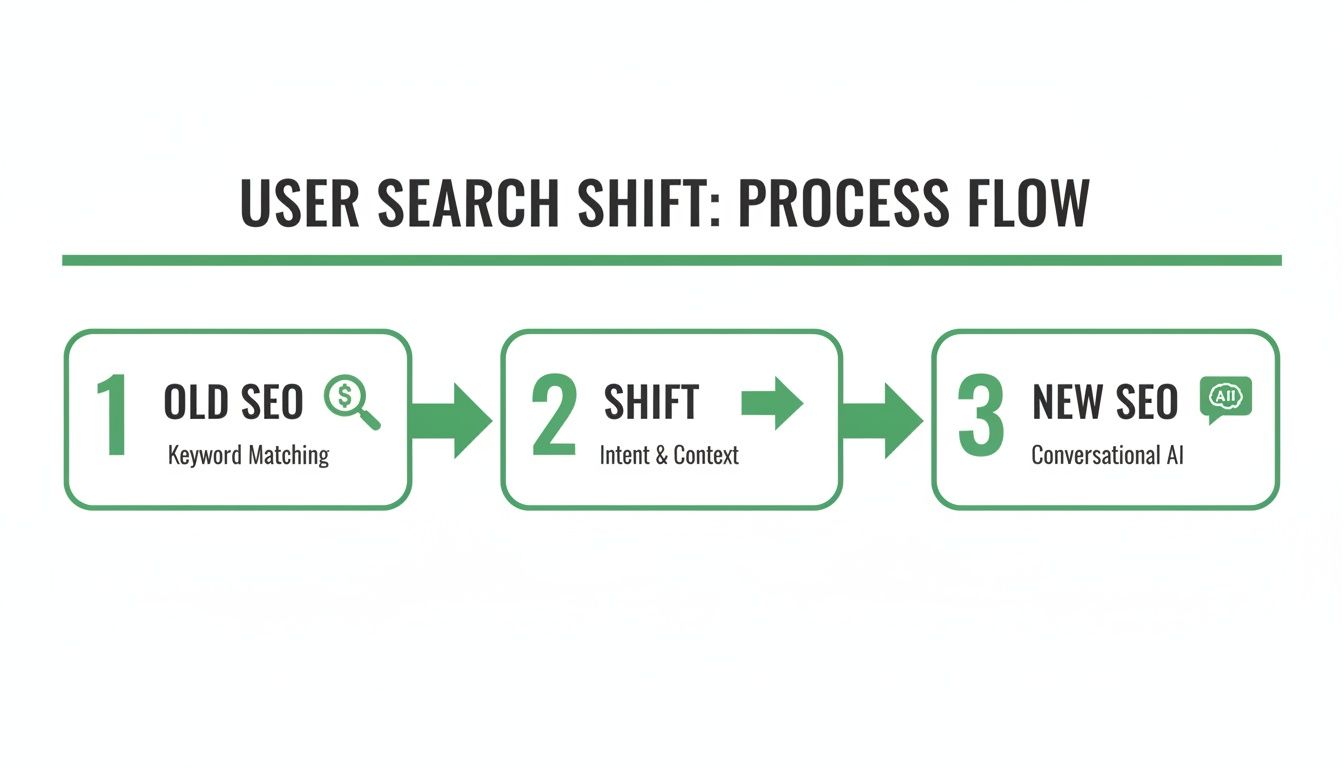
As you can see, getting your brand inside the AI generated answer is now the name of the game. It is far more valuable than just ranking on a results page.
Setting Up Your First AI Monitoring Project
Let's be honest: trying to track mentions in Perplexity manually is a losing battle. You need a specialized platform to do the heavy lifting. A tool like Riff Analytics is built for this, automating the whole process so you can build a dashboard that catches every mention as it happens. You can see the full rundown on the Riff Analytics Perplexity Brand Mention Tracker page, but the setup is simple and gets you actionable data right away.
Start by plugging in your core brand and product names. Here is a pro tip that most people miss: also track the names of your key executives or anyone on your team who has a public profile. Their personal brand often drives citations in AI answers.
Just as important, add your top competitors to the same dashboard. This gives you a side by side view, showing you exactly where they are stealing answer share from you.
Configuring Alerts for Your AI Search Visibility
Once you have got your keywords and competitors locked in, the last piece of the setup is creating alerts. Instead of remembering to check your dashboard every day, let the notifications come to you. This is absolutely critical for reputation management.
When an AI gives an inaccurate or negative mention of your brand, you want to know immediately, not a week later when it has already been seen by thousands. Set up alerts for any new mention of your brand, but do not stop there. Set up alerts for your competitors, too. It is one of the easiest ways to get a steady stream of competitive intel delivered right to your inbox.
Turning Perplexity Mention Data into Actionable Insights
Collecting data is the easy part. The real work and the real value is turning those raw numbers into a strategic edge. As we push deeper into 2025 and 2026, just knowing you were mentioned in an AI answer is not nearly enough. You have to understand the how and the why to actually master your visibility in these new search ecosystems.
The platform's growth is explosive, with some reports indicating a 191.9% jump in monthly visits since early 2024, cementing its role as a major answer engine. For brands, this means learning how to dissect your presence within billions of AI generated responses.
Analyze the Quality of Your Perplexity Mentions
Raw mention counts are a vanity metric. Do not fall for them. To get anywhere, you need to dig into the qualitative side of each mention. This is where you graduate from asking "if" your brand was mentioned to the far more critical questions of "how" and "why."
Knowing what to look for is half the battle. This is similar to the discipline of asking key questions to AI to get meaningful intelligence out of the system. You are not just logging data; you are interrogating it.
For every single mention you find, ask these three questions:
Context: Is your brand being positioned as an authority? Or is it just a minor example in a long list? Worse, is the mention negative?
Sentiment: What is the tone of the language used? Is it positive, neutral, or openly critical?
Accuracy: Did the AI get the facts right? Is it describing your products and services correctly, or is it pulling from outdated information?
Dissect Citations to Improve LLM Tracking
One of the most powerful things you can do is trace your mentions back to the source. Perplexity's citations are a direct feedback loop on your content strategy, telling you exactly which assets are successfully influencing the AI.
Tools that track AI overviews are built for this, letting you see all these sources in one place. By analyzing these citations, you can pinpoint the specific articles, whitepapers, or third party reviews that are doing the heavy lifting. This is not guesswork; it is a data driven map telling you exactly what kind of content to double down on.
Optimizing Your Content for Perplexity Citations
Once you are tracking mentions in Perplexity and have a clear baseline, it is time to start influencing the results. Shifting from passive monitoring to active optimization is how you win answer share in 2025 and beyond. This means strategically auditing your existing content and creating new assets engineered for AI consumption.
The goal is pretty straightforward: make your content the most logical, authoritative, and digestible source for an AI model to cite. Large language models are trained to value factual accuracy, clear structure, and data rich information above all else. Your content has to deliver on those fronts, consistently.
Audit Your Content to Improve Perplexity Mentions
Before you write a single new word, run an audit to see which of your current assets are closest to being "AI ready" and which need a major overhaul. This is not about old school keyword density; it is about clarity and trustworthiness.
Focus your audit on these key areas:
Factual Density: Does your content use specific numbers, dates, stats, and named entities? Vague claims get ignored. Hard data gets cited.
Clear Structure: Is the content broken down with descriptive subheadings (H2s, H3s), bullet points, and short paragraphs? AI models parse structured content way more effectively.
Source Citing: Are you linking out to authoritative primary sources to back up your claims? This signals to the AI that your information is well researched and credible.
How to Create New Content for Generative SEO
With your audit complete, you can now focus on creating content specifically designed to become a go to source for answer engines. Certain formats are heavily favored by LLMs simply because they are inherently structured and factual.
Think about producing assets like original research reports, statistical deep dives, and comprehensive guides. For instance, a report on "The State of B2B SaaS Marketing in 2026" filled with proprietary data is far more likely to be cited than another generic blog post on the same topic. The more unique and data backed your content is, the more indispensable it becomes.
According to a 2024 analysis of generative SEO trends, content that includes original research or proprietary data is over 70% more likely to be used as a primary citation in AI generated answers compared to opinion based articles. This highlights the value of investing in unique, factual assets.
Compare Optimization Tactics for Perplexity Visibility
This table compares different strategies to increase your brand's visibility and citation frequency in Perplexity AI responses, outlining the impact and effort for each.
| Optimization Tactic | Impact on AI Mentions | Effort Level | Best For |
|---|---|---|---|
| Publishing Original Research | High | High | Brands wanting to establish category leadership and become a primary source. |
| Updating Old Posts with New Data | Medium | Low | Teams looking for quick wins by refreshing high potential existing content. |
| Improving Content Structure | Medium | Low | Making it easier for AI to parse and extract specific facts from your articles. |
| Adding Schema Markup (FAQ, Product) | High | Medium | Clearly defining entities and answering common questions for AI models. |
| Securing Guest Posts on Trusted Sites | High | High | Building authority by association and getting cited on domains Perplexity already trusts. |
| Creating Statistical Roundups | Medium | Medium | Compiling valuable data points into a single, highly citable resource. |
Ultimately, a mix of these tactics is your best bet. Start with the low effort, high impact items like updating old content and improving structure while you plan bigger projects like original research.
Building Authority to Increase AI Visibility
Finally, where your content lives matters almost as much as what it says. Perplexity and other AI models have a clear bias toward high trust domains. A huge part of your strategy must involve building authority by securing placements and mentions on these websites.
This is where your LLM tracking data becomes a roadmap. Identify the third party sites that Perplexity frequently cites in your niche and make it a priority to get your brand featured there through guest posts, collaborations, or digital PR. Each placement on a trusted domain acts as a powerful vote of confidence, signaling to the AI that your brand is a credible authority. The process has a lot in common with traditional link building, and you can find a deeper exploration in our guide on how to rank in AI Overviews.
Advanced Strategies for Holistic AI Visibility
Just reacting to mentions in Perplexity is a decent starting point, but winning in 2025 and 2026 demands a proactive, ecosystem wide game plan. If you want a complete picture of your brand's visibility, you have to look beyond a single AI. That means monitoring your presence across ChatGPT, Gemini, Claude, and others to see how your brand is actually perceived across the entire generative AI landscape.
Each model has its own biases, training data, and preferred sources. A brand might be a top citation in Perplexity for technical questions but completely invisible in Gemini for commercial ones. This broader perspective stops you from over optimizing for one engine and gives you a much more honest view of your overall answer share.
Use Long Tail Queries for Deeper LLM Tracking
A truly sophisticated strategy moves beyond just tracking your brand name. You need to monitor long tail conversational queries that people in your niche are actually asking.
Think of the difference between "best accounting software" and a real world query like, "which accounting software integrates best with a small Shopify store?" This is where you find the high value content gaps your competitors are filling and winning citations for.
Tracking these longer, more specific questions helps you:
Find unmet user needs: See the specific problems your audience is trying to solve.
Uncover content opportunities: Discover the precise questions your content is not answering.
Pinpoint competitor strengths: See exactly where a rival's content is more specific and helpful.
How Trend Analysis Can Prove Your ROI
To get buy in and prove your efforts are worth it, you have to connect your LLM tracking to real business outcomes. This is where trend analysis comes in. Stop looking at mentions day to day and start zooming out to measure performance over quarters or even years.
This long term view lets you draw a clear line between your content optimization and a sustained rise in positive mentions and answer share. For example, you can show that after publishing a series of data rich reports in Q2, your brand's citation frequency for key informational queries jumped by 40% in Q3. This turns AI visibility from a fuzzy concept into a hard performance metric with clear ROI.
For more ideas on how to use AI for content and strategy, you can explore different ways AI tools like Google NotebookLM can be used in marketing and sales.
Summary and Frequently Asked Questions
To truly master your visibility in the age of AI, you must move beyond basic monitoring. This involves expanding your tracking across multiple AI engines to get a holistic view, digging into long tail conversational queries to uncover hidden content gaps, and using long term trend analysis to prove the business value of your efforts. By adopting these advanced strategies, you can shift from simply appearing in AI answers to strategically dominating the conversation, securing a competitive advantage for 2025, 2026, and beyond.
FAQ on Tracking Mentions in Perplexity
How can I track mentions in Perplexity for very specific, niche topics?
Use a specialized AI visibility tool to set up tracking for long tail keywords and full sentence questions relevant to your niche. This lets you monitor how Perplexity responds to detailed user queries, showing you which sources it trusts for expert level information and where your content opportunities are hiding.
What is the best way to benchmark my AI search visibility against competitors?
Set up a monitoring dashboard that tracks your brand alongside your top three to five competitors. The key metric to focus on is "answer share" the percentage of mentions you get for a shared set of target queries. It is a clean, competitive benchmark for your performance in AI answers.
How often should I be checking my brand's mentions in AI engines?
For active reputation management, you will want real time alerts for your brand name to catch any negative or inaccurate mentions immediately. For strategic analysis, review your answer share, sentiment trends, and competitor performance on a weekly or bi weekly basis. This rhythm is perfect for informing your ongoing content strategy.
What is LLM tracking and how does it relate to Perplexity?
LLM tracking is the practice of monitoring how Large Language Models (LLMs) like the one powering Perplexity mention your brand, products, or key topics. It goes beyond traditional SEO by focusing on how you are represented within AI generated answers, not just where you rank in a list of links.
Why is AI search visibility important for my brand in 2025?
By 2025, a significant portion of users will rely on AI for initial product research and problem solving. If your brand is not visible as a trusted source within these AI answers, you will miss out on a massive and growing discovery channel, ceding ground to competitors who have adapted their strategies for this new landscape.