What Is Answer Engine Optimization: Your Guide to AI Search Visibility in 2026
Updated December 25, 2025
In 2026, the question is no longer "How do I rank #1 on Google?" but "How does my brand become the answer?" This is the core of Answer Engine Optimization (AEO). In plain language, AEO is the practice of optimizing your brand’s content to be the direct source for answers generated by AI search platforms like Google’s AI Overviews, Perplexity, and ChatGPT. The goal isn't just to get a click; it's to earn a citation and become the recognized authority in the AI's response.
Defining Answer Engine Optimization in the AI Era
Think of an AI model as a high speed researcher compiling a report. Your brand's content is a book in its digital library. When a user asks a question, the AI scans its resources to find the most credible, clear, and factual information to synthesize an answer. AEO is the process of ensuring that your book is the one it pulls off the shelf first. This strategic shift moves the focus from competing for visibility on a list of blue links to competing for direct inclusion within conversational, AI generated summaries.
This isn't a future trend; it's happening now. Recent data from March 2024 shows that Google’s AI Overviews already appear for nearly 15% of all queries, and other studies suggest that for a significant portion of users, AI is becoming the primary interface for information discovery. This represents a massive redistribution of online attention, making AEO a critical discipline for brands that want to remain visible.
Why Optimizing for Answer Engines Matters Now
The rise of AI search is a fundamental evolution in how people access information. Users are increasingly skipping the step of browsing multiple websites and instead rely on instant, synthesized answers. AEO is the strategy that prepares your brand for this new reality. Its importance is rooted in three key areas:
AI Search Visibility: Securing mentions and citations where user attention is shifting.
Brand Authority: Becoming a trusted, go to source that AI models learn to rely on for accurate information.
Future Proofing: Aligning your content strategy with the dominant form of search technology for the coming years.
Understanding this transition is crucial for long term success. While the technical details are complex, you can Master LLM SEO to learn how to influence the models themselves. Ultimately, AEO ensures your brand doesn't just appear in search results; it actively shapes the answers users receive.
How AI Answer Engines Construct Responses
To succeed with Answer Engine Optimization, you must first understand how the technology operates. AI answer engines like Perplexity or Google’s AI Overviews function as incredibly efficient digital researchers. They use Large Language Models (LLMs) to analyze user intent and assemble genuinely helpful responses in real time.
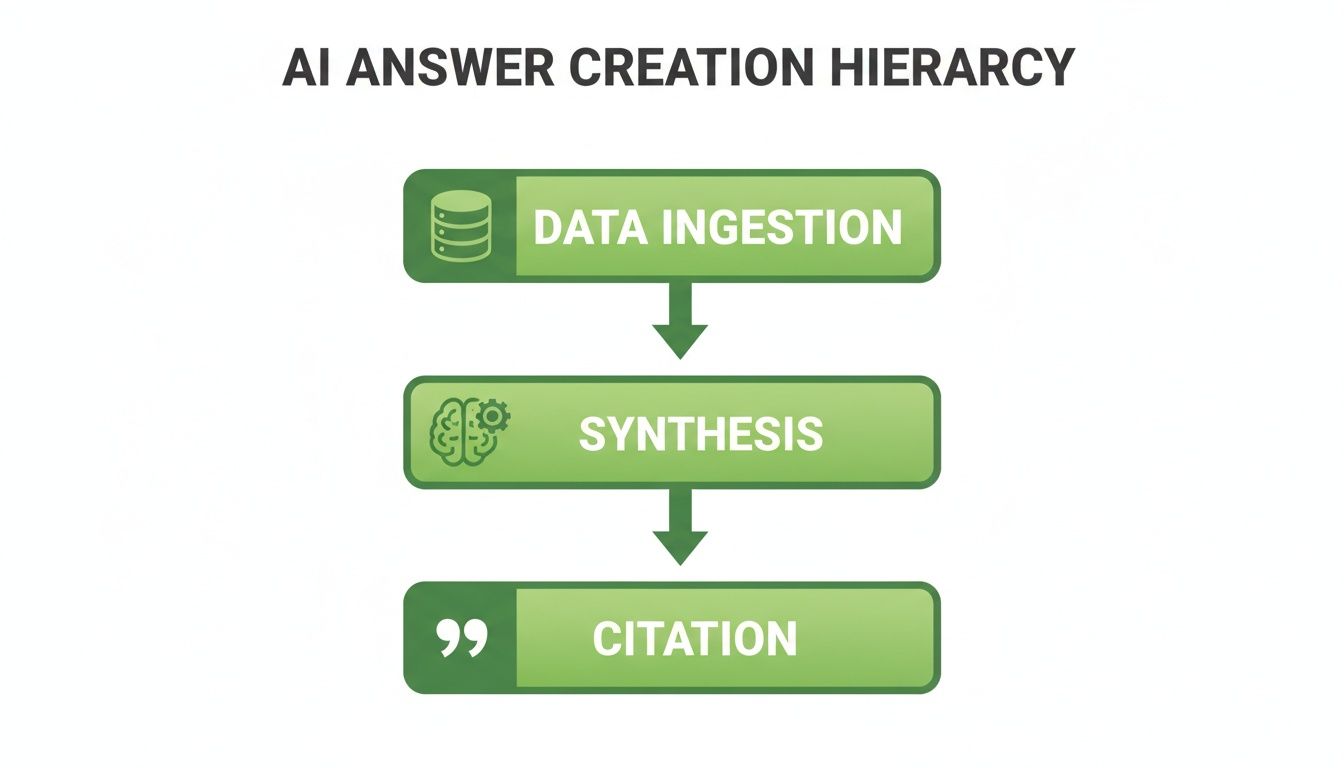
The process begins the moment a user submits a query. The AI uses Natural Language Processing to grasp the true intent behind the words, not just the keywords. From there, it scans a vast index of web content including articles, reports, and product pages to find relevant and credible information to address the query.
The Answer Synthesis Process for AEO
After gathering potential information, the AI performs its most crucial function: synthesis. It doesn't just copy and paste text. Instead, it weaves facts and insights from multiple sources into a single, coherent answer. This generative process is where your content has the opportunity to become a foundational part of the response.
The AI prioritizes content that is clear, well structured, and factually sound. It actively looks for signals of authority, such as:
Verifiable Data: Hard numbers, statistics, and specific facts are highly valued.
Clear Structure: Content organized with descriptive headings (H2s, H3s) and lists is easier for an AI to parse.
Authoritative Sourcing: Pages that link to other reputable sources are seen as more credible.
If your content is selected, it moves to the final and most important step for your brand.
Understanding the Role of Citations in AEO
After composing an answer, the AI provides citations, linking back to the original sources it used. This is a fundamental mechanism for building user trust, as it allows people to verify the information and explore topics in greater depth. For your brand, the ultimate objective of Answer Engine Optimization is to become one of those cited sources.
Each citation acts as a powerful endorsement, positioning your brand as a credible authority at the exact moment a user is seeking information.
The Difference Between AEO and Traditional SEO
For decades, SEO has been a race to the top of the search results page. The primary goal was to rank a webpage as high as possible to earn a user's click. Answer Engine Optimization, or AEO, operates under a completely different paradigm. It is not about climbing a list of links. The true objective of optimizing for an answer engine is to embed your brand’s expertise directly inside an AI generated response. The prize isn't a click; it's a citation.
Core Objectives of Answer Engine Optimization vs SEO
This represents a fundamental shift in digital strategy. We must move our thinking from "how do I rank number one?" to "how do I become the primary source?" Instead of focusing solely on keywords and backlinks to improve a page's position, AEO compels us to create citable, fact dense content that an AI model can easily understand, verify, and reference. The urgency to adapt is clear.
According to Gartner, by 2026, search engine volume will drop 25%, with search marketing losing market share to AI chatbots and other virtual agents. This is a seismic shift from a click based economy to a citation based one.
If you are not preparing for this change, you are already falling behind. Grasping the mechanics of this new ecosystem is the first step in transitioning from SEO to AI-first visibility.
Comparing AEO and SEO Tactics
The tactics and metrics for these two disciplines are naturally different. AEO requires a much deeper focus on structured data, semantic richness, and the creation of original, data driven assets that Large Language Models are designed to find and trust. While traditional SEO lives and dies by rankings and click through rates, AEO tracks metrics like "answer share" and the frequency of brand mentions within AI responses. This is often referred to as generative SEO or tracking AI search visibility.
| Aspect | Traditional SEO | Answer Engine Optimization (AEO) |
|---|---|---|
| Primary Goal | Achieve high organic rankings to earn clicks. | Earn direct citations within AI-generated answers. |
| Key Tactics | Keyword optimization, backlink building, page speed. | Structured data, creating citable assets, brand authority. |
| Success Metrics | SERP rankings, organic traffic, click-through rate. | Answer share, brand mentions, sentiment analysis, LLM tracking. |
| Content Focus | In-depth articles targeting specific keywords. | Concise, factual, and easily parsable answers with verifiable data. |
The playbook has changed. While foundational principles of creating valuable content remain, the execution and measurement have evolved. For a deeper dive, explore our guide on AI SEO vs. Traditional SEO.
Core Strategies for an AEO Blueprint
Let's move from theory to action. A solid Answer Engine Optimization blueprint is built on core pillars designed to make your content trustworthy to an AI and useful to a person. The game plan focuses on structure, authority, and creating unique information that AI models are compelled to cite. It all begins with creating highly structured, fact driven content. AI models are not just reading your articles; they are parsing them for specific, extractable pieces of information. This means content formatted with clean headings, bullet points, and short paragraphs is far easier for an AI to interpret and use as a source.
Building Brand Authority for Answer Engines
Brand authority is a massive signal for answer engines. Established, trusted domains get a head start because LLMs are trained to recognize and prioritize information from credible sources. Your brand’s reputation and digital footprint directly impact your AEO success.
According to a study by SparkToro, nearly 75% of SEO professionals believe that brand authority and reputation are more important than ever for visibility in the age of AI search. This is because AI engines see these signals as validation that your content is credible enough to cite.
You build this authority over time through consistent, high quality content, positive brand mentions, and a strong backlink profile from other reputable sites. For AEO, this foundation is essential for getting real visibility in AI generated answers.
Creating Citable Assets for Answer Engine Optimization
One of the most powerful strategies is to create citable assets. These are unique pieces of content containing original information that cannot be found elsewhere. LLMs are engineered to find and reference this material, transforming your content from just another article into a primary source.
Examples of powerful citable assets include:
Original Research: Publish findings from industry surveys with unique statistics.
Data Rich Reports: Compile and analyze data to create comprehensive market trend analyses.
Unique Statistics: Isolate a specific, noteworthy data point that others will want to reference.
Expert Analysis: Offer a unique perspective or framework that redefines a topic in your industry.
For example, a B2B SaaS company that publishes an annual "State of the Industry" report packed with exclusive data quickly becomes the go to source for journalists, bloggers, and AI engines looking for market trends. You can learn more about creating content that wins these spots in our guide on how to rank in AI Overviews.
Using Schema Markup in Your AEO Strategy
Schema markup is another critical AEO strategy. It is a set of digital labels you add to your website's code to explicitly define information for search engines and AI models, making your content more machine readable. By implementing the right Schema, you remove guesswork for the AI, helping it parse your content with greater accuracy and increasing its chances of being selected for an answer.
| Schema Type | How It Helps Your AEO Strategy | Example Use Case |
|---|---|---|
| FAQPage | Clearly defines a question and its corresponding answer for LLMs. | Labeling an FAQ section on a product page. |
| HowTo | Structures step by step instructions in a clear, sequential format. | A DIY guide or a technical tutorial. |
| Article | Defines the author, publication date, and other key metadata to establish credibility. | Any blog post or news article. |
| Person | Establishes author expertise and credentials, a key trust signal. | An author bio on an expert-written article. |
Measuring Success in Answer Engine Optimization
How do you prove your Answer Engine Optimization efforts are working when clicks are no longer the primary goal? The old SEO playbook, built around organic traffic and click through rates, doesn't fully apply in a world where winning means earning a citation. This demands a new set of analytics focused on AI search visibility and brand presence inside AI generated answers.
The new north star metric is answer share. This KPI measures how often your brand gets cited in AI responses for your target topics compared to your competitors. It’s a direct measure of your influence in this new ecosystem, shifting the entire focus from ranking on a page to being the source of the answer itself.
Key Performance Indicators for AEO
Beyond answer share, a solid AEO measurement plan tracks a few other new indicators. Monitoring brand mentions inside AI answers is a great start, but it’s not just about counting them. You also have to analyze the context and sentiment of those mentions to truly understand how your brand is being framed. This new breed of analytics requires specialized tools. Platforms like Riff Analytics are built for this. They are essential for tracking your citations, benchmarking performance against rivals, and spotting content gaps. To get a better handle on this, you can learn more about how to track brand visibility in ChatGPT and other AI models.
Demonstrating ROI with AEO Metrics
Adopting these new metrics is the key to demonstrating a clear return on your investment. We’re already seeing that programs treating answer share as a core KPI are posting significant, measurable gains. One analysis of early AEO efforts showed a 335% increase in traffic from AI sources in a single quarter for optimized brands. Another found a 3.4x uplift in answer engine traffic versus competitors who were slower to adapt.
By tracking the right data, you can build a powerful business case for AEO. The table below outlines a simple workflow for monitoring and improving your performance over time.
| Step | Action | Key Metric to Track |
|---|---|---|
| 1. Baseline | Audit your current answer share for core topics. | Initial Answer Share (%) |
| 2. Competitor Analysis | Identify who AI cites for your target queries. | Competitor Citation Frequency |
| 3. Content Gap ID | Find topics where competitors dominate answers. | Topic Opportunity Score |
| 4. Optimization | Create or update content to fill identified gaps. | Change in Answer Share |
| 5. Report | Track changes in citations and sentiment quarterly. | Answer Share Growth |
Summary and AEO FAQ
Answer Engine Optimization is the evolution of search strategy, moving the goal from ranking for clicks to becoming the cited source in AI generated answers. It requires a focus on creating factually dense, well structured, and authoritative content that Large Language Models can easily parse and trust. Success is no longer measured by traffic alone, but by "answer share" and brand mentions within the AI responses themselves. By building brand authority, creating citable assets, and using technical tools like Schema markup, you can position your brand to win in the new era of AI search.
Frequently Asked Questions about AEO
1. What is the difference between AEO and generative SEO?
They are closely related terms. AEO is the broad strategy of optimizing for AI answer engines, while generative SEO often refers to the specific tactics used to influence generative AI models and track visibility within their outputs. Both focus on earning citations over clicks.
2. How do I start tracking my AI search visibility?
The most effective method is using a specialized AEO or LLM tracking platform. These tools can monitor your brand mentions and citations across multiple AI engines, track your answer share for key topics, and benchmark your performance against competitors over time.
3. Will answer engine optimization replace traditional SEO?
No, AEO is an evolution of SEO, not a replacement. Foundational SEO practices like technical site health, link building, and creating high quality content are still essential. AEO builds on this foundation by shifting the strategic goal from ranking to becoming a cited source within an AI's answer.
4. How can I measure the ROI of my answer engine optimization strategy?
Measure ROI by tracking metrics like answer share, brand mentions, and referral traffic from AI sources. A higher answer share for commercial queries can be correlated with increased brand awareness and leads. One case study showed that a 10% increase in answer share led to a 4% lift in qualified leads over six months.
Putting Your AEO Strategy into Practice
All the theory in the world doesn't mean much until you can turn it into a repeatable workflow. The good news is that implementing an Answer Engine Optimization strategy isn't some monumental task. It’s a manageable discipline you can start building today.
The first move, always, is to get a baseline. You can't know if you're winning if you don't know the score. You have to track your brand's current answer share for your most important topics to see where you stand right now. This initial audit gives you the hard data needed to measure progress and prove the impact of your work down the line.
From there, the focus shifts to competitive intelligence. Figure out which sources the AI engines are already citing in your space. Analyzing what your competitors are doing right will quickly show you where the opportunities are and highlight the content gaps you can fill.
Building Your Actionable AEO Roadmap
Once you have these insights, you can build an actual roadmap. This isn't a vague wish list; it’s a specific plan that highlights pages needing immediate optimization or identifies new, data driven content required to fill those citation gaps. Your goal is to systematically build your presence as a trusted, citable source.
According to one leading digital strategist, “A proactive AEO approach is no longer optional. It’s the difference between shaping the narrative and being left out of the conversation entirely.”
This roadmap becomes your guide for prioritizing every action, ensuring you’re spending time on the activities that will deliver the biggest gains in AI search visibility. And the results can show up surprisingly fast.
For instance, one agency reported a 42% lift in AI driven traffic for a client in just 30 days after they rolled out a similar AEO blueprint. This just goes to show how quickly a targeted strategy can pay off. You can see more details in this report on leading AEO agencies.
To get your AEO strategy off the ground, just follow this simple workflow:
Establish a Baseline: Track your current answer share and brand mentions.
Analyze Competitors: Identify who AI engines are already citing for your core topics.
Create a Roadmap: Pinpoint content gaps and prioritize your optimization tasks.
Execute and Measure: Create citation worthy assets and monitor your answer share growth.