What Is Brand Voice and How to Define Yours in 2025
Updated January 14, 2026
Your brand voice is your company's unique personality. It's not just what you say, but how you say it across every channel, from your website and social media posts to your emails and ad campaigns. In a digital world crowded with generic, AI generated content, a distinct and consistent brand voice is essential for cutting through the noise in 2025 and 2026. It makes your brand recognizable, relatable, and trustworthy, which is critical for building lasting customer relationships and improving your visibility in both traditional and AI search.
What a Clear Brand Voice Truly Is

If your brand were a person, what would it sound like? Would it be witty and energetic, like a clever friend? Or would it be calm and authoritative, like a trusted mentor? This personality comes to life through the specific words, sentence structures, and emotional tone you use consistently. In 2025 and beyond, this consistency is non negotiable. A unique, human like voice is your best tool for building a genuine connection that automated content simply cannot replicate, fostering real trust and loyalty with your audience.
How Your Brand's Voice Shapes Customer Perception
A well defined brand voice actively shapes how customers see your business. The data confirms this; research shows that maintaining brand consistency can increase revenue by up to 33%. When people know what to expect from you, your brand feels more dependable and professional, making them more likely to trust what you sell. This trust is the foundation for long term growth and ensures every interaction reinforces the same core identity.
Why Your Brand Voice Definition Matters for AI Search
Your brand's voice is also a massive factor in AI search visibility. As tools like Google’s AI Overviews and other large language models (LLMs) answer questions directly, they hunt for authoritative, consistent sources to cite. A clear, distinct voice helps AI engines understand who you are and what you stand for. This makes your content far more likely to get picked up in generated answers, boosting your brand’s authority in the new landscape of generative SEO.
The Core Elements That Make Up Your Brand Voice
To build a brand voice that actually works, you need to understand its components. It is a combination of four distinct elements that lock together to create a recognizable personality. Think of these as the core pillars holding up your brand's identity. They give your team a reliable framework for every tweet, blog post, and email, making sure everything you publish reinforces the same story.
The Four Pillars of a Distinctive Brand Voice
Let's break brand voice down into its four manageable parts. Each one plays a specific role in shaping how the world sees you.
Character: This is your brand's core personality or archetype. Are you the witty sidekick, the wise mentor, or the fearless innovator? Your character is the foundation everything else is built on.
Language: This covers the actual words, phrases, and sentence structures you choose. It’s about your stance on jargon, slang, or formality. Do you sound like a research paper or a conversation over coffee?
Tone: This is the emotional inflection you apply in different situations. While your voice is constant, your tone needs to adapt. You might use an encouraging tone in a how to guide but a more formal one in a press release.
Purpose: This is the "why" behind every piece of content. Are you here to educate, entertain, inspire, or sell? Your purpose dictates the goal of every message.
According to HubSpot, a well defined brand voice should be applied consistently across all content, from blogs and web pages to social media and emails, to ensure a unified customer experience.
Brand Voice vs. Brand Tone: Understanding the Difference
Mixing up brand voice and tone is a fast track to inconsistent messaging. Here’s the simplest way to think about it: Your brand voice is your fixed personality and it never changes. If your brand’s voice is knowledgeable and friendly, it’s always knowledgeable and friendly. Your brand tone, on the other hand, is the specific mood you apply for a particular context. You would use a supportive tone to handle a customer complaint but an enthusiastic one to announce a new product.
| Scenario | Brand Voice (Consistent) | Tone (Situational) |
|---|---|---|
| Writing a technical guide | Expert and approachable | Instructive and clear |
| Posting on social media | Expert and approachable | Engaging and conversational |
| Responding to a complaint | Expert and approachable | Empathetic and professional |
| Announcing a new feature | Expert and approachable | Excited and celebratory |
How a Consistent Brand Voice Boosts Your Business
Defining your brand voice is a core business strategy that directly impacts revenue. A consistent voice builds familiarity and trust, which are the bedrock of customer loyalty. When every email, social post, and landing page reinforces the same personality, your brand becomes a reliable, recognizable presence. Businesses that achieve this see an average revenue increase of 23%. A unified message cuts through the noise and makes your brand feel dependable in a crowded market.
Driving Growth and Differentiating Your Brand
In a crowded market, a strong brand voice is your competitive advantage. It helps you stand out. When customers can predict how you communicate, they feel more confident in their decision to buy from you. That trust not only retains customers but also allows you to command better prices. This differentiation also carves out a stronger market position. Brands that present themselves consistently enjoy three to four times the visibility of competitors who do not. That extra presence directly grows your share of voice, a key metric for leading your category.
Building Authority for Modern SEO and AI Visibility
Your brand voice has a massive impact on modern SEO and the new world of generative AI. Large Language Models (LLMs) and AI search engines are trained to prioritize sources that are authoritative and consistent. A clear, steady voice across all your content signals expertise. It makes your perspective more credible and your content a prime candidate for AI generated answers to cite. This authority directly boosts your AI search visibility. When AI engines like Google's AI Overviews see a consistent viewpoint, they are far more likely to feature your brand in their answers. This is the new game of generative SEO.
A Step-by-Step Guide to Defining Your Brand Voice
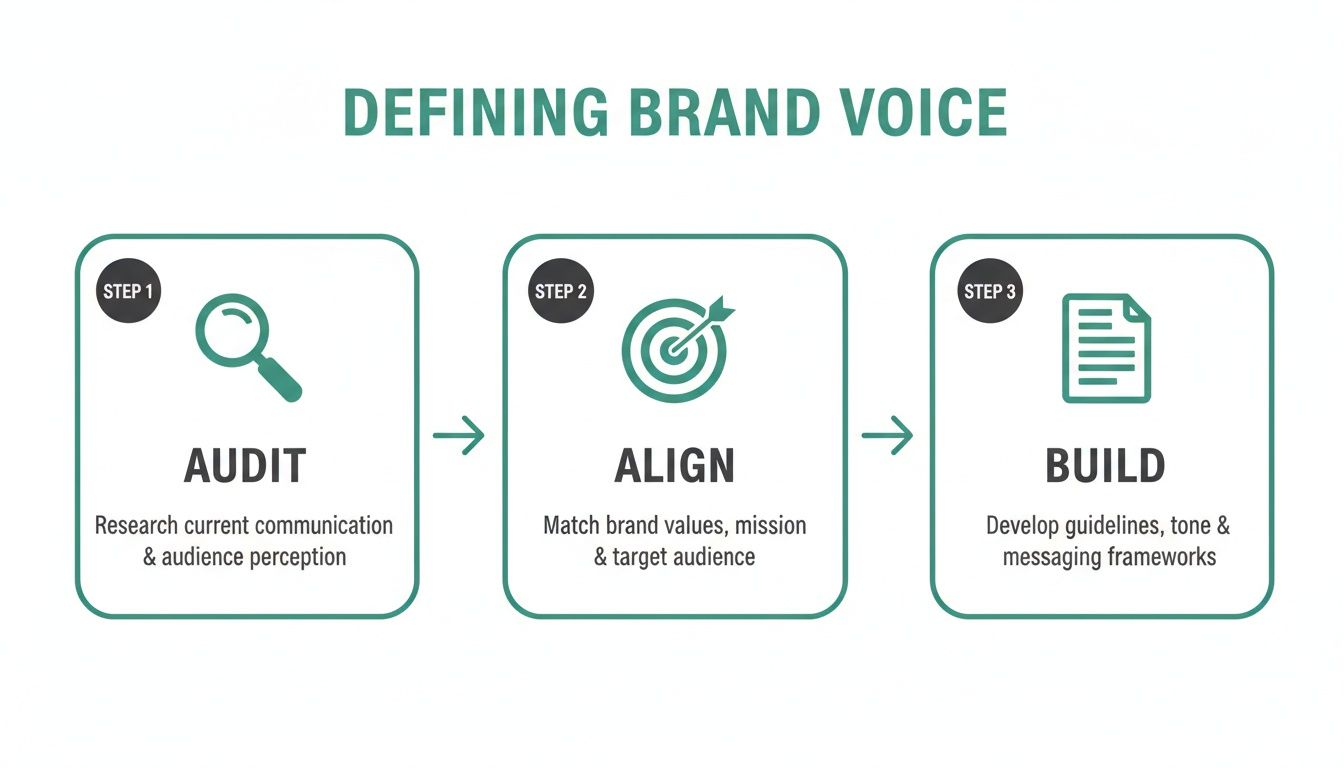
Figuring out your brand voice is a structured process that turns your company’s personality into a usable guide. The best place to start is with a simple content audit. Gather a bit of everything you’ve already published: blog posts, ad copy, social media updates, and even customer support emails. Read through them and look for patterns. This gives you an honest look at the voice you have now, even if it was unintentional.
Aligning Your Brand's Voice with Core Values
Once you know where you are, look at where you want to be. Your brand voice should be a direct extension of your company’s mission statement and core values. If one of your core values is "simplicity," a voice loaded with corporate jargon creates a disconnect. A huge part of this is knowing who you're talking to. This is where creating buyer personas helps you understand their needs and communication style. Your voice has to speak to them in a way they appreciate.
According to research by Sprout Social, a unique brand voice is essential for cutting through the noise on social media, where generic AI content often fails to build genuine connections with audiences.
Building Your Practical Brand Voice Framework
Now, let's build the actual guide. Start by picking three to five adjectives that capture your desired personality. Are you helpful, witty, and direct? Or more sophisticated, authoritative, and inspiring? These words are the foundation. From there, create a brand voice chart. This simple tool translates those adjectives into clear do's and don'ts, providing real examples that make the voice easy for anyone to adopt.
Optimizing Your Brand Voice for AI Search
In 2025 and 2026, your brand voice is a core part of technical SEO. Generative search engines like Perplexity, Gemini, and Google's AI Overviews don't just scan for keywords. They evaluate the consistency and authority of your content to decide which brands to cite. A strong, clear brand voice sends a powerful signal of expertise to these Large Language Models (LLMs). When your perspective is coherent everywhere, AI systems learn to trust you as a reliable source, improving your AI search visibility.
How to Make Your Brand Voice AI Ready
An "AI ready" brand voice means creating content with a consistent viewpoint, structured language, and clear signals of expertise. As you optimize for these new search experiences, it's critical to understand the nuances of AI search and LLMs and their current limits. The payoff is huge. Consistent brand presentation across all platforms can boost revenue by up to 33%. In crowded markets, a precise voice is what separates you from the noise. It is now possible to use LLM tracking to pinpoint where an inconsistent tone might cause you to lose citations to competitors.
Tools and Workflows for Managing Brand Voice
Maintaining a consistent brand voice requires the right tools and a clear workflow, especially as your team grows. This table compares different approaches to managing and measuring voice consistency.
| Tool/Workflow | Primary Function | Best For | Key Metrics |
|---|---|---|---|
| Brand Style Guide | Provides static rules and examples of do's and don'ts. | All teams; foundational document. | Qualitative review, team adherence. |
| AI Content Editors | Analyzes text in real time for tone, clarity, and style. | Content teams writing daily. | Tone scores, readability, style match. |
| LLM Tracking Platforms | Monitors brand mentions and sentiment within AI answers. | SEO and marketing strategists. | Answer share, citation context. |
| Quarterly Audits | Manual review of content samples from all channels. | Marketing leadership. | Message pull through, sentiment trends. |
By using a combination of these, you can create a robust system for governance. You can learn how to optimize content for AI search by focusing on these new performance indicators.
Measuring and Maintaining Your Brand Voice for Success
Defining your brand voice is the first step; maintaining it is the real work. The goal is consistency, especially as your team grows and publishes content across multiple channels. Without a clear system, the personality you worked hard to build can drift, creating a disconnected experience for your audience. A practical workflow, regular content audits, and clear feedback are non negotiable for turning your brand voice into a reliable business asset.
Using Key Metrics for a Consistent Brand Voice
How do you know if you're actually being consistent? You need to track the right things. These KPIs help you move beyond gut feelings and use data to see if your message is landing as intended.
Message Pull Through: Are your core value propositions showing up clearly in your content?
Sentiment Analysis: What is the emotional reaction to your content? Is it being perceived as helpful, authoritative, or inspiring?
Context of Mentions: How and where are people talking about you? This provides insight into how your voice is shaping public perception.
You can get a deeper understanding of these metrics by exploring the tools behind AI brand monitoring.
Summary and Final Takeaways
Defining and maintaining a strong brand voice is more critical than ever. It's the key to differentiating yourself in a crowded market, building trust with your audience, and boosting your visibility in the age of AI search. By auditing your current content, aligning your voice with your core values, and building a practical framework with clear guidelines, you empower your entire team to communicate with a single, recognizable personality. This consistency not only strengthens your brand identity but also drives measurable business growth and solidifies your authority for both customers and search engines.
Frequently Asked Questions About Brand Voice
What is the first step to creating a brand voice?
Start with your mission and core values. Then, research your target audience to understand how they communicate and what they care about. Use this insight to choose three to five adjectives that capture your desired brand personality, like "empowering," "playful," or "authoritative." These will become the foundation of your voice guidelines.
How does brand voice impact generative SEO?
A consistent and authoritative brand voice signals expertise to Large Language Models (LLMs). When AI systems recognize your content as a reliable and coherent source of information, they are more likely to cite your brand in their generated answers. This directly improves your AI search visibility and is a cornerstone of modern generative SEO strategy.
What is a brand voice chart?
A brand voice chart is a practical guide that translates your brand's personality adjectives into concrete do's and don'ts for content creators. For each characteristic (e.g., "Witty"), it provides clear examples of what to do (use clever wordplay) and what to avoid (don't use sarcasm). It is an essential tool for maintaining consistency across all teams.
How is brand voice different from brand tone?
Think of brand voice as your fixed personality; it never changes. Brand tone is the emotional inflection you apply to that voice in different situations. For example, your voice might always be "helpful," but your tone would be "reassuring" when responding to a customer complaint and "enthusiastic" when announcing a new product.
Why is LLM tracking important for brand voice?
LLM tracking involves monitoring how AI models like ChatGPT and Gemini mention your brand. It helps you measure your "answer share" and analyze the context and sentiment of those mentions. This data provides direct feedback on how AI interprets your brand voice, allowing you to refine your content to ensure it aligns with your strategic goals.