The AI SEO Analytics Stack: How to Automate Search Growth
Updated November 5, 2025
If organic growth today feels more like teaching machines than chasing rankings, you're not wrong. Search is no longer just about keywords — it's about how AI systems describe your brand in response to real prompts. Whether the question appears in Google's AI Overviews, ChatGPT, or Perplexity, your inclusion now depends on what large language models (LLMs) know and believe about your business.
That's where AI SEO analytics comes in — the discipline of measuring, interpreting, and automating the signals that improve your visibility inside AI search.
This article builds on insights from Top 10 AI Brand Visibility Tools (2025), which ranked leading visibility platforms such as Riff Analytics, Profound, and Authoritas. We'll explore how these tools fit into a modern analytics stack, how to combine automation with human oversight, and how to turn insights into measurable search growth.
Why AI SEO Analytics Is the New Core of Growth
Traditional SEO was built on keywords and backlinks. But as AI engines absorb the web into model training, optimization now requires controlling how AI perceives your entity.
You're no longer competing for a blue link. You're competing for inclusion in the AI-generated paragraph that most users will read — and trust.
Key metrics in AI SEO analytics:
Inclusion Rate
Percentage of model responses that mention your brand for high-intent prompts.
Entity Accuracy
How factually correct AI-generated summaries are about your brand.
Sentiment
Whether model tone is positive, neutral, or negative.
Citations
Which domains or sources AI models use to justify their answers.
Teams that integrate these signals into content and distribution workflows typically see 20–40% growth in AI-referred traffic within two months — based on aggregated data from early adopters across SaaS and marketing platforms.
The Four Layers of the AI SEO Analytics Stack
A scalable AI SEO analytics stack organizes your measurement and automation into four layers: Visibility, Evidence, Entity Optimization, and Distribution.
1. Visibility Layer: Detect and Quantify
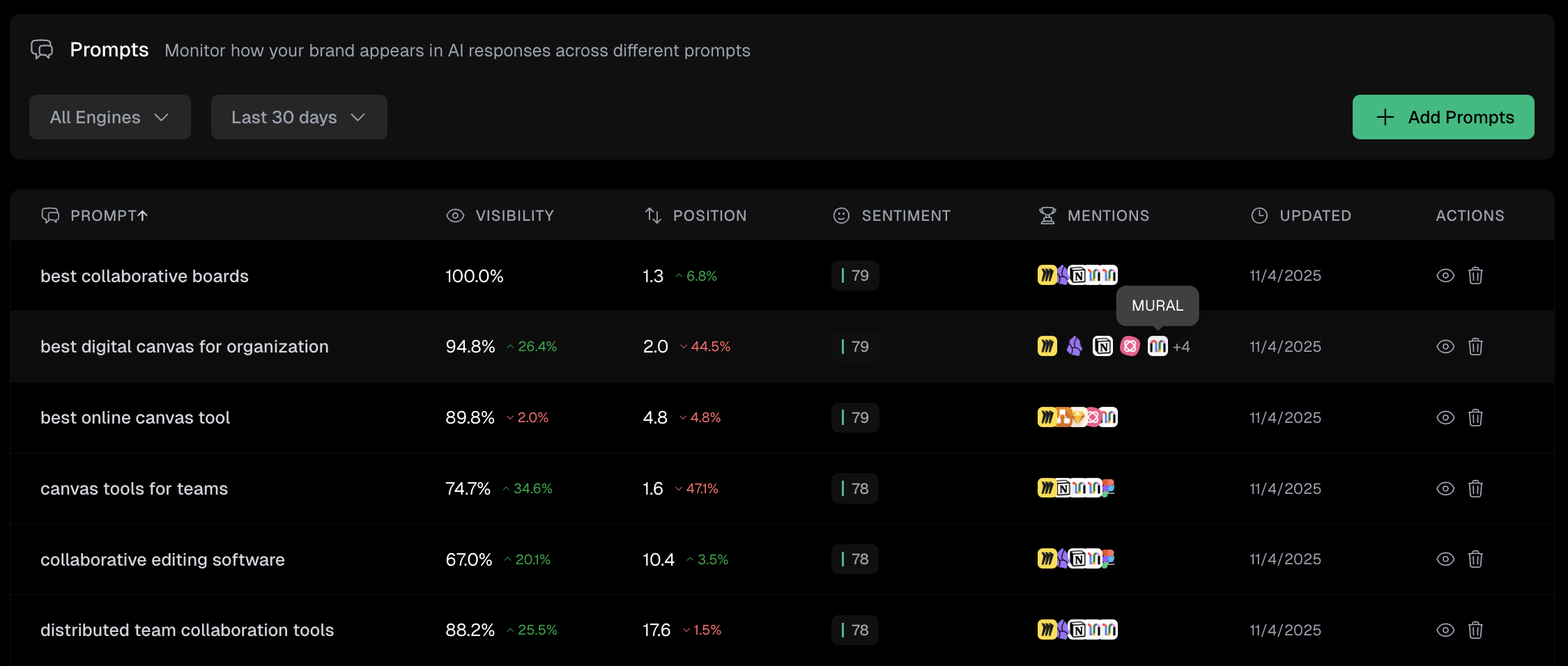
You can't optimize what you can't see. The visibility layer captures where your brand appears (or doesn't) across AI-generated results.
Platforms like Riff Analytics, Profound, and AI Overviews Tracker are purpose-built for this, scanning major LLMs (ChatGPT, Gemini, Claude, Perplexity, and Grok) to measure inclusion rates and factual drift. Others like OpenSERP Monitor and SearchEye AI extend coverage into Bing Copilot and Google's Search Generative Experience (SGE).
Visibility analytics surfaces questions like:
- Does ChatGPT include our brand for "best AI analytics tools"?
- What percentage of Gemini's summaries list our competitor?
- Which sources cause factual errors in Claude's responses?
Automation Tip: Schedule weekly prompt scans (20–50 prompts) to track inclusion trends. Use webhook alerts for any drop below 50% visibility on critical terms.
2. Evidence Layer: Feed the Machines Correctly
AI systems don't "index" in the old search sense; they learn from structured, recent, and widely corroborated facts. The evidence layer ensures they have what they need.
Here, Authoritas and SurgeGraph AI shine. They map the sources feeding AI-generated answers and reveal which citations drive model training. Combine this with Google's Structured Data Testing Tool and Schema.org validators to maintain consistent facts across the web.
Essential components:
- Schema for Organization, Product, FAQ, Review, and HowTo pages
- A canonical facts section (pricing, features, launch dates)
- A changelog or release log that keeps your recency signal alive
Automation Tip: Run schema checks weekly. If facts (pricing, product count, features) change, auto-trigger updates in CMS, docs, and press kits.
Here are practical examples of structured data and content formats that help AI systems understand and correctly represent your brand:
{
  "@context": "https://schema.org",
  "@type": "Organization",
  "name": "Riff Analytics",
  "url": "https://riffanalytics.ai",
  "logo": "https://riffanalytics.ai/logo.png",
  "description": "AI brand visibility platform tracking mentions across ChatGPT, Perplexity, and Google AI",
  "foundingDate": "2024",
  "founders": [{
    "@type": "Person",
    "name": "Your Name"
  }],
  "contactPoint": {
    "@type": "ContactPoint",
    "contactType": "Customer Service",
    "email": "support@riffanalytics.ai"
  },
  "sameAs": [
    "https://twitter.com/riffanalytics",
    "https://linkedin.com/company/riffanalytics"
  ]
}
3. Entity Optimization Layer: Shape AI Understanding
The entity layer governs how AI systems talk about you. It bridges content, metadata, and context.
Here's where tools like MarketMuse, NeuronWriter, and Scalenut AI SEO help identify missing topical clusters and generate factual summaries optimized for AI answers. Meanwhile, LucidRank and Parse.gl provide entity audit reports — showing not only if your brand appears, but how it's framed relative to competitors.
When a model consistently describes your product incorrectly (e.g., "free tool" instead of "paid SaaS"), entity tuning involves rewriting your brand's official answers, FAQs, and public data to overwrite false embeddings.
Automation Tip: Connect prompt audit data to your CMS. When a fact mismatch is detected, auto-create an editorial task tagged "AI fact correction."
These tools help create AI-optimized content that improves how search engines understand and represent your brand:
| Tool | Price | Description |
|---|---|---|
| MarketMuse | $149/mo | Content optimization and topic clustering |
| NeuronWriter | $19/mo | AI-powered content writing assistant |
| Scalenut AI SEO | $39/mo | Content research and optimization |
| Surfer SEO | $89/mo | On-page SEO optimization tool |
| Frase.io | $44.99/mo | Content research and optimization |
| Copy.ai | $49/mo | AI copywriting and content generation |
| Jasper AI | $49/mo | AI content creation platform |
| Writesonic | $19/mo | AI writing assistant for SEO content |
| ContentKing | $129/mo | Content auditing and monitoring |
| Clearscope | $170/mo | Content optimization for SEO |
4. Distribution Layer: Amplify and Reconfirm
The final layer ensures your corrected facts, testimonials, and case studies reach the datasets and surfaces AI systems depend on.
This means pushing structured content to credible, high-authority platforms. Social engagement still matters — AI engines crawl public Threads, X, and LinkedIn data to assess sentiment and relevance.
Tools such as Sprinklr AI, Brandwatch GPT Insights, and Peec AI automate the monitoring of tone and public reactions. Pair them with Riff Analytics or AI Mention Radar to confirm that positive narratives are reflected in LLM responses over time.
Automation Tip: Set monthly distribution goals: 5 authoritative backlinks, 3 high-engagement posts, 1 AI-citation refresh in a trusted directory (e.g., Product Hunt, G2, or Capterra).
Distribution Checklist
Directory Listings
Content Distribution
Social & Community
Backlinks & Authority
The AI SEO Analytics Stack Overview
Understanding how each layer contributes to your AI visibility is crucial. The following table breaks down the four core layers, their objectives, recommended tools, and automation benefits.
| Layer | Objective | Example Tools | Automation Benefit |
|---|---|---|---|
| Visibility | Measure inclusion, sentiment, accuracy | Riff Analytics, Profound, SearchEye AI | Detect brand presence gaps across AI models |
| Evidence | Feed correct facts and structure | Authoritas, SurgeGraph AI, Schema validators | Ensure LLMs pull updated facts |
| Entity Optimization | Refine how AI understands you | LucidRank, Parse.gl, MarketMuse | Correct model misconceptions |
| Distribution | Strengthen reputation signals | Peec AI, Sprinklr AI, Brandwatch | Push updated data to sources AI trusts |
How the Tools Fit Together (Name-Dropping with Roles)
Each tool in the AI SEO analytics stack plays a specific role. Here's how they map to your workflow — from visibility tracking to content optimization.
Together, they form a stack that listens, interprets, and automates — transforming scattered visibility data into a growth feedback loop.
A 30-Day AI SEO Automation Sprint
Ready to implement? This 30-day sprint breaks down the process into actionable phases, helping you establish visibility tracking, correct factual errors, and optimize content distribution systematically.
Days 1–5: Baseline Visibility
Baseline visibility with Riff Analytics. Identify top 20 prompts and competitors.
Days 6–10: Correct Facts
Correct facts with Authoritas (citations) and schema validation.
Days 11–20: Publish Content
Publish answer-style Q&A content using MarketMuse or Scalenut.
Days 21–30: Measure Results
Push proof signals using Peec AI and Brandwatch. Measure shifts in inclusion and sentiment.
What to Track:
- Inclusion rate changes week-over-week for your top prompts
- Factual accuracy by auditing AI responses for pricing, features, and company details
- Sentiment shifts across different AI engines and model versions
- Citation quality — which domains AI systems use to justify mentions of your brand
- Competitor positioning relative to your brand in AI-generated summaries
Focus on measurable improvements rather than absolute numbers. Track trends over 30–60 days to identify which optimizations drive the most impact for your specific brand and industry.
The Takeaway
AI SEO analytics blends visibility measurement, fact management, and automated distribution into one integrated loop. It's no longer about gaming the algorithm. Instead, it's about aligning truth, context, and authority so that AI systems want to mention you.
Because in 2025 and beyond, the brands that master AI visibility aren't just optimizing search. They're shaping how intelligence itself describes them.
FAQ: AI SEO Analytics Stack
Common questions about building and implementing an AI SEO analytics stack.
Next Up: Complete Your AI SEO Strategy
Now that you understand the AI SEO analytics stack, explore these pillars to build comprehensive AI visibility and measurement capabilities.
AI Brand Visibility Explained
Learn the fundamentals of measuring brand presence in AI-generated answers and understand the key metrics that matter.
Read AI Brand Visibility Explained →LLM Tracking 2025
Discover tools and strategies for monitoring how ChatGPT, Gemini, Perplexity, and Claude describe your brand over time.
Explore LLM Tracking Tools →AI Search Optimization vs Traditional SEO
Understand the strategic differences between traditional SEO and AI-powered search optimization approaches.
Read AI Search Optimization vs Traditional SEO →